
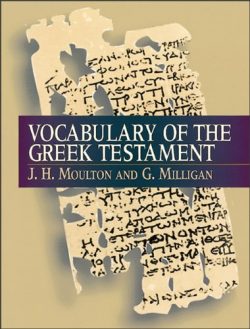
Vocabulary of the Greek Testament: Student Edition
Updated to Version 1.5
Video by Allan Loder on VGNTS
‘Vocabulary of the Greek Testament: Student Edition’ (VGNTS) is an update/revision by Allan Loder of Moulton’s and Milligan’s ‘VGNT’ published 1924-1930. It is based on the 1929 print edition — which is now in the public domain — along with some supplemental material from the 1930 edition. However, this is not merely an electronic reproduction of Moulton’s and Milligan’s book. Rather, it is a major update/revision designed to make this valuable resource more accessible to a wider English-speaking audience — especially those whose knowledge of the Biblical languages is very basic, “rusty,” or non-existent.
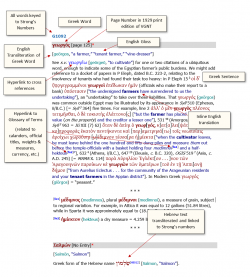
Each lexical entry is keyed to Strong’s numbers, has a transliteration and an English gloss.
There are over 937 new entries, not covered in the original print edition
New source materials are added to existing lexical entries, where available and deemed helpful.
There are over 500 cross-references to other related lexical entries within the module
Inline English translations are provided for all Greek text, as well as for most Hebrew, Aramaic, Syriac, Latin, French and German text. A transliteration of some text is also provided, where deemed helpful.
Pertinent information, such as units of measure, currency, names of Egyptian months, official titles, etc., is provided and hyperlinked.
Please note: This resource is protected under derivative copyright law.
An overview of the module from inside theWORD
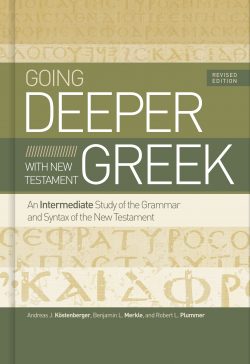
Going Deeper with New Testament Greek
DESCRIPTION
Updated to 2020 Version!
In his final letter to his foremost disciple, the apostle Paul made this solemn appeal: “Be diligent to present yourself to God as one approved, a worker who doesn’t need to be ashamed, correctly teaching the word of truth” (2 Tim 2:15). The message is clear: Timothy (and, by implication, all teachers of God’s Word) must work hard to arrive at a correct interpretation of any given passage of Scripture. Such careful attention to correctly interpreting Scripture was to set Timothy apart from false teachers such as Hymenaeus and Philetus (2 Tim 2:17). Since the NT was written in Greek, and since inerrancy and inspiration extend specifically to the Scriptures in the autographs (original manuscripts), a good working knowledge of NT Greek greatly enhances one’s interpretive skill.
In this book, we hope to stir in you a passion, and to provide you with the necessary tools, to “go deeper” in your pursuit of your mastery of NT Greek. You’ve taken a course or two in elementary Greek, or perhaps taught yourself by using some of the many helpful tools that are available. You’ve memorized the most common Greek vocabulary, learned the basic forms of the Greek noun, adjective, and verb, studied foundational principles of Greek syntax, and tried your hand at translating NT texts of increasing difficulty. But you know that you’ve got more to learn. We want to help you take your knowledge of NT Greek to the next level, not as an end in itself but as a means to correctly interpreting and teaching God’s Word. So are you ready? Let us take a moment to get oriented, and then we’ll be off and running in our quest to “go deeper” with NT Greek.
A GRAMMAR DESIGNED TO BE READ, NOT MERELY REFERENCED
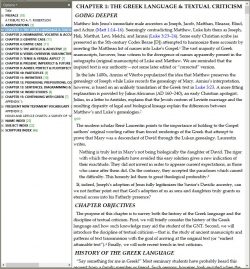
theWord Features
- Verse popups
- Fully searchable text
- Footnotes
- Pages links
- Easy navigation of topics via topics tree display.
- Special Text Colors
- Normal: Text
- Hyperlink: 330 | Luke 20:21
- Page Number: [pg21>
- Greek: Καλλίμαχος
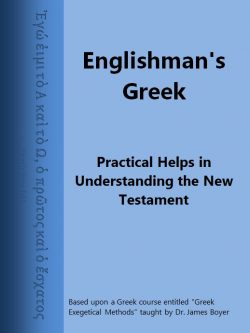
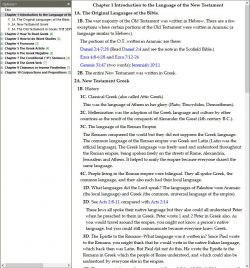
Englishman’s Greek
Practical Helps in Understanding the New Testament
Based upon a Greek course entitled “Greek Exegetical Methods” taught by Dr. James Boyer
“This excellent study helps a beginner to Greek dive into the Greek New Testament. It is also a helpful review of Greek. This book will bringing you along in your exegetical study of the New Testament by reading Greek, word studies, and more.” – Jonathan Koehn

theWord Features:
- Verse popups
- Fully searchable text
- Easy navigation of topics via topics tree display.
- Special Text Colors
- Normal: Text
- Hyperlink: LXX | Luke 20:21
- Greek: ἑαυτούς
- Chiasmus: A Repent
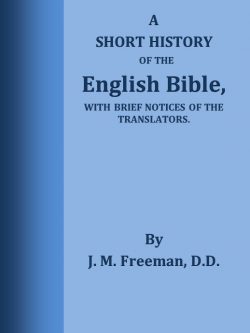
A Short History of the English Bible
WITH BRIEF NOTICES OF THE TRANSLATORS.
BY J. M. FREEMAN, D.D.
“Believers should ascertain for themselves the matters of their faith by having the Scriptures in a language which they fully understand.”—Wycliffe.
“If God spare my life, ere many years I will cause a boy that driveth the plow to know more of the Scriptures than the priests do.”—Tyndale.
theWord Features:
- Verse popups
- Fully searchable text
- Footnotes
- Pages links
- Easy navigation of topics via topics tree display.
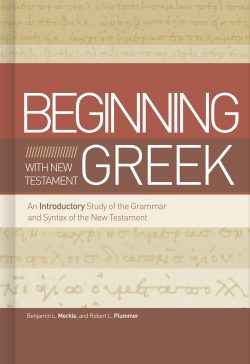
Beginning with New Testament Greek
DESCRIPTION
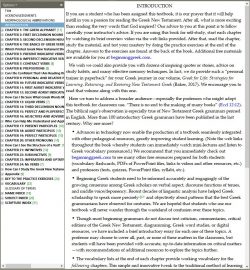
If you are a student who has been assigned this textbook, it is our prayer that it will help instill in you a passion for reading the Greek New Testament. After all, what is more exciting than reading the very words that God inspired? Our advice to you at this point is to follow carefully your instructor’s advice. If you are using this book for self-study, start each chapter by watching its brief overview video via the web links provided. After that, read the chapter, study the material, and test your mastery by doing the practice exercises at the end of the chapter. Answers to the exercises are found at the back of the book. Additional free materials are available for you at beginninggreek.com.
We wish we could also provide you with dozens of inspiring quotes or stories, advice on study habits, and many effective memory techniques. In fact, we do provide such a “personal trainer in paperback” for your Greek journey in our volume, Greek for Life: Strategies for Learning, Retaining, and Reviving New Testament Greek (Baker, 2017). We encourage you to read that volume along with this one.
Here we turn to address a broader audience—especially the professors who might adopt this textbook for classroom use. “There is no end to the making of many books” (Eccl 12:12). The biblical sage’s observation is especially true of New Testament Greek grammars penned in English. More than 100 introductory Greek grammars have been published in the last century. Why one more?
- Advances in technology now enable the production of a textbook seamlessly integrated with other pedagogical resources, greatly improving student learning. (Note the web links throughout the book whereby students can immediately watch mini-lectures and listen to Greek vocabulary pronounced.) We recommend that you immediately check out beginninggreek.comto see many other free resources prepared for both students (vocabulary flashcards, PDFs of PowerPoint files, links to videos and other resources, etc.) and professors (tests, quizzes, PowerPoint files, syllabi, etc.).
- Beginning Greek students need to be informed accurately and engagingly of the growing consensus among Greek scholars on verbal aspect, discourse functions of tenses, and middle voice/deponency. Recent decades of linguistic analysis have helped Greek scholarship to speak more precisely and objectively about patterns that the best Greek grammarians have observed for centuries. We are hopeful that students who use our textbook will never wander through the wasteland of confusion over these topics.
- Though most beginning grammars do not discuss text criticism, commentaries, critical editions of the Greek New Testament, diagramming, Greek word studies, or digital resources, we have included a brief introductory essay for each one of these topics. A professor may choose to cover all, part, or none of these matters in the classroom, but students will have been provided with accurate, up-to-date information on critical matters—with recommendations of additional resources to explore the topics further.
- The vocabulary lists at the end of each chapter provide working vocabulary for the followingchapters. This simple and innovative tweak to the traditional method of learning Greek vocabulary enables students to focus on new grammatical concepts without the distraction of learning many new words at the same time.
- Without sacrificing accuracy or essential detail, this textbook streamlines and consolidates essential Greek grammar into 24 chapters—giving professors maximum flexibility in choosing to cover the material in one or two semesters.
Though not original to our grammar, we also think the following features help increase its pedagogical effectiveness:
- Each chapter begins with a “significance” section—looking at specific text from the Greek New Testament that illustrates the meaning payoff of the new grammatical category that is being introduced.
- Chapters contain multiple practice exercises that isolate specific new skills before applying them to translation sentences.
- All translation sentences come directly from the Greek New Testament—a great encouragement to students who are learning Greek in order to read the Bible more faithfully. If you find the exercises at the end of the chapter are taking your students too long, feel free to assign only a percentage of them.
- An answer key is provided in the back of the book, allowing students to check their work immediately.
We love seeing students ablaze with a passion to read, understand, believe, obey, enjoy, and teach the Greek New Testament. It is our prayer and hope that this textbook aids in igniting that fire in many hearts.
theWord Features
- Verse popups
- Fully searchable text
- Footnotes
- Pages links
- Easy navigation of topics via topics tree display.
- Glossary of terms
- Name Index
- Subject Index
- Scripture Index
- Special Text Colors
- Normal: Text
- Hyperlink: LXX| Luke 20:21
- Page Number: [p21>
- Greek: Καλλίμαχος
Learn to Read New Testament Greek
DESCRIPTION
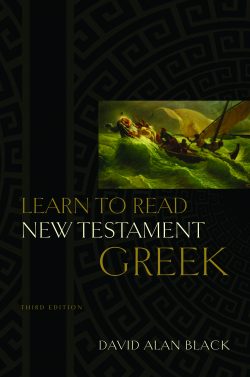
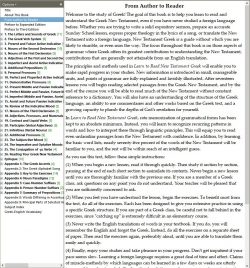
Welcome to the study of Greek! The goal of this book is to help you learn to read and understand the Greek New Testament, even if you have never studied a foreign language before. Whether you are trying to write a solid expository sermon, prepare an accurate Sunday School lesson, express proper theology in the lyrics of a song, or translate the New Testament into a foreign language, New Testament Greek is a guide without which you are likely to stumble, or even miss the way. The focus throughout this book is on those aspects of grammar where Greek offers its greatest contributions to understanding the New Testament, contributions that are generally not attainable from an English translation.
The principles and methods used in Learn to Read New Testament Greek will enable you to make rapid progress in your studies. New information is introduced in small, manageable units, and points of grammar are fully explained and lavishly illustrated. After seventeen lessons you will begin reading selected passages from the Greek New Testament, and by the end of the course you will be able to read much of the New Testament without constant reference to a dictionary. You will also have an understanding of the structure of the Greek language, an ability to use commentaries and other works based on the Greek text, and a growing capacity to plumb the depths of God’s revelation for yourself.
In Learn to Read New Testament Greek, rote memorization of grammatical forms has been kept to an absolute minimum. Instead, you will learn to recognize recurring patterns in words and how to interpret these through linguistic principles. This will equip you to read even unfamiliar passages from the New Testament with confidence. In addition, by learning the basic word lists, nearly seventy-five percent of the words of the New Testament will be familiar to you, and the rest will be within reach of an intelligent guess.
As you use this text, follow these simple instructions:
(1) When you begin a new lesson, read it through quickly. Then study it section by section, pausing at the end of each short section to assimilate its contents. Never begin a new lesson until you are thoroughly familiar with the previous one. If you are a member of a Greek class, ask questions on any point you do not understand. Your teacher will be pleased that you are sufficiently concerned to ask.
(2) When you feel you have understood the lesson, begin the exercises. To benefit most from the text, do all of the exercises. Each has been designed to give you extensive practice in using a specific Greek structure. If you are part of a Greek class, be careful not to fall behind in the exercises, since “catching up” is extremely difficult in an elementary course.
(3) Never write the English translations of words in your textbook. If you do, you will remember the English and forget the Greek. Instead, do all the exercises on a separate sheet of paper. Then read the exercises again, preferably aloud, until you are able to translate them easily and quickly.
(4) Finally, enjoy your studies and take pleasure in your progress. Don’t get impatient if your pace seems slow. Learning a foreign language requires a great deal of time and effort. Claims of miracle-methods by which languages can be learned in a few days or weeks are utterly irresponsible and unfounded. On the other hand, if you make proper use of your instruction, you will be surprised how rapidly you progress. By the end of the course, you will actually be reading your New Testament in the original Greek!
theWord Features
- Verse popups
- Fully searchable text
- Footnotes
- Section links
- Easy navigation of topics via topics tree display.
- Special Text Colors
- Normal: Text
- Hyperlink: §15| Luke 20:21
- Greek: Καλλίμαχος
Kingcomments (Nederlands)
Inleiding
Het doel van dit commentaar is mensen aan te moedigen de Bijbel te lezen. Het commentaar is oorspronkelijk gepubliceerd op de website www.kingcomments.com. Van alle Bijbelboeken is een commentaar beschikbaar. De commentaren zijn bedoeld om te helpen de Bijbel persoonlijk te bestuderen. De Bijbelcitaten die in de commentaren voluit geschreven zijn, komen uit de Herziene Statenvertaling als het een citaat uit het Oude Testament betreft en uit de TELOS-vertaling als het een citaat uit het Nieuwe Testament betreft.
De commentaren over Job, Psalmen en Jesaja zijn samen met Tony Jonathan geschreven. Het commentaar over Ezechiël is geschreven in nauwe samenwerking met Ron Vellekoop.
De Bijbel is het onfeilbare, eeuwige Woord van God. De Bijbel gaat over de Zoon van God, Die Mens werd om aan het kruis te sterven voor zondige mensen. God heeft Hem opgewekt uit de dood en Hij is nu in de hemel. Ieder die zijn zonden belijdt en gelooft in de Zoon en Zijn verzoeningswerk op het kruis, zal niet verloren gaan, maar ontvangt het eeuwige leven. Zo iemand is een kind van God. God vertelt Zijn kinderen in Zijn Woord hoe zij tot Zijn eer kunnen leven en alles wat Hij van plan is hun te geven, vanwege hun verbinding met Zijn Zoon.
Waardering Bron:
Deze module is omgezet vanuit het publieke domein of er is toestemming gegeven om dit materiaal te gebruiken. De waardering is voor ons als theWordBooks Team voor het besteden van tijd, geld voor het programmeren en meer activiteiten om de module om te zetten naar het theword Bible software formaat. De module voldoet aan de vereisten voor kwaliteit en consistentie waarbij alle functies op een correcte wijze zijn geïmplementeerd zodat ze op een mooie wijze geïntegreerd zijn in theWord. U kunt kiezen hoeveel waardering u wilt geven voordat u de module in de winkelkar plaatst. Bijv. $0 voor geen waardering, $2, $10, tot het volledige bedrag van $24.
theWord Functies:
- Vers pop-ups
- Gebonden aan Bijbelse verwijzingen
- Volledig doorzoekbare tekst
- Gemakkelijke navigatie van onderwerpen via de weergave van de onderwerpenboom.

Kingcomments (English)
Introduction
The purpose of the comments is to encourage people to read the Bible. The original web address of the comments is www.kingcomments.com. The comments that are available have been translated from Dutch into English. It is planned that, God willing, the four lacking comments will be translated and made available in the course of this year 2021. The comments are intended to help you study the Bible personally. The Bible quotations written in full in the commentaries are from the New American Standard Bible-NASB 1995.
The comments on Job, Psalms and Isaiah are written together with Tony Jonathan. The commentary on Ezekiel was written in close collaboration with Ron Vellekoop.
The Bible is the infallible, everlasting Word of God. The Bible is about the Son of God, Who became Man to die on the cross for sinful people. God raised Him from the dead and He is now in heaven. Anyone who confesses his sins and believes in the Son and His work of atonement on the cross will not perish but receive eternal life. Such a person is a child of God. God tells His children in His Word how to live to His glory and all that He intends to give them, because of their connection to His Son.
theWord Features:
- Verse popups
- Tied to Biblical references
- Fully searchable text
- Easy navigation of topics via topics tree display.
New American Standard Bible 2020 and Dictionary
DESCRIPTION
Bundle contents:
- NASB 2020
- NASBHGD-2020
The NASB 2020 is an update of the NASB 1995 that further improves accuracy where possible, modernizes language, and improves readability. These refinements maintain faithful accuracy to the original texts and provide a clear understanding of God’s Word to those who prefer more modern English standards. The long-established translation standard for the NASB remains the same as it always has been, that is to accurately translate the inspired Word of God from the Hebrew, Aramaic, and Greek texts into modern English that is clearly understandable today.
theWord Features
NASB 2020 Bible
- Searchable text (via regular text and Strong’s Numbers)
- Strong’s Numbers
- Words of Jesus in Red
- Headings
- Paragraphs
- Cross references
- Footnotes
- Strong’s Numbers linked to NASBHGD 2020 Dictionary
NASBHGD-2020 Dictionary
- Fully searchable text
- Easy navigation via topics tree display.
- Strong’s Numbers
- Greek Lemmas
- Hebrew Lemmas
- Special Text Colors
- Normal: Text
- Usage: NASB 2020 Usage
- Hyperlink: G10
- Transliteration: Melek
- Hebrew: מֶלֶךְ
- Greek: κοδράντης
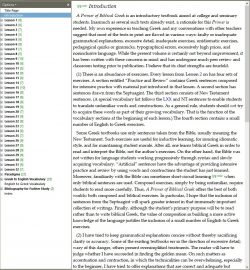
A Primer of Biblical Greek, Croy
DESCRIPTION
Download student resources
Request instructor resources
Though there are currently a number of texts for teaching biblical Greek, most of them are plagued by various deficiencies. Written with these flaws in mind, this new primer by N. Clayton Croy offers an effective, single-volume introduction to biblical Greek that has proven successful in classrooms around the country.
This volume takes a primarily deductive approach to teaching biblical Greek and assumes that students have no prior knowledge of the language. Divided into 32 separate lessons, each containing a generous number of exercises, the text leads students from the Greek alphabet to a working understanding of the language of the Septuagint and the New Testament.
Special features of A Primer of Biblical Greek:
- An abundance of exercises Each lesson includes practice sentences taken from the Septuagint and the New Testament as well as Greek sentences composed by the author. Exercises in English-to-Greek translation are also included.
- Concise but accurate grammatical explanations Great care has been taken to insure that grammatical explanations are clear, correct, and succinct. In particular, the Greek participle receives a fuller-than-usual treatment.
- A natural order of presentation Material is presented according to the natural structure of Greek and the traditional terminology of grammarians. Declensions and principal parts, for example, are presented in numerical order.
- Inclusive language The book uses inclusive language for human beings throughout.
- Helpful appendixes for quick reference Included at the back of the book are the Greek paradigms, Greek-to-English vocabulary, English-to-Greek vocabulary, and a bibliography for further study.
theWord Features
- Verse popups
- Terms explained popups
- Footnote popups
- Fully searchable text
- Easy navigation via topics tree display.
- Greek Lemmas
- Special Text Colors
- Normal: Text
- Hyperlink: LXX| Luke 20:21
- Page Number: [pg 21>
- Latin: septuaginta
- Transliteration: Gamma
- Greek: Καλλίμαχος
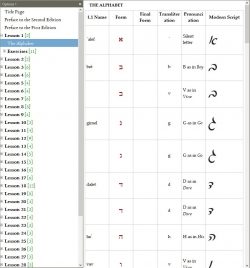
Biblical Hebrew An Introductory Grammar
DESCRIPTION
theWord Features
- Verse popups
- Terms explained popups
- Footnote popups
- Fully searchable text
- Easy navigation via topics tree display.
- Hebrew Lemmas
- Special Text Colors
- Normal: Text
- Hyperlink: Glossary| Gen. 9:8
- Page Number: [pg 21>
- Latin: matres lectionis
- Transliteration: šeqel
- Hebrew: א
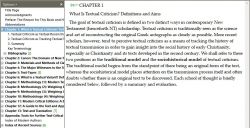
Fundamentals of New Testament Criticism
DESCRIPTION
theWord Features
- Verse popups
- Footnote popups
- Terms explained popups
- Fully searchable text
- Easy navigation via topics tree display.
- Special Text Colors
- Normal: Text
- Hyperlink: Nom | Rev. 7:12
- Page Number: [pg 21>
- Latin: exempli gratia
- Transliteration: ang-gelos
- Greek: σωμάτων
- Hebrew: א
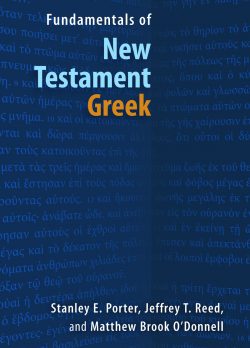
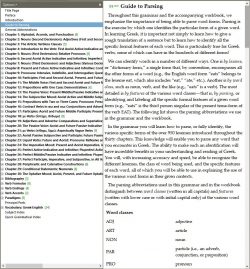
Fundamentals of New Testament Greek
DESCRIPTION
Request instructor resources
Get the workbook
“We know that this book works and will take students to a level not often achieved through other beginning textbooks.” So say Stanley Porter and his coauthors in the preface to their Fundamentals of New Testament Greek — an ambitious, comprehensive introduction to the grammar and vocabulary of the Greek New Testament.
This first-year Greek textbook discusses all the forms and basic syntax of Koine Greek, complete with extensive paradigms, examples, and explanations. Porter, Reed, and O’Donnell’s Fundamentals of New Testament Greek features pedagogically sound and linguistically informed techniques of language instruction. The volume introduces the individual words and grammatical details of Greek, sensitive to their frequency of use in the New Testament, reinforcing for students the elements that they will most often encounter. Grammatical forms, including the less common ones, are analyzed and explained in detail, often with illustrative examples from the Greek New Testament. The authors include complete paradigms and give numerous examples; the vocabulary list includes nearly one thousand words, which are introduced throughout the book’s thirty chapters.
Students who complete this text will be able to move directly into Greek exegesis courses and more advanced Greek-language courses. Fundamentals of New Testament Greek will prove invaluable for gaining a thorough foundational understanding of New Testament Greek, including full exposure to the formation, accenting, and semantics of its complex verbal system.
Read more about the book in a blog post by its editor, Craig Noll, on EerdWord.
theWord Features
- Verse popups
- Footnote popups
- Terms explained popups
- Fully searchable text
- Easy navigation via topics tree display.
- Lemmas (which can be used with Bibles that have Lemmas)
- Special Text Colors
- Normal: Text
- Hyperlink: Nom | Rev. 7:12
- Page Number: [pg 21>
- Latin: exempli gratia
- Transliteration: ang-gelos
- Greek: σωμάτων
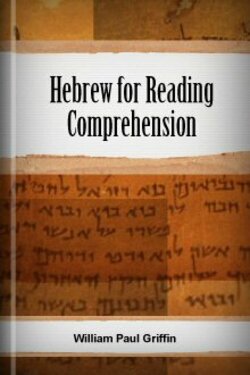
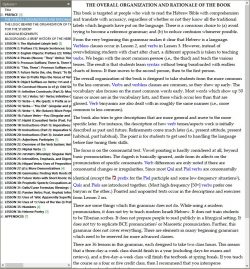
Hebrew for Reading Comprehension
Hebrew for Reading Comprehension is a first year Biblical Hebrew grammar which is designed to promote reading comprehension and translation precision while reducing the confusion of traditional grammars. Two major features which distinguish this from other grammars are a tremendous reduction of emphasis on vowel pointing and a paradigm-less approach to teaching verbs.
This Grammar’s Differences
- The end goal is always kept in mind: reading comprehension and translation precision.
- Vowel pointing is not emphasized. Students learn to read unpointed and pointed Hebrew from the beginning. Exercises have both pointed and unpointed Hebrew.
- Verbs and verbless clauses (i.e., sentences) are introduced at the very beginning so that the student feels like they are learning language as language, not as lists.
- There is an almost complete lack of verb paradigms. Rather, verbs are introduced in the third person (all tenses/aspects), then the second person, then the first.
- Students do not have to be trained linguists in order to utilize the textbook. Instead, the book includes reviews of basic grammatical terminology and explanations of other important terms.
- Some traditional (confusing) linguistic terminology is avoided.
- Here is a chart which compares this grammar with others. Click here to download a .pdf file.
Philosophy of the Grammar
The following essays describe the philosophy underlying the grammar.These were both presented at Central States Society of Biblical Literature meetings.
William P. Griffin, “Killing a Dead Language: A Case against Emphasizing Vowel Pointing when Teaching Biblical Hebrew,” SBL Forum , n.p. [cited May 2007]
William P. Griffin, “Breaking Old Paradigms: Further Reflections on Hebrew Pedagogy,” paper presented at the Central States Society of Biblical Literature meeting, March, 2010.
theWord Features
- Verse popups
- Terms explained popups
- Fully searchable text
- Easy navigation via topics tree display.
- Normal text
- Hebrew text
- Footnotes
- ◌ represents any unspecified Hebrew character.
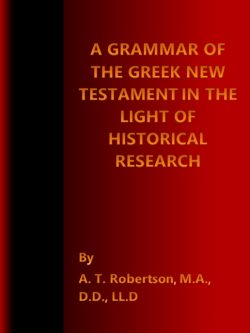
A Grammar of the Greek New Testament in the Light of Historical Research
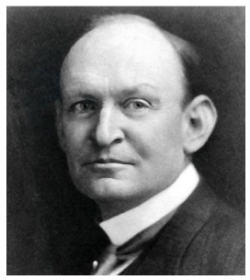
Archibald Thomas Robertson (November 6, 1863 – September 24, 1934) was a Southern Baptist preacher and biblical scholar whose work focused on the New Testament and Koine Greek.
Robertson was born at Cherbury near Chatham, Virginia. He was educated at Wake Forest (N. C.) College (M. A., 1885) and at the Southern Baptist Theological Seminary (SBTS), Louisville, Kentucky (Th. M., 1888), where he was thereafter instructor and professor of New Testament interpretation, and remained in that post until one day in 1934, when he dismissed his class early and went home and died of a stroke.
Robertson’s books are still consulted today, particularly his Word Pictures in the New Testament and his landmark volume A Grammar of the Greek New Testament in Light of Historical Research. In all, he published 45 books, several of which are still in print today. Robertson helped found the Baptist World Alliance in 1900. He was an important Southern Baptist and a well-respected scholar in his day. Robertson sought to equip his students with the proper tools for good preaching.
(text from Wikipedia.org)
theWord Features:
⦁ Verse popups
⦁ Fully searchable text
⦁ Hebrew, Greek, etc.
⦁ Footnotes
⦁ Pages links
⦁ Easy navigation of topics via topics tree display.
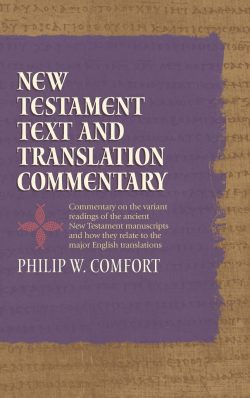
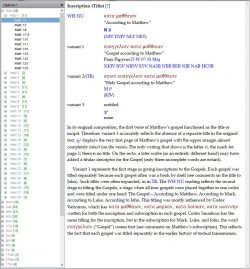
New Testament Text and Translation Commentary
The purpose of this work is to provide scholars, pastors, students, and serious Bible readers with a commentary on the variant readings in the New Testament that have significance for Bible interpretation and Bible translation—and to do so in a format that is communicative and informative to English readers as well as those who know Greek.
theWord Features
- Verse popups
- Verse synchronization
- Fully searchable text
- Inline Commentary can be set in Bible view.
- Commentary link popup can be set in Bible view.
- Easy navigation via topics tree display.
- Builtin witness explanations.
- [?] Additional information available, including How to use this module.
Introduction to Exegesis
Description
“Dr. Robert Thomas has written this very powerful introduction to exegesis. True biblical understanding and interpretation lies in solid biblical exegesis. This significant work goes to the very heart of the matter beginning with a very accurate meaning of biblical exegesis. Dr. Thomas takes the reader through a very systematic study of the grammatical-historical method. This book is highly recommended for any student of the Greek New Testament.”
David Olander, Ph.D, Th.D, Professor of Biblical Languages at Tyndale Theological Seminary & Biblical Institute (Ft. Worth, TX).
This wonderful resource includes a great deal of Greek Grammar content and includes the page numbers of, . . . “the work by H. E. Dana and Julius R. Mantey, A Manual Grammar of New Testament Greek (New York: Macmillan, 1957). . .” so it can be used side by side.
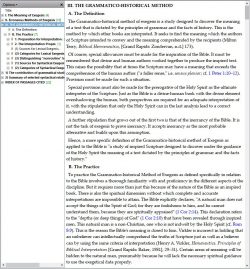
theWord Features:
- Verse popups
- Fully searchable text
- Footnotes
- Cited passages page links
- Easy navigation of topics via topics tree display.
Kingcomments (Deutsch)
Einleitung
Das Ziel der Kommentare besteht darin, das Lesen der Bibel anzuregen. Die ursprüngliche Webadresse der Kommentare ist www.kingcomments.com. Die Kommentare, die vorhanden sind, sind aus dem Niederländischen ins Deutsche übersetzt worden. Es ist vorgesehen, dass, so Gott will, im Laufe der Zeit die fehlenden Kommentare übersetzt und verfügbar gemacht werden. Die Kommentare sollen das persönlich Bibelstudium unterstützen. Die Bibelzitate, die in den Kommentaren vollständig wiedergegeben sind, sind der Elberfelder Übersetzung 2009 (Edition CSV Hückeswagen) entnommen.
Die Kommentare zu den Büchern Hiob, Psalmen und Jesaja habe ich gemeinsam mit Tony Jonathan geschrieben. Der Kommentar zu Hesekiel ist in enger Zusammenarbeit mit Ron Vellekoop entstanden.
Die Bibel ist das unfehlbare, ewige Wort Gottes. In der Bibel geht es um den Sohn Gottes, der Mensch wurde, um am Kreuz für sündige Menschen zu sterben. Gott hat Ihn von den Toten auferweckt und Er ist jetzt im Himmel. Jeder, der seine Sünden bekennt und an den Sohn und sein Versöhnungswerk am Kreuz glaubt, wird nicht verlorengehen, sondern ewiges Leben empfangen. So jemand ist ein Kind Gottes. Gott unterweist seine Kinder in seinem Wort, wie sie zu seiner Ehre leben können und was sie durch ihre Verbindung mit seinem Sohn geschenkt bekommen haben.
Hier de vertaling:
Dies sind Quellen, die aus Public-Domain-Materialien oder Materialien, für die eine Genehmigung erteilt wurde, konvertiert wurden. Die Wertschätzung gilt uns als WordBooks-Team dafür, dass wir die Zeit, das Geld für die Programmierung der Quellen und mehr investiert haben, um diese Quellen in das Format der Bibel-Software theWord zu konvertieren. Die Quellen sind mit allen verfügbaren Funktionen qualitativ hochwertig und konsistent formatiert und korrekt implementiert, damit sie sich wunderschön in theWord integrieren lassen. Sie können wählen, wie viel Wertschätzung Sie zeigen möchten, bevor Sie diese Quelle zum Einkaufswagen hinzufügen. Beispiel: $0 Keine Wertschätzung, $2, $10, bis zum vollen Betrag von $24.
theWord-Funktionen: