
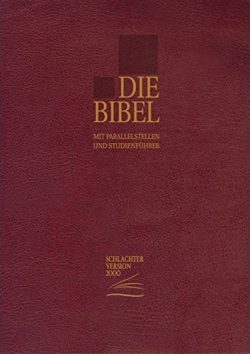
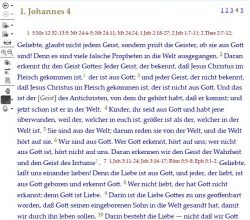
Schlachter Bibel 2000
It was the first German translation of the last century and was published for the first time in 1905. The Bible of the Swiss preacher Franz Eugen Schlachter (1859-1911) was first revised by the Swiss pastors Linder and Kappeler in 1911 after his death. The second revision was made in 1951 by the Geneva Bible Society. It was a reworking of the original 1905 translation, no revision of the Linder and Kappeler edition.
The renewed revision of the slaughtering Bible of 1951 was commissioned by the Geneva Bible Society in 1995 and published as “Schlachter 2000”. Members of this revision were initially responsible for the direct editing of texts by Rudolf Ebertshäuser (editor), Peter Toscan (coordinator), Karl-Hermann Kauffmann (revision director), and for the New Testament by Professor Herbert Jantzen (Grundtextspezialist Altgriechisch) Liebi (Grundtextspezialist Hebrew) and Dr. Martin Heide (Grundtextspezialist Hebrew). As a rule, the commission was convened on Saturdays in the Freie Brüdergemeinde in Albstadt. Additional employees were, among other things, for the parallel positions Gottfried Maron, the former president of the Geneva Bible Society, with his own team and, in time, Gottfried Wüthrich, The former secretary secretary of the Geneva Bible Society, for the tangents to the old butcher’s version. Electronic processing was carried out by the Free Brotherhood of Albstadt, Jürgen Oberwegner and Willi Welte, after the text of the slaughter-edition 1951 as a basis for processing by the Allgäuer communities around Erwin Keck had been recorded. When exchanging obsolete words, Wilfried Dabnar was involved in computer technology. Technical questions were coordinated by the then president of the Geneva Bible Society, Paul André Eicher. In 2003 the revision was completed after nine years of processing. The new revised slavery Bible uses exclusively the basic texts of the Reformation, ie, the textus Receptus with its variants as a basis. For the tangents to the old butcher’s version. The electronic processing was carried out by the Free Brotherhood of Albstadt, Jürgen Oberwegner and Willi Welte, after the text of the slaughter-edition 1951 as a processing basis of the Allgäuer municipalities around Erwin Keck had been captured. When exchanging obsolete words, Wilfried Dabnar was involved in computer technology. Technical questions were coordinated by the then president of the Geneva Bible Society, Paul André Eicher. In 2003 the revision was completed after nine years of processing. The new revised slavery Bible uses exclusively the basic texts of the Reformation, ie, the textus Receptus with its variants as a basis. For the tangents to the old butcher’s version. The electronic processing was carried out by the Free Brotherhood of Albstadt, Jürgen Oberwegner and Willi Welte, after the text of the slaughter-edition 1951 as a processing basis of the Allgäuer municipalities around Erwin Keck had been captured. When exchanging obsolete words, Wilfried Dabnar was involved in computer technology. Technical questions were coordinated by the then president of the Geneva Bible Society, Paul André Eicher. In 2003 the revision was completed after nine years of processing. The new revised slavery Bible uses exclusively the basic texts of the Reformation, ie, the textus Receptus with its variants as a basis. Jürgen Oberwegner and Willi Welte, after the text of the butcher’s edition 1951 as a basis for processing by the Allgäuer communities around Erwin Keck had been recorded. When exchanging obsolete words, Wilfried Dabnar was involved in computer technology. Technical questions were coordinated by the then president of the Geneva Bible Society, Paul André Eicher. In 2003 the revision was completed after nine years of processing. The new revised slavery Bible uses exclusively the basic texts of the Reformation, ie, the textus Receptus with its variants as a basis. Jürgen Oberwegner and Willi Welte, after the text of the butcher’s edition 1951 as a basis for processing by the Allgäuer communities around Erwin Keck had been recorded. When exchanging obsolete words, Wilfried Dabnar was involved in computer technology. Technical questions were coordinated by the then president of the Geneva Bible Society, Paul André Eicher. In 2003 the revision was completed after nine years of processing. The new revised slavery Bible uses exclusively the basic texts of the Reformation, that is, the Textus Receptus with its variants as a basis. Technical questions were coordinated by the then president of the Geneva Bible Society, Paul André Eicher. In 2003 the revision was completed after nine years of processing. The new revised slavery Bible uses exclusively the basic texts of the Reformation, ie, the textus Receptus with its variants as a basis. Technical questions were coordinated by the then president of the Geneva Bible Society, Paul André Eicher. In 2003 the revision was completed after nine years of processing. The new revised slavery Bible uses exclusively the basic texts of the Reformation, ie, the textus Receptus with its variants as a basis.
Publisher’s website: http://www.societebiblique.com/

Abbott-Smith’s Manual Greek Lexicon of the New Testament
Description
Abbot-Smith’s A Manual Lexicon of the New Testament was written to offer an update to older lexicons—those written before the discovery of manuscripts demonstrating that the New Testament was written in koine Greek, rather than a Hebrew variant of classical Greek. It was also written to be a quick reference guide for students of the New Testament to use while reading their Greek text. It adopts the textual standard of Moulton and Geden’s Concordance to the Greek New Testament by following the Westcott & Hort Greek text.

theWord Features:
- Verse popups
- Fully searchable text
- Easy navigation of topics via topics tree display.
- Greek Lemmas
- Strong’s Numbers in topic tree
- Special Text Colors
- Normal: Text
- Hyperlink: Php 1:16
- Greek: σωμάτων
- Hebrew: מִשְׁפָּט
American Bible Society Bible Resource Center Maps
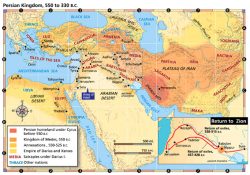
Sixteen (16) high-resolution maps of Bible lands which are in color at 300dpi resolution for high-quality printing and viewing. The integrated Graphics Viewer of theWord allows zooming, panning, and easy navigation. With these high-quality maps, you can locate places and their relationships one to another very easily. The areas are in a red font, and the cities are in a black font. These maps are not even available on the American Bible Society website, so this is a great resource for the Bible student.
While any Bible student needs this kind of resource, this is especially excellent for Bible class teachers, Sunday School teachers, and pastors as you can copy and paste these images into your own personal Bible presentations. When these high-resolution maps are projected (enlarged on a projection screen), they still look very good. This is not true with images downloaded off of the Internet. High-resolution maps of Bible lands are hard to find.
Theological Wordbook of the Old Testament (TWOT)
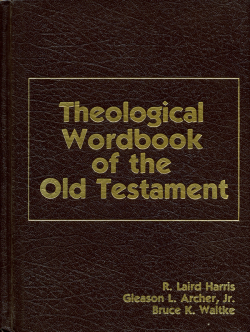
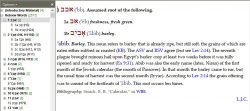
This extensive, scholarly work includes discussions of every Hebrew word of theological significance in the Old Testament, plus brief definitions of all other words found in Brown, Driver and Briggs Hebrew Lexicon. Keyed to Strong’s Concordance, the Theological Wordbook of the Old Testament (TWOT) has been a longtime favorite of serious students of the Bible -pastors and laypeople alike. The busy pastor or earnest Christian worker who has neither the time nor the background for detailed technical study yet desires to understand important terms will enjoy this practical resource.
There are more than 1,400 articles written by 43 Old Testament scholars, plus some 400 sub-entries giving definitions only. The articles focus on theological meanings and importance and do not include lengthy, technical linguistic discussions. Virtually exhaustive bibliographies of published material relating to the words discussed are also included, in addition to a special section of Aramaic words used in the Old Testament.
International Standard Version Bible (ISV)
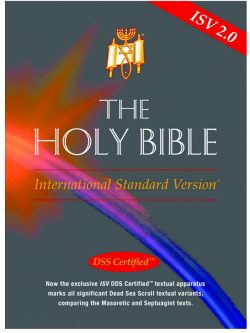
The ISV is a totally new work translated directly from the original languages of Scripture and derived from no other English translation.
The ISV was produced by Bible scholars who believe that “All Scripture is inspired by God and is useful for teaching, for reproof, for correction, and for training in righteousness.” (2 Timothy 3:16 ISV) It takes advantage not only of the most ancient manuscripts available, but also of the most recent archaeological discoveries. The ISV is the first English Bible conceived, designed, translated, and formatted primarily for a computer-literate generation. It is being produced entirely in a computer-aided media (CAM) format.
The ISV is Sensitive to Poetic Literary Forms in the Original Text. It treats subtle nuances of the original texts with special care. For example, several passages of the Bible appear to have been rendered in poetic form when first penned by their authors. The ISV has meticulously crafted these original passages as true poems—thus communicating a sense of their original literary form as well as translating the original intent of the New Testament author.
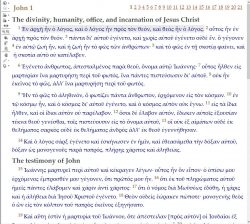
Greek Bible text of the Novum Testamentum Graece, 28th edition (Nestle Aland) (GNT)
Note: If you came here to purchase NA27. Sorry it is no longer available but if you already own NA27you may get the fixes in theWord > Add Titles.
DESCRIPTION
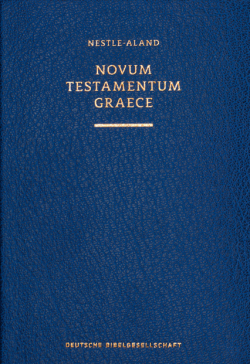
This is the Greek text, sometimes referred to as the “critical text tradition”. It is the most widely used critical version of the Greek New Testament. It includes:
- letter casing
- accents
- breathing marks
- punctuation
- capitalization
- Old Testament quotes in bold
- paragraphs and poetry formatting
- Tagged with:
- Strong’s codes
- morphology (grammatical parsing)
- word lemmas
Strong’s codes and morphology codes can either be displayed next to each word or be hidden away and appear when the mouse moves over a word. The module can be searched on original words, ignoring accents and breathing marks if desired. Complex searches including Strong’s codes, word grammar and even lemmas are also supported, along with any arbitrary combination of these.
We want to make you aware of some similar products that if you like this work, you might consider getting also.
(1.) Student’s Guide to New Testament Textual Variants, A (“Free to You” from theWord.net)
(2.) Variant Readings of the New Testament (“Free to You” from theWord.net)
(click on the link and you will directly download the module from theWord.net)
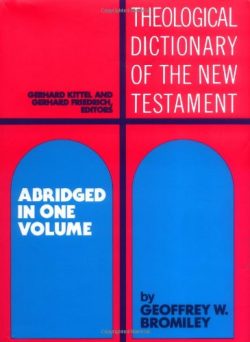
Theological Dictionary of the NT: Abridged in One Volume (TDNTa)
This dictionary is a landmark Greek dictionary which has come to us through a lot of people and years of scholarship dedicated to making this scholarly work available. One of the neat features about this work is that it has Strongs numbers, so those who are not proficient in the Greek language can still use the work, working off of the Strong’s Greek Numbers.
Note that there is a foundational work back to Gerhard Kittel, and thus that work is called “Big Kittels” or just “Kittel”, and there is the present work we are offering which is abridged, and called “Little Kittels”. The unabridged Kittel is very large, and has very long and detailed studies on each word, including a lot of linguistics, Greek, German, Latin, Hebrew, etc. It is a very scholarly work, and understood best “by scholars” (very educated scholars at that). Little Kittel though has been edited so as to delete most of that, and leave a simple work that most laymen could understand (and most Bible students with normal Greek abilities, or no Greek abilities at all, in the style of Strong’s Lexicon perhaps).
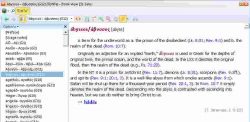
For actual samples of articles in the dictionary, click on the image at left (a popup viewer should open) and then use the left-right arrow keys on the keyboard, or click on the far left or far right arrows on the image itself.
The samples are:
ábyssos/άβυσσος [abyss]
agathós/αγαθός [good],
ángelos/άγγελος [messenger, angel],
kýrios/κύριος [Lord, lord], -searching dictionary for a word
kýrios/κύριος [Lord, lord], – searching using Strongs Number
mágos/μάγος [magician, Magus],
méli/μέλι [honey]
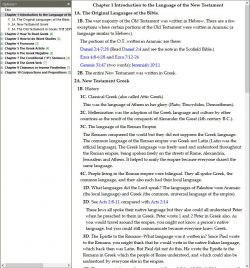
Englishman’s Greek
Practical Helps in Understanding the New Testament
Based upon a Greek course entitled “Greek Exegetical Methods” taught by Dr. James Boyer
“This excellent study helps a beginner to Greek dive into the Greek New Testament. It is also a helpful review of Greek. This book will bringing you along in your exegetical study of the New Testament by reading Greek, word studies, and more.” – Jonathan Koehn
theWord Features:
- Verse popups
- Fully searchable text
- Easy navigation of topics via topics tree display.
- Special Text Colors
- Normal: Text
- Hyperlink: LXX | Luke 20:21
- Greek: ἑαυτούς
- Chiasmus: A Repent
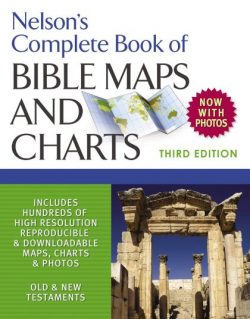
Nelson’s Complete Book of Bible Maps and Charts
Description
This updated edition of Thomas Nelson’s popular Complete Book of Bible Maps and Charts has everything you need to visualize the events, places, and people in the Old and New Testaments.
This updated edition of Thomas Nelson’s popular Complete Book of Bible Maps and Charts has everything you need to visualize the events, places, and people in the Old and New Testaments.
Perfect for small-group leaders, Bible school teachers, or if you’re simply curious about biblical times, Complete Book of Bible Maps and Charts provides a visual overview of the Bible in its entirety. Valuable resources include new, full-color, high-resolution maps and charts along with downloadable PDFs for presentations and classes; tables, charts, and diagrams that organize Bible information for ease of learning and memorization; historical articles providing insight into Bible times; and introductions to each book of the Bible.
An overview of the book from inside theWORD:
theWord Features:
- Illustrations
- Bible Maps
- Bible Charts
- Cross References
- Tables
- Surveys
Nelson’s Complete Book of Bible Maps and Charts has a lot of resources for the pastor, Bible teacher or the Sunday School teacher to help them in their preparations.
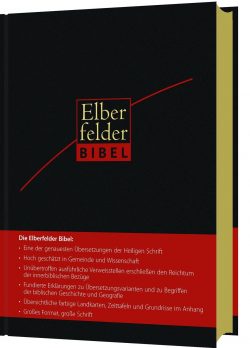
Elberfelder Bibel 2006 R. Brockhaus Verlag Wuppertal
Es ist die erneut durchgesehene Ausgabe der revidierten Elberfelder Bibel unter Berücksichtigung der neuen Rechtschreibung.
Der SCM R.Brockhaus Verlag wirbt für diese Bibelübersetzung mit den folgenden Worten:
„Die Elberfelder Bibel gehört zu den führenden deutschen Bibelübersetzungen“.
Der Name geht auf Elberfeld zurück, den heutigen Stadtteil Wuppertals, wo ein großer Teil der Übersetzungsarbeit geleistet wurde.
Ziel dieser Arbeit ist es, eine Übersetzung der ältesten Handschriften der biblischen Schriften vorzulegen, die möglichst unverfälscht deren Aussagegehalte wiedergibt und dabei möglichst wenig theologische Interpretation von außen an die Schriften heranträgt.
In ihrem Vorwort schreiben der R. Brockhaus Verlag Wuppertal und die Christliche Verlagsgesellschaft mbH Dillenburg:
„Wir wünschen uns, dass die Elberfelder Bibel 2006 allen Lesern zum Segen wird und dass sie weiterhin wichtige Impulse für das geistliche Leben der Christen im deutschsprachigen Raum liefern kann.“
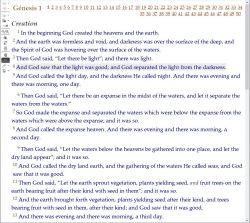
Legacy Standard Bible and Dictionary
DESCRIPTION
Bundle contents:
- LSB
- LSBHGD
In the history of English Bible translations, the King James Version is the most well-known. The time-honored version of 1611, itself a revision of the Bishops’ Bible of 1568, became the basis for the English Revised Version, which appeared in 1881 (New Testament) and 1885 (Old Testament). Its American counterpart, a product of both British and American scholarship, was published in 1901. Recognizing the values of the American Standard Version, The Lockman Foundation felt an urgency to preserve the ASV while incorporating recent discoveries of Hebrew and Greek textual sources and rendering it into more current English. This resulted in the New American Standard Bible, a translation based upon the time-honored principles of translation of the ASV and KJV, along with other linguistic tools and biblical scholarship.
The Legacy Standard Bible reflects another iteration of such preservation and refinement. Worked on by a core translation team in conjunction with pastors and educators from different countries, it is designed to honor, maintain, and advance the tradition represented by the NASB.
theWord Features
LSB
- Searchable text (via regular text and Strong’s Numbers)
- Strong’s Numbers
- Words of Jesus in Red
- Headings
- Paragraphs
- Cross references
- Footnotes
- Strong’s Numbers linked to LSBHGD Dictionary
LSBHGD Dictionary
(Dictionary is part of a bundle with the LSB, and cannot be purchased separately.)
- Fully searchable text
- Easy navigation via topics tree display.
- Strong’s Numbers
- Greek Lemmas
- Hebrew Lemmas
- Special Text Colors
- Normal: Text
- Usage: LSB Usage
- Hyperlink: G10
- Transliteration: Melek
- Hebrew: מֶלֶךְ
- Greek: κοδράντης
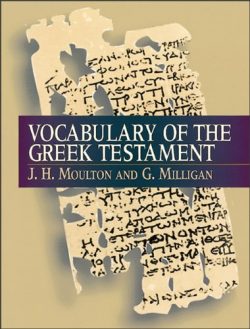
Vocabulary of the Greek Testament: Student Edition
Updated to Version 1.5
Video by Allan Loder on VGNTS
‘Vocabulary of the Greek Testament: Student Edition’ (VGNTS) is an update/revision by Allan Loder of Moulton’s and Milligan’s ‘VGNT’ published 1924-1930. It is based on the 1929 print edition — which is now in the public domain — along with some supplemental material from the 1930 edition. However, this is not merely an electronic reproduction of Moulton’s and Milligan’s book. Rather, it is a major update/revision designed to make this valuable resource more accessible to a wider English-speaking audience — especially those whose knowledge of the Biblical languages is very basic, “rusty,” or non-existent.
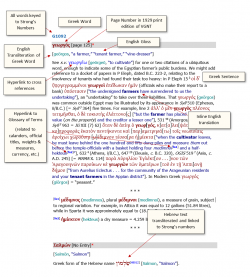
Each lexical entry is keyed to Strong’s numbers, has a transliteration and an English gloss.
There are over 937 new entries, not covered in the original print edition
New source materials are added to existing lexical entries, where available and deemed helpful.
There are over 500 cross-references to other related lexical entries within the module
Inline English translations are provided for all Greek text, as well as for most Hebrew, Aramaic, Syriac, Latin, French and German text. A transliteration of some text is also provided, where deemed helpful.
Pertinent information, such as units of measure, currency, names of Egyptian months, official titles, etc., is provided and hyperlinked.
Please note: This resource is protected under derivative copyright law.
An overview of the module from inside theWORD
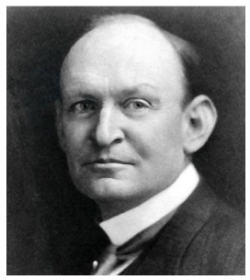
A Grammar of the Greek New Testament in the Light of Historical Research
Archibald Thomas Robertson (November 6, 1863 – September 24, 1934) was a Southern Baptist preacher and biblical scholar whose work focused on the New Testament and Koine Greek.
Robertson was born at Cherbury near Chatham, Virginia. He was educated at Wake Forest (N. C.) College (M. A., 1885) and at the Southern Baptist Theological Seminary (SBTS), Louisville, Kentucky (Th. M., 1888), where he was thereafter instructor and professor of New Testament interpretation, and remained in that post until one day in 1934, when he dismissed his class early and went home and died of a stroke.
Robertson’s books are still consulted today, particularly his Word Pictures in the New Testament and his landmark volume A Grammar of the Greek New Testament in Light of Historical Research. In all, he published 45 books, several of which are still in print today. Robertson helped found the Baptist World Alliance in 1900. He was an important Southern Baptist and a well-respected scholar in his day. Robertson sought to equip his students with the proper tools for good preaching.
(text from Wikipedia.org)
theWord Features:
⦁ Verse popups
⦁ Fully searchable text
⦁ Hebrew, Greek, etc.
⦁ Footnotes
⦁ Pages links
⦁ Easy navigation of topics via topics tree display.
New Heart English Bible
While there are many Bible translations available, few are in the public domain in modern English, and even fewer in the public domain are based on the latest textual criticism using all available manuscripts. The goal of the New Heart English Bible (NHEB) project is to meet these requirements. The NHEB began with the public domain World English Bible, and was updated with consideration of all the available manuscripts.
theWord Features:
- Old and New Testament
- Fully searchable text
Reina Valera 1960 Biblia
La mayoría del mundo hispano usa la Reina Valera 1960. Es una Biblia que fue traducida antes del Rey Jaime (King James Version), y los traductores del Rey Jaime hicieron referencia a la Reina Valeria en hacer su obra en inglés.
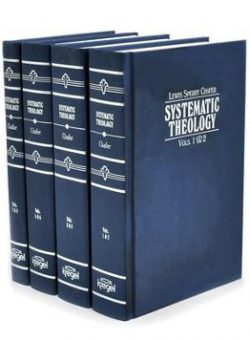
Chafer’s Systematic Theology
Written by Lewis Sperry Chafer, the founding president of Dallas Theological Seminary and long-time editor of Bibliotheca Sacra, this is the first dispensational, premillenial systematic theology ever published. It is a complete, unabridged systematic theology meaning it covers a lot of ground that many earlier theologies did not, such as ecclesiology (e.g., the doctrine of the universal church, the church’s rule of life), angelology (e.g., the relationship between Satan and sin), and typology. This is truly one of the heavyweight works of the evangelical movement, very much in demand today.
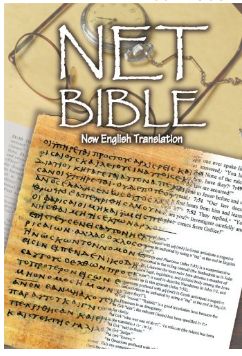
NET Bible, full notes edition
The NET Bible is a powerful new translation of the Bible (having 60,932 translators’ notes by experts in the original biblical languages). When you combine theWord Bible software program with this Bible, you can easily see the translator’s many notes by simply mousing over the translator’s note’s number, and the actual text will pop up. These translator’s notes are an excellent commentary for Bible students knowing Greek and Hebrew in that they point out the original words, how their underlying forms (grammatical structure) affects the translation of the verse. But at the same time, while this highly technical information is available for the experienced scholar, it is also very clear and understandable for the common Bible student as far as what it means. For example, the moods and tenses of Greek verbs often have comments when they reflect on the meaning of the text. This is very helpful and insightful to common Bible student.
Kingcomments (English)
Introduction
The purpose of the comments is to encourage people to read the Bible. The original web address of the comments is www.kingcomments.com. The comments that are available have been translated from Dutch into English. It is planned that, God willing, the four lacking comments will be translated and made available in the course of this year 2021. The comments are intended to help you study the Bible personally. The Bible quotations written in full in the commentaries are from the New American Standard Bible-NASB 1995.
The comments on Job, Psalms and Isaiah are written together with Tony Jonathan. The commentary on Ezekiel was written in close collaboration with Ron Vellekoop.
The Bible is the infallible, everlasting Word of God. The Bible is about the Son of God, Who became Man to die on the cross for sinful people. God raised Him from the dead and He is now in heaven. Anyone who confesses his sins and believes in the Son and His work of atonement on the cross will not perish but receive eternal life. Such a person is a child of God. God tells His children in His Word how to live to His glory and all that He intends to give them, because of their connection to His Son.
theWord Features: