
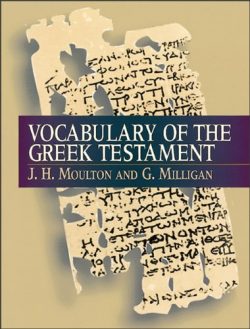
Vocabulary of the Greek Testament: Student Edition
Updated to Version 1.5
Video by Allan Loder on VGNTS
‘Vocabulary of the Greek Testament: Student Edition’ (VGNTS) is an update/revision by Allan Loder of Moulton’s and Milligan’s ‘VGNT’ published 1924-1930. It is based on the 1929 print edition — which is now in the public domain — along with some supplemental material from the 1930 edition. However, this is not merely an electronic reproduction of Moulton’s and Milligan’s book. Rather, it is a major update/revision designed to make this valuable resource more accessible to a wider English-speaking audience — especially those whose knowledge of the Biblical languages is very basic, “rusty,” or non-existent.
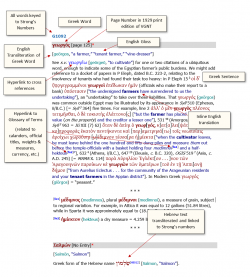
Each lexical entry is keyed to Strong’s numbers, has a transliteration and an English gloss.
There are over 937 new entries, not covered in the original print edition
New source materials are added to existing lexical entries, where available and deemed helpful.
There are over 500 cross-references to other related lexical entries within the module
Inline English translations are provided for all Greek text, as well as for most Hebrew, Aramaic, Syriac, Latin, French and German text. A transliteration of some text is also provided, where deemed helpful.
Pertinent information, such as units of measure, currency, names of Egyptian months, official titles, etc., is provided and hyperlinked.
Please note: This resource is protected under derivative copyright law.
An overview of the module from inside theWORD
New American Standard Bible Bundle (NASB77, NASB95, LBLA, NBLA)
This bundle includes the following modules:
- New American Standard Bible 1995 Update with Strong’s numbers – NASB
- New American Standard Bible 1977 edition (also available as a separate add-on) – NASB77
- La Biblia de las Americas – LBLA
- Nueve Biblia de las Américas – NBLA
Includes: NASB, NASB 1977, LBLA, NBLA, 17,000 translator’s notes, 93,000 cross-references, NASEC (Exhaustive Hebrew-Aramaic and Greek concordance).
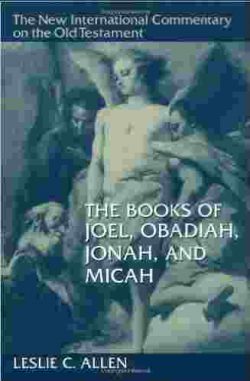
New International Commentary: The Books of Joel, Obadiah, Jonah, and Micah
PRODUCT HIGHLIGHTS:
- Verse-by-verse commentary
- In-depth discussion of textual and critical matters
- Introductions to each book’s authorship, date, purpose, structure, and theology
- Detailed bibliography
DESCRIPTION
The eloquent and uncompromising calls for social righteousness by some of the Minor Prophets are familiar to many, yet the writings themselves are probably the least studied and least known texts of the Old Testament. Those who are familiar with these books are also aware of the historical and literary problems that plague their study. Drawing on insights from various perspectives—theological, historical, and literary—Leslie Allen’s commentary on Joel, Obadiah, Jonah, and Micah carefully and imaginatively reconstructs the stage on which the message of these four books was conveyed to their Hebrew hearers and shows what relevance, in turn, they hold for contemporary Christians.
For each of the books there is a substantial introduction in which the full range of scholarly opinion is presented and assessed, a select bibliography, the author’s own translation of the text—a significant contribution to biblical studies in itself—and an extensive commentary. The commentary on Micah is foundational for these four books in that it treats at greater length some of the same forms and motifs that appear in Joel, Obadiah, and Jonah. The introductory material for Joel includes discussions of canonicity and textual criticism that apply to the entire volume.
….

Abbott-Smith’s Manual Greek Lexicon of the New Testament
Description
Abbot-Smith’s A Manual Lexicon of the New Testament was written to offer an update to older lexicons—those written before the discovery of manuscripts demonstrating that the New Testament was written in koine Greek, rather than a Hebrew variant of classical Greek. It was also written to be a quick reference guide for students of the New Testament to use while reading their Greek text. It adopts the textual standard of Moulton and Geden’s Concordance to the Greek New Testament by following the Westcott & Hort Greek text.

theWord Features:
- Verse popups
- Fully searchable text
- Easy navigation of topics via topics tree display.
- Greek Lemmas
- Strong’s Numbers in topic tree
- Special Text Colors
- Normal: Text
- Hyperlink: Php 1:16
- Greek: σωμάτων
- Hebrew: מִשְׁפָּט
Thayer’s Greek–English Lexicon of the New Testament
Description
A Greek-English Lexicon of the New Testament being Grimm’s Wilke’s Clavis Novi Testmenti
Translated Revised and Enlarged by Joseph Henry Thayer, D.D.
theWord Features:
- Verse popups
- Fully searchable text
- Easy navigation of topics via topics tree display.
- Greek Lemmas
- Strong’s Numbers in topic tree
- Special Text Colors
- Normal: Text
- Hyperlink: Php 1:16
- Greek: σωμάτων
- Hebrew: מִשְׁפָּט
New Testament Text and Translation Commentary
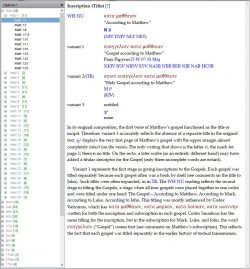
The purpose of this work is to provide scholars, pastors, students, and serious Bible readers with a commentary on the variant readings in the New Testament that have significance for Bible interpretation and Bible translation—and to do so in a format that is communicative and informative to English readers as well as those who know Greek.
theWord Features
- Verse popups
- Verse synchronization
- Fully searchable text
- Inline Commentary can be set in Bible view.
- Commentary link popup can be set in Bible view.
- Easy navigation via topics tree display.
- Builtin witness explanations.
- [?] Additional information available, including How to use this module.
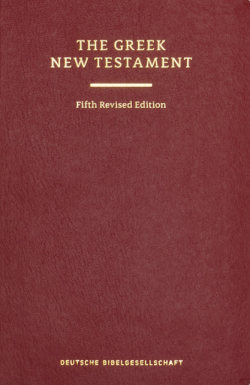
Greek New Testament, (UBS5) 5th revised edition
This is the Greek text, sometimes referred to as the “critical text tradition” (UBS5). It is the most widely used critical version of the Greek New Testament. It includes:
- Passage headings
- Parallel passages
- letter casing
- accents
- breathing marks
- punctuation
- capitalization
- Old Testament quotes in bold
- paragraphs and poetry formatting
- Tagged with:
- Strong’s codes
- morphology (grammatical parsing)
- word lemmas
Upgrade note: Owners of UBS4 may use their UBS4 unlock key as a coupon to receive 50% OFF UBS5.
- If purchased on theWordBooks.com go to https://www.thewordbooks.com/index.php/my-account/downloads/
- If purchased on theWord.net go to https://www.theword.net/index.php?purchase-recoverserial&l=english
Note: If you came here to purchase UBS4. Sorry it is no longer available but if you already own UBS4 you may get the fixes in theWord > Add Titles.
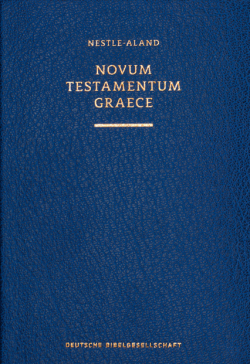
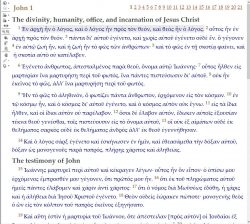
Greek Bible text of the Novum Testamentum Graece, 28th edition (Nestle Aland) (GNT)
Note: If you came here to purchase NA27. Sorry it is no longer available but if you already own NA27you may get the fixes in theWord > Add Titles.
DESCRIPTION
This is the Greek text, sometimes referred to as the “critical text tradition”. It is the most widely used critical version of the Greek New Testament. It includes:
- letter casing
- accents
- breathing marks
- punctuation
- capitalization
- Old Testament quotes in bold
- paragraphs and poetry formatting
- Tagged with:
- Strong’s codes
- morphology (grammatical parsing)
- word lemmas
Strong’s codes and morphology codes can either be displayed next to each word or be hidden away and appear when the mouse moves over a word. The module can be searched on original words, ignoring accents and breathing marks if desired. Complex searches including Strong’s codes, word grammar and even lemmas are also supported, along with any arbitrary combination of these.
We want to make you aware of some similar products that if you like this work, you might consider getting also.
(1.) Student’s Guide to New Testament Textual Variants, A (“Free to You” from theWord.net)
(2.) Variant Readings of the New Testament (“Free to You” from theWord.net)
(click on the link and you will directly download the module from theWord.net)
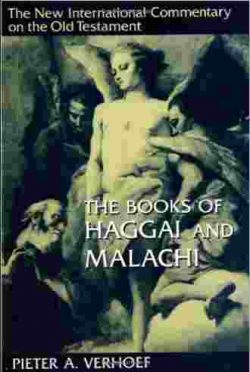
New International Commentary: The Books of Haggai and Malachi
PRODUCT HIGHLIGHTS:
- Verse-by-verse commentary
- In-depth discussion of textual and critical matters
- Introductions to each book’s authorship, date, purpose, structure, and theology
- Detailed bibliography
DESCRIPTION
This commentary by Pieter A. Verhoef offers a thorough exegesis and exposition of Haggai and Malachi—two important books of Scripture that, unfortunately, are not only little studied but have sometimes been maligned by contemporary scholarship—and stresses the relevance of these prophets’ messages in terms of continuity and discontinuity for the Christian church.
Verhoef’s introduction to each book elucidates the questions of authorship, style, text, structure, historical background, and message. Making extensive use of structural analysis, Verhoef argues convincingly for the authenticity, unity, and integrity of both books.
Verhoef also brings his knowledge of the ancient Near East, the Old Testament, and past and current biblical scholarship to bear in the commentary proper, and he displays theological acumen and pastoral sensitivity in tailoring his exposition for the student and pastor as well as for the scholar.
….
New International Commentary: The Books of Nahum, Habakkuk and Zephaniah
PRODUCT HIGHLIGHTS:
- Verse-by-verse commentary
- In-depth discussion of textual and critical matters
- Introductions to each book’s authorship, date, purpose, structure, and theology
- Detailed bibliography
DESCRIPTION
The close-knit bond between prophecy and history, according to O. Palmer Robertson, becomes particularly clear through the study of Nahum, Habakkuk, and Zephaniah. As the historical context of their messages is explored, it becomes ever more apparent that biblical history—in addition to providing the context for prophecy—actually embodies and functions as prophecy. The events that occurred to Judah and its neighbors spoke in anticipation of world-shaking circumstances that were yet to come.
In this commentary Robertson combines the insights of biblical theology with a keen awareness of the age in which we live. After first dealing with the relevant background issues of Nahum, Habakkuk, and Zephaniah—redemptive-historical setting, theological perspective, date and authorship, and so on—Robertson applies the care and precision of an exegete and the concern of a pastor to his verse-by-verse exposition of each book. The result is a relevant confrontation with the ancient call to repentance and faith—a confrontation greatly needed in today’s world.
….
New International Commentary: The Book of Joshua
PRODUCT HIGHLIGHTS:
- Verse-by-verse commentary
- In-depth discussion of textual and critical matters
- Introductions to each book’s authorship, date, purpose, structure, and theology
- Detailed bibliography
DESCRIPTION
Recognizing that Old Testament studies today are in a state of flux as never before and that the Book of Joshua seems to be at the crossroads of this animated discussion. Marten Woudstra here takes into careful account the various views represented by recent scholarship as well as Hebrew usage and text-critical concerns.
Woudstra demonstrates that the central theme in Joshua, to which everything in the book has been made subordinate, is the fulfillment of God’s promise to the patriarchs regarding the promised land. To support his understanding of this central theme, Woudstra emphasizes the nature of the Hebrew narrative as both proleptic, offering provisional summaries of events to be taken up later in considerable detail, and programmatic, indicating that the book was written close to actual events. The excellent introduction and section-by-section commentary are supplemented by an extensive bibliography and seven instructive maps.
….
New International Commentary: The Book of Deuteronomy
PRODUCT HIGHLIGHTS:
- Verse-by-verse commentary
- In-depth discussion of textual and critical matters
- Introductions to each book’s authorship, date, purpose, structure, and theology
- Detailed bibliography
DESCRIPTION
Deuteronomy is a book about Israel’s preparation for a new life. Hardship and the wilderness lie behind; the conquest of the promised land lies ahead. What remains at this crucial stage in Israel’s history—the end of the Mosaic Age—is a call for a new commitment to God and a fresh understanding of the nature of the community of God’s people.
Interpreting Deuteronomy from a conservative perspective, Peter C. Craigie highlights the centrality of the book’s theme of covenant commitment while also taking great care to demonstrate how Deuteronomy is a book with considerable contemporary relevance. He uses resources of recent research in Old Testament studies to effectively bridge the gap of more than three thousand years that separates the modern reader from the events described in Deuteronomy, thus clarifying the primary message of the text for the modern reader. In its simplest phrasing that message is “Commit yourself to God wholeheartedly.” Deuteronomy, according to Craigie, provides a paradigm for the kingdom of God in the modern world.
….
New International Commentary: The Book of Leviticus
PRODUCT HIGHLIGHTS:
- Verse-by-verse commentary
- In-depth discussion of textual and critical matters
- Introductions to each book’s authorship, date, purpose, structure, and theology
- Detailed bibliography
DESCRIPTION
Leviticus used to be the first book that Jewish children studied in the synagogue. In the modern church it tends to be the last part of the Bible that anyone looks at seriously. Because Leviticus is largely concerned with subjects that seem incomprehensible and irrelevant today—rituals for sacrifice and regulations concerning uncleanness—it appears to have nothing to say to twenty-first-century Christians.
In this excellent commentary on Leviticus, Gordon Wenham takes with equal seriousness both the plain original meaning of the text and its abiding theological value. To aid in reconstructing the original meaning of the text, Wenham draws from studies of Old Testament ritual and sacrifice that compare and contrast biblical customs with the practices of other Near Eastern cultures. He also closely examines the work of social anthropologists and expertly utilizes the methods of literary criticism to bring out the biblical author’s special interests.
In pursuit of his second aim, to illumine the enduring theological value of Leviticus, Wenham discusses at the end of each section how the Old Testament passages relate to the New Testament and to contemporary Christianity. In doing so, he not only shows how pervasive Levitical ideas are in the New Testament but also highlights in very practical ways the enduring claim of God’s call to holiness on the lives of Christians today.
….
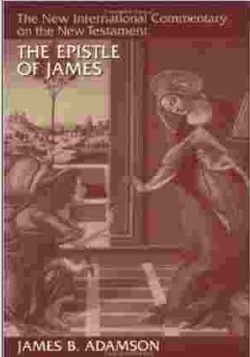
New International Commentary: The Epistle of James
PRODUCT HIGHLIGHTS:
- Verse-by-verse commentary
- In-depth discussion of textual and critical matters
- Introductions to each book’s authorship, date, purpose, structure, and theology
- Detailed bibliography
DESCRIPTION
The author of the Epistle of James, a letter distinguished for its passionate commitment to Jewish Christianity, has been dubbed “the Amos of the new covenant.” As a guide to Christian behavior, the letter deals with themes of universal importance, among which are the nature of God and man, the evils of lust and pride, the virtues of faith and hope, and the fruits of faith and love.
James B. Adamson, in contrast to many scholars, is convinced that James was a master writer whose knowledge and choice of Greek bestow on his epistle a sustained unity of style and content that bears a close affinity with the Synoptic Gospels and the sayings of Jesus. The substance and authoritative tone of this epistle follow in the tradition of Elijah and Moses, and the style and diction resemble some of the outstanding qualities of the Psalms the prophets.
In this thorough exegesis of his own working translation, Adamson combats some prevalent notions and corrects misunderstandings of the nature of this unique epistle, which, he says, cannot really be understood apart from the whole context of the New Testament.
….
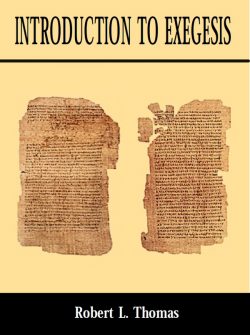
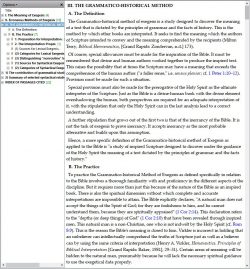
Introduction to Exegesis
Description
“Dr. Robert Thomas has written this very powerful introduction to exegesis. True biblical understanding and interpretation lies in solid biblical exegesis. This significant work goes to the very heart of the matter beginning with a very accurate meaning of biblical exegesis. Dr. Thomas takes the reader through a very systematic study of the grammatical-historical method. This book is highly recommended for any student of the Greek New Testament.”
David Olander, Ph.D, Th.D, Professor of Biblical Languages at Tyndale Theological Seminary & Biblical Institute (Ft. Worth, TX).
This wonderful resource includes a great deal of Greek Grammar content and includes the page numbers of, . . . “the work by H. E. Dana and Julius R. Mantey, A Manual Grammar of New Testament Greek (New York: Macmillan, 1957). . .” so it can be used side by side.
theWord Features:
- Verse popups
- Fully searchable text
- Footnotes
- Cited passages page links
- Easy navigation of topics via topics tree display.
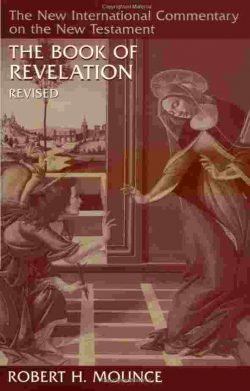
New International Commentary: The Book of Revelation
- Verse-by-verse commentary
- In-depth discussion of textual and critical matters
- Introductions to each book’s authorship, date, purpose, structure, and theology
- Detailed bibliography
DESCRIPTION
No New Testament book has caused as much confusion and been subjected to as many varied interpretations as Revelation. Today we continue to witness a surge of popular interest in Bible prophecy and questions concerning such matters as the “last days” and the second coming of Christ. Scholarly debates continue as well, especially regarding the occurrence, timing, and theological significance of the “tribulation” and the “millennium.” It is therefore the special task of the commentator on Revelation to address such difficult questions in a scholarly and responsible manner while also remaining accessible to pastors, students, and general readers.
When first published, this volume on Revelation by Robert H. Mounce was widely praised as a standard commentary on the Apocalypse. In this new edition, now based on the NIV and Nestle-Aland, Mounce has revised and expanded his work to reflect more than twenty additional years of mature thought on Revelation and to bring his work up to date with the latest scholarship. As in the original edition, Mounce here engages seriously with the various approaches to interpretation and with the conventions common to apocalyptic literature. In affirming more directly his own reading of the Apocalypse, Mounce steers a middle course between an extreme literalism and a highly imaginative subjectivism, believing this to be the way the ancient text spoke to the first-century churches to whom it was addressed—and the way it still speaks to us today.
New International Commentary: The Book of the Acts
PRODUCT HIGHLIGHTS:
- Verse-by-verse commentary
- In-depth discussion of textual and critical matters
- Introductions to each book’s authorship, date, purpose, structure, and theology
- Detailed bibliography
DESCRIPTION
First published in 1954, F.F. Bruce’s volume on the Book of Acts in the NICNT series has stood for more than fifty years as a standard commentary on Acts. In keeping with the effort to be faithful to the description “new” in the series title, however, Bruce undertook a thorough revision of this commentary before his death in 1990.
Expanded and fully updated, this volume now reflects the best elements of recent notable contributions to the study of Luke-Acts as well as the author’s own deepened understanding gained from years of further reflection on the text. Whereas the first edition used the text of the American Standard Version of 1901, this revision is based on Bruce’s own fresh translation of the Greek text. The result is a work that makes transparent the walls between the first and the twentieth centuries and enables readers to hear not only the voice of Luke but the Word of God.
….
NIV Application Commentary: Job
DESCRIPTION
From the Back Cover
About the Book
The NIV Application Commentary helps you communicate and apply biblical text effectively in today’s context.
To bring the ancient messages of the Bible into today’s world, each passage is treated in three sections:
This unique, award-winning commentary is the ideal resource for today’s preachers, teachers, and serious students of the Bible, giving them the tools, ideas, and insights they need to communicate God’s Word with the same powerful impact it had when it was first written.
theWord Features:
Note: Does not display commentary under Bible text.