
La Biblia de las Americas (LBLA)
LA BIBLIA DE LAS AMERICAS es una traducción fiel de las Sagradas Escrituras según fueron escritas originalmente en hebreo, arameo y griego. Se ha producido con el propósito de ofrecer al mundo de habla hispana la riqueza y el poder de la Palabra de Dios en forma tal que sea un verdadero tesoro devocional y un instrumento práctico de estudio.
Esta versíon es producto de la intensa labor y dedicación de un considerable número de eruditos de distintas denominaciones cristianas, representantes de varios países de Hispanoamérica, de España y de los Estados Unidos. Se publica con la firme convicción de que las Sagradas Escrituras, según fueron escritas en los idiomas originales, fueron inspiradas por Dios, y puesto que son su eterna Palabra, hablan con renovado poder a cada generación para impartir la sabiduría que lleva a la salvación en Cristo, equipando al creyente para disfrutar de una vida abundante y feliz en la tierra, y constituyéndolo en testimonio viviente de la verdad para la gloria eterna de Dios.
El Comité Editorial ha observado dos principios básicos: En primer lugar, ha tratado de ceñirse en todo lo posible a los idiomas originales de las Sagradas Escrituras, y en segundo lugar, ha observado las reglas de la gramática moderna en una dimensión continental contemporánea, usando un estilo ágil y ameno, procurando mantener la mayor belleza literaria.
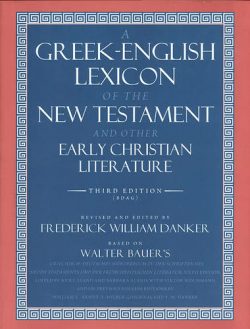
Bible Dictionary of Ancient Greek (BDAG) A Greek-English Lexicon of the New Testament
22% off Lowest price possible is $175. (Publisher requirement)
Now includes Strong’s numbers in topic tree! It will now work with your Strong’s number resources NASB, NET2, etc.
Described as an “invaluable reference work” (Classical Philology) and “a tool indispensable for the study of early Christian literature” (Religious Studies Review) in its previous edition, this new updated edition takes Walter Bauer’s Wörterbuch zu den Schriften des Neuen Testaments even further. This work includes Greek definitions for works of all periods of Greek, and has more than 25,000 additional references to classical, intertestamental, Early Christian, and modern literature.
In this edition, Frederick W. Danker’s broad knowledge of Greco-Roman literature, as well as papyri and epigraphs, provides a more panoramic view of the world of Jesus and the New Testament. Danker has also introduced a more consistent mode of reference citation, and has provided a composite list of abbreviations to facilitate easy access to this wealth of information.
Perhaps the single most important lexical innovation of Danker’s edition is its inclusion of extended definitions for Greek terms. For instance, a key meaning of “episkopos” was defined in the second American edition as overseer; Danker defines it as “one who has the responsibility of safeguarding or seeing to it that something is done in the correct way, guardian.” Such extended definitions give a fuller sense of the word in question, which will help avoid both anachronisms and confusion among users of the lexicon who may not be native speakers of English.
Danker’s edition of Bauer’s Wörterbuch is an indispensable tool for New Testament exegete.
theWord Features:
- Verse popups
- Abbreviation popups
- Fully searchable text
- Easy navigation of topics via topics tree display.
- Greek Lemmas
- Strong’s Numbers in topic tree
- Special Text Colors
- Normal: Text
- Hyperlink: New Docs | Hb 9:4
- Greek: σωμάτων
- Hebrew: מִשְׁפָּט
Discovering the Language of Jesus
Discovering the Language of Jesus: Hebrew or Aramaic? For the last 150 years, both popular and academic views have asserted that Jesus spoke Aramaic as his primary language of communication since supposedly Hebrew died out after the children of Israel were taken into Babylonian captivity. This view, however, is not based on the testimony of the Old Testament, the New Testament, historical sources, or Jesus’ actual words. Just which language did Jesus and his disciples speak?
Pastor and teacher Douglas Hamp takes you on a journey through history, Scripture and linguistics to solve the puzzle. By Discovering the Language of Jesus, you will gain a deeper understanding of Jesus’ words and culture and will be fully convinced that every detail in God’s Word is accurate, reliable and worthy of your trust.
New American Standard Bible Bundle (NASB77, NASB95, LBLA, NBLA)
This bundle includes the following modules:
- New American Standard Bible 1995 Update with Strong’s numbers – NASB
- New American Standard Bible 1977 edition (also available as a separate add-on) – NASB77
- La Biblia de las Americas – LBLA
- Nueve Biblia de las Américas – NBLA
Includes: NASB, NASB 1977, LBLA, NBLA, 17,000 translator’s notes, 93,000 cross-references, NASEC (Exhaustive Hebrew-Aramaic and Greek concordance).
The New King James Bible (NKJV)
The New King James Version is a total update of the 1611 King James Version, also known as the “Authorized Version.” Every attempt has been made to maintain the beauty of the original version while updating the English grammar to contemporary style and usage. The result is much better “readability.” It is noteworthy that the NKJV is one of the few modern translations still based on the “Western” or “Byzantine” manuscript tradition. This makes the New King James Version an invaluable aid to comparative English Bible study.
Commissioned in 1975 by Thomas Nelson Publishers, 130 respected Bible scholars, church leaders, and lay Christians worked for seven years to create a completely modern edition of the King James Version that would continue the classic tradition of the original King James. With unyielding faithfulness to the original Greek, Hebrew, and Aramaic texts, the translators applied the most recent research in archaeology, linguistics, and textual studies. The resulting work provides today’s Bible reader with an accurate and modern translation of the Scriptures with the stylistic beauty and memorable quality of the King James.
New International Version 2011 (NIV)
Getting the words right means being true to the original Greek, Hebrew, and Aramaic of the Bible. But it also means being true to the reader — capturing the Bible’s original meaning in natural, everyday English.
That’s what sets the NIV Bible apart. It doesn’t sacrifice precision for clarity or the other way around. It delivers both, all in a Bible translation you’ll love to read.
THE NIV IS…
ACCURATE
The NIV translators are united by their conviction that the Bible is God’s inspired Word. That, along with their years of studying biblical languages, helps them to capture subtle nuances and the depth of meaning in the Bible. (More)
CLEAR
If the first recipients understood God’s Word when they heard it, so should you. That’s the driving force behind the NIV’s commitment to clarity. The Bible should be every bit as clear to you as it was to its original audience. (More)
BEAUTIFUL
Bible reading isn’t just a solo exercise; it’s meant to be a shared experience. That’s why the NIV translators prioritize literary beauty, resulting in a Bible translation that’s suitable for public reading and use in churches. (More)
TRUSTWORTHY
The NIV is translated by an independent, self-governing team of Bible scholars. No publisher, commercial or otherwise (not even us!), can tell them how to translate God’s Word. The translators come from dozens of denominations and churches, and they can only make changes to the text if 70% of the committee agrees — safeguarding against theological bias. (More)
There are plenty of things to wrestle with in the Bible.
Your translation shouldn’t be one of them.
(taken from https://www.biblica.com/bible/niv-bible/)
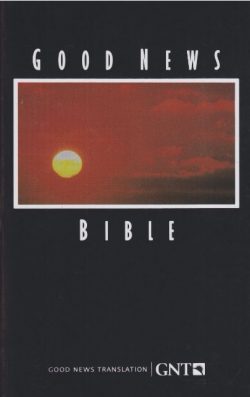
Good News Translation in Today’s English Version with Apocrypha (GNT)
The GNT (also known as Today’s English Version or Good News Bible) was one of the first meaning-based (or functional equivalent) translations of the Bible into English. It was originally published in 1976, then it was revised in 1992. The GNT presents the message of the Bible in a level of English that is common to most of the English-speaking world. The GNT is still used widely in youth Bible study groups and in less formal worship services.
A very contemporary translation that is designed to be easy to read for those who are not familiar with the Bible. Also known as the Good News Bible, this translation of the Bible follows a dynamic equivalence theory of translation. Published in 1966, revised in 1992.

Amplified Bible, Classic Edition (AMPC)
This is a digital Bible for theWord Bible Software
The first complete Bible produced by The Lockman Foundation was the Amplified Bible. The Amplified Bible is a translation that, by using synonyms and definitions, both explains and expands the meaning of words in the text by placing amplification in parentheses and brackets and after keywords or phrases. This unique system of translation allows the reader to more completely grasp the meaning of the words as they were understood in the original languages. Through multiple expressions, fuller and more revealing appreciation is given to the divine message as the original text legitimately permits.
The Amplified Bible is free of personal interpretation and is independent of denominational prejudice. It is a translation from the accepted Hebrew, Aramaic, and Greek manuscripts into literary English. It is based on the American Standard Version of 1901, Rudolph Kittel’s Biblia Hebraica, the Greek text of Westcott and Hort, and the 23rd edition of the Nestle Greek New Testament as well as the best Hebrew and Greek lexicons available at the time. Cognate languages, the Dead Sea Scrolls, and other Greek works were also consulted. The Septuagint and other versions were compared for interpretation of textual differences. In completing the Amplified Bible, translators made a determined effort to keep, as far as possible, the familiar wording of the earlier versions, and especially the feeling of the ancient Book.
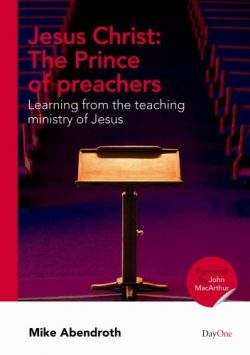
Jesus Christ: The Prince of preachers
This work points preachers to learn directly from the preaching ministry of Jesus Christ. It is excellent material for those committed to expository preaching.
“The pulpit lies at the heart of the church.” — Abendroth

Bible Panorama
Part One: A work surveying the scenery of Scripture: Each chapter of each book of the Bible plainly summarised and explained;
Part Two: Enjoying the unhindered view with confidence including Practical topics about the Bible to help you trust and read it. Chapters on why the bible is trustworthy, how to read all of the bible, bible reading schemes, etc.

Die Bybel in Afrikaans 1983
Die vertaling van die Bybel in Afrikaans wat hiermee aangebied word, is die vrug van vertaalwerk wat in 1970 begin is. Die doel was ’n vertaling wat rekening hou met die ontwikkeling in Afrikaans die afgelope jare en met die resultate van wetenskaplike ondersoek; ’n waardige vertaling waardeur Afrikaanssprekendes aangespreek word, buite en binne die kerk, in die erediens en in huislike gebruik, in ons teenwoordige situasie en tyd.
As grondteks vir die Ou Testament is die Biblia Hebraica Stuttgartensia (1977) gebruik. Hierdie uitgawe van die Hebreeuse, en gedeeltelik Aramese, grondteks is gebaseer op die oudste volledig behoue manuskrip, dieCodex Leningradensis(1008 n.C.). Gegewens uit ouer manuskripte is in die teksuitgawe bygewerk.
Vir die Nuwe Testament is gebruik gemaak van die Griekse grondteks soos gepubliseer deur die Wereldbond van Bybelgenootskappe onder die titel: The Greek New Testament , derde uitgawe (1975).
Die nuwe vertaling word aangebied met die bede dat dit mag dien om die Woord van God in te dra in die hart en lewe van almal wat Afrikaans praat.
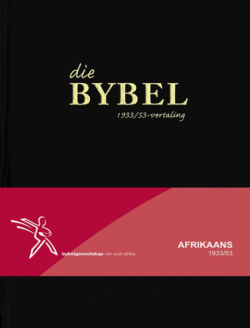
Die Bybel in Afrikaans 1933/1953
Hierdie is die volledige Bybel in Afrikaans. Die vertaal-projek is deur die Afrikaanse kerke begin in 1926 en die voltooide Bybel is feestelik deur die kerke ontvang op Sondag 27 Augustus 1933 dwarsoor die land. Gedurende die periode 1933-1953 het die vertalers die teks hersien in die lig van kommentaar wat ontvang is op die 1933 teks. Teen die tyd dat die voltooide hersiening beskikbaar geword het, het nog net een van die vertalers gelewe. Hierdie vertaling het voortreflike hoedanighede gehad en was van besonder groot betekenis vir die vestiging van die Afrikaanse taal.
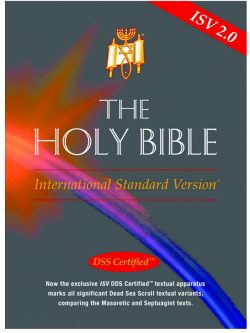
International Standard Version Bible (ISV)
The ISV is a totally new work translated directly from the original languages of Scripture and derived from no other English translation.
The ISV was produced by Bible scholars who believe that “All Scripture is inspired by God and is useful for teaching, for reproof, for correction, and for training in righteousness.” (2 Timothy 3:16 ISV) It takes advantage not only of the most ancient manuscripts available, but also of the most recent archaeological discoveries. The ISV is the first English Bible conceived, designed, translated, and formatted primarily for a computer-literate generation. It is being produced entirely in a computer-aided media (CAM) format.
The ISV is Sensitive to Poetic Literary Forms in the Original Text. It treats subtle nuances of the original texts with special care. For example, several passages of the Bible appear to have been rendered in poetic form when first penned by their authors. The ISV has meticulously crafted these original passages as true poems—thus communicating a sense of their original literary form as well as translating the original intent of the New Testament author.
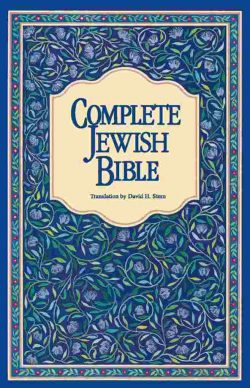
Complete Jewish Bible (CJB)
Presenting the Word of God as a unified Jewish book, the Complete Jewish Bible is a translation for Jews and non-Jews alike. It connects Jews with the Jewishness of the Messiah, and non-Jews with their Jewish roots. Names and key terms are returned to their original Hebrew and presented in easy-to-understand transliterations, enabling the reader to say them the way Yeshua (Jesus) did! For readers familiar with the Jewish New Testament, the Complete Jewish Bible is a welcome sight!
The CJB is a translation of the Bible into English by Dr. David H. Stern. It consists of Dr. Stern’s revised translation of the Old Testament (Tanakh) plus his original Jewish New Testament (B’rit Hadashah) translation in one volume. It was published in its entirety in 1998 by Jewish New Testament Publications, Inc.
The Old Testament translation is a paraphrase of the public domain 1917 Jewish Publication Society version. The New Testament section is Dr. Stern’s original translation from the ancient Greek.
Dr. Stern’s purpose for producing the Complete Jewish Bible was “to restore God’s Word to its original Jewish context and culture as well as be in easily read modern English.”
The CJB follows the order and the names of the Old Testament books in the Jewish Bible, rather than those of typical Christian Bibles. It uses Hebrew names for people and places, such as Eliyahu for “Elijah”, and Sha’ul for “Saul.” The work also incorporates Hebrew and Yiddish expressions, such as matzah for “unleavened bread” and mikveh for “ritual immersion pool”.
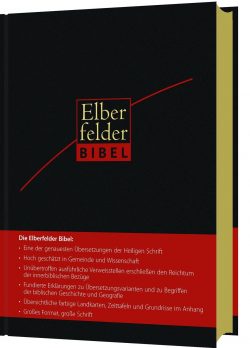
Elberfelder Bibel 2006 R. Brockhaus Verlag Wuppertal
Es ist die erneut durchgesehene Ausgabe der revidierten Elberfelder Bibel unter Berücksichtigung der neuen Rechtschreibung.
Der SCM R.Brockhaus Verlag wirbt für diese Bibelübersetzung mit den folgenden Worten:
„Die Elberfelder Bibel gehört zu den führenden deutschen Bibelübersetzungen“.
Der Name geht auf Elberfeld zurück, den heutigen Stadtteil Wuppertals, wo ein großer Teil der Übersetzungsarbeit geleistet wurde.
Ziel dieser Arbeit ist es, eine Übersetzung der ältesten Handschriften der biblischen Schriften vorzulegen, die möglichst unverfälscht deren Aussagegehalte wiedergibt und dabei möglichst wenig theologische Interpretation von außen an die Schriften heranträgt.
In ihrem Vorwort schreiben der R. Brockhaus Verlag Wuppertal und die Christliche Verlagsgesellschaft mbH Dillenburg:
„Wir wünschen uns, dass die Elberfelder Bibel 2006 allen Lesern zum Segen wird und dass sie weiterhin wichtige Impulse für das geistliche Leben der Christen im deutschsprachigen Raum liefern kann.“

Elberfelder Übersetzung Edition (CSV)
Die vorliegende Bibelausgabe geht zurück auf die so genannte „Elberfelder Übersetzung“, die erstmals in den Jahren 1855 bis 1871 erschien und mit dem Ziel erstellt wurde, unter Berücksichtigung der damals vorhandenen wissenschaftlichen Ausgaben des hebräischen und griechischen Grundtextes eine möglichst wortgetreue Übersetzung des Grundtextes zu bieten.
Durch Gottes Gnade kann jetzt eine Neubearbeitung dieser Übersetzung erscheinen. Dazu wurden unter anderem die heutigen wissenschaftlichen Grundtext-Ausgaben des Alten und Neuen Testaments herangezogen (K. Elliger und W. Rudolph: Biblia Hebraica Stuttgartensia, Stuttgart, 2. Auflage 1984; Nestle-Aland: Novum Testamentum Graece, Stuttgart, 27. Auflage 1993; The New Testament: The Greek Text Underlying the English Authorised Version of 1611, London o. J.) Hier und da bestand die Möglichkeit, die Genauigkeit der Übersetzung etwas zu verbessern. Auch sprachliche und stilistische Glättungen wurden an vielen Stellen vorgenommen. Dabei war es Wunsch und Ziel der Bearbeiter, dass diese Ausgabe der Heiligen Schrift weiterhin dem Anspruch genügt, möglichst wortgetreu und doch verständlich zu sein.
Wie die ursprünglichen Übersetzer lehnen auch die jetzigen Bearbeiter alle Ansätze der Bibelkritik ab, die die Inspiration und Autorität des Wortes Gottes und seine innere Einheit in Frage stellen. Dem Gesamtzusammenhang der Heiligen Schrift muss daher besonders Rechnung getragen werden, wenn der Handschriftenbefund gelegentlich nicht eindeutig ist. Das bedeutet, dass die Bearbeiter nicht kritiklos dem Text der wissenschaftlichen Grundtext-Ausgaben folgen.
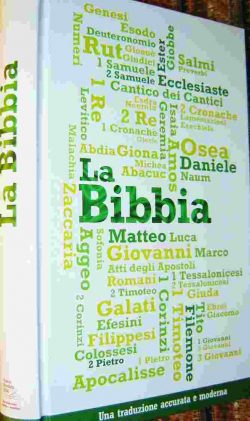
La Sacra Bibbia Nuova Riveduta 2006
Una traduzione accurata e moderna
La versione Nuova Riveduta 2006 è una delle versioni bibliche più diffuse in Italia. Essa si presenta come una revisione della precedente edizione del 1994. La Nuova Riveduta è il frutto di un intenso lavoro di ricerca, di confronto sui testi ebraici e greci e di aggiornamento linguistico sulla base della versione Riveduta del 1924. Essa si colloca nella linea della tradizione del testo tradotto da Giovanni Diodati nel 1607 a Ginevra; allo stesso tempo se ne distingue sia per l’aggiornamento linguistico, sia per la revisione operata sulla base di quei manoscritti greci ed ebraici che non erano disponibili all’epoca del Diodati stesso.
Sito Web dell’editore: http://www.casadellabibbia.it
English
NEW REVISED 2006
an accurate and modern translation
The 2006 New Revised Version is a Bible translation that is widely used in Italy. It is a revision of the 1994 edition. The New Revised Version is the result of intensive linguistic research and translation, comparing the Hebrew and Greek texts and updating language based on the revised version of 1924. It follows the tradition of the 1607 Giovanni Diodati Geneva translation, but at the same time is distinguished by its revisions and updates based on Greek and Hebrew manuscripts that were not available in Diodati’s time.
Publisher’s website: http://www.casadellabibbia.it
IVP Bible Background Commentary, Old Testament
The unique commentary joins The IVP Bible Background Commentary: New Testament in providing historical, social and cultural background for each passage of the Old Testament. From Genesis through Malachi, this single volume gathers and condenses an abundance of specialized knowledge–making it available and accessible to ordinary readers of the Old Testament. Expert scholars John Walton, Victor Matthews and Mark Chavalas have included along with the fruits of their research and collaboration