
The New International Greek Testament Commentary: The First Epistle to the Corinthians
“WORK IN PROGRESS!”
(These are resources that are being developed. There is no release date. Pricing is subject to change.)
(These are resources that are being developed. There is no release date. Pricing is subject to change.)
DESCRIPTION
Series: The New International Greek Testament Commentary (NIGTC)
This superb volume in the New International Greek Testament Commentary series provides the most detailed, definitive, and distinctive commentary on 1 Corinthians available in English to date.
One of the world’s most respected Christian theologians, Anthony Thiselton here provides in- depth discussion of the language of 1 Corinthians, presents his own careful translation of the Greek, traces the main issues of interpretation from the church fathers to the present, and highlights topics of theological, ethical, and sociohistorical interest today, including ethics and “rights,” marriage, divorce and remarriage, “headship,” gender, prophecy, and many others.
No other commentary on 1 Corinthians embodies the wealth and depth of detail presented in Thiselton’s work, which takes account of nearly all scholarly research on 1 Corinthians and incorporates substantial bibliographies throughout. In his commentary Thiselton indeed addresses virtually every question that thoughtful, serious readers — scholars, students, pastors, teachers — may wish to ask of or about the text of 1 Corinthians. His work truly offers a fresh, comprehensive, and original contribution to our understanding of this major epistle and its contemporary relevance.
Author:
Anthony C. Thiselton is professor emeritus of Christian theology at the University of Nottingham, England. His many other books include A Shorter Guide to the Holy Spirit, Systematic Theology, and Life after Death: A New Approach to the Last Things.
theWord Features:
- Verse popups
- Verse (span) synchronization
- Fully searchable text
- Footnotes
- Pages links
- Easy navigation of topics via topics tree display.
- Special Text Colors
- Normal: Text
- Hyperlink: Gen 3:15
- Page Number: [pg 21>
- Greek: σκανδάλων
- Hebrew: לבנות
The New International Greek Testament Commentary: The Book of Revelation
DESCRIPTION
This volume on Revelation is accessible and comprehensive. It provides an in-depth look at the parallels between images in the Apocalypse and their Old Testament and Jewish antecedents G.K. Beale’s painstaking anaylsis will help you better understand the obscure metaphors in Revelation and the purpose of the book itself.
Author:
G. K. Beale is J. Gresham Machen Chair of New Testament and professor of New Testament and biblical theology at Westminster Theological Seminary.
G. K. Beale is J. Gresham Machen Chair of New Testament and professor of New Testament and biblical theology at Westminster Theological Seminary.
theWord Features:
- Verse popups
- Verse (span) synchronization
- Fully searchable text
- Footnotes
- Pages links
- Easy navigation of topics via topics tree display.
- Special Text Colors
- Normal: Text
- Hyperlink: Gen 3:15
- Page Number: [pg 21>
- Greek: σκανδάλων
- Hebrew: לבנות
The New International Greek Testament Commentary: The Gospel of Matthew
“WORK IN PROGRESS!”
(These are resources that are being developed. There is no release date. Pricing is subject to change.)
(These are resources that are being developed. There is no release date. Pricing is subject to change.)
DESCRIPTION
Having devoted the past ten years of his life to research for this major new work, John Nolland gives us a commentary on the Gospel of Matthew that engages with a notable range of Matthean scholarship and offers fresh interpretations of the dominant Gospel in the history of the church.
Without neglecting the Gospel’s sources or historical background, Nolland places his central focus on the content and method of Matthew’s story. His work explores Matthew’s narrative technique and the inner logic of the unfolding text, giving full weight to the Jewish character of the book and its differences from Mark’s presentation of parallel material. While finding it unlikely that the apostle Matthew himself composed the book, Nolland does argue that Matthew’s Gospel reflects the historical ministry of Jesus with considerable accuracy, and he brings to the table new evidence for an early date of composition.
Including accurate translations based on the latest Greek text, detailed verse-by-verse comments, thorough bibliographies for each section, and an array of insightful critical approaches, Nolland’s Gospel of Matthew will stimulate students, preachers, and scholars seeking to understand more fully Matthew’s presentation of the gospel narrative.
Author:
John Nolland is academic dean and lecturer in New Testament studies at Trinity College, Bristol, England. An ordained minister of the Church of England, he is also the author of the three-volume Word Biblical Commentary on the Gospel of Luke.
theWord Features:
- Verse popups
- Verse (span) synchronization
- Fully searchable text
- Footnotes
- Pages links
- Easy navigation of topics via topics tree display.
- Special Text Colors
- Normal: Text
- Hyperlink: Gen 3:15
- Page Number: [pg 21>
- Greek: σκανδάλων
- Hebrew: לבנות
New International Commentary: The Book of Proverbs (2 vols.)
PRODUCT HIGHLIGHTS:
- Verse-by-verse commentary
- In-depth discussion of textual and critical matters
- Introductions to each book’s authorship, date, purpose, structure, and theology
- Detailed bibliography
DESCRIPTION
This collection includes the two volumes of Bruce Waltke’s study of Proverbs from The New International Commentary on the Old Testament
Volume 1
Over twenty-five years in the making, this much-anticipated commentary promises to be the standard study of Proverbs for years to come. Written by eminent Old Testament scholar Bruce Waltke, this two-volume commentary is unquestionably the most comprehensive work on Proverbs available.
Grounded in the literary criticism that has so strengthened biblical interpretation, Waltke’s commentary on Proverbs demonstrates the profound, ongoing relevance of this Old Testament book for Christian faith and life. A thorough introduction addresses such issues as text and versions, structure, authorship, and theology. The detailed commentary itself explains and elucidates Proverbs as “theological literature.” Waltke’s highly readable style—evident even in his original translation of the Hebrew text—makes his scholarly work accessible to teachers, pastors, Bible students, and general readers alike.
Volume 2
For the modern mind, the book’s cultural setting seems far removed from the twenty-first century. Proverbs puts a high priority on tradition and age, while the modern mind prizes change and youth. For Christians, Proverbs seems irrelevant. For the translator, Proverbs defies translations.
In the second part of his two-volume commentary, Waltke confronts these exegetical and interpretive challenges head on. This historico-grammatical commentary on Proverbs uncovers the profound philosophical and theological insights of this ancient book. Waltke helps readers understand the poetics used in its composition, and challenges modern prejudices toward the book.
….
Premium Feature: Full Bible Search Helper
Description:
This is still a work in progress feature and subject to change.
(Note: Premium Features are not needed to use theWord it still maintains existing functionality this just adds special extended features.)
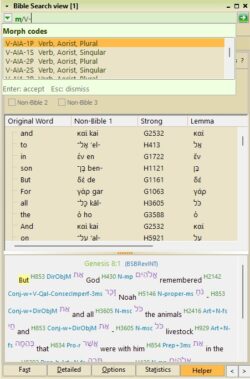
- Bible Background Indexer
- Indexes the Bibles to provide much internal data (Original Word, Strong, Lemma, Morphology). This is required for the use of the Inline Helper, Bible Search Helper.
- .morph files (May be included with their Bibles or this Premium feature (to decide)
- Used for Definitions of the Morphology code and Morphology Builder
- Bible View – Top translation words: for Bibles with Strong’s #/Lemma
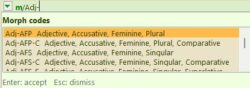
- Bible Search – inline helper (as you type it gives you a list of available terms.)
- Auto complete for Original Words (English, Hebrew, Greek, Main Text of the Bible)
- Auto complete for Strongs (H#, G#)
- Auto complete for Lemma (Hebrew/Greek)
- Auto complete for Morphology with expanded definition (RMAC for NA28, BYZa, SBLGNT; WHMC for WHM 4.22; BHSMorphoogy for BHS5/ETCBC; BSB Morphology for BSBHebInt, BSBGrkInt, BSBRevInt; PMAC for lxx;
- Bible Search Helper (accessible via Helper tab in Bible Search)
- Tabs: (Dependent on what is supported in a Bible)
- Combined
- Filter for sorting with advanced sorting
- Column Toggles: Original Word, Strong, Lemma, Morphology, Switch Text 1..3, Non-Bible 1..3, Count
- Column Sorting
- Verse Preview
- highlight of hovered word
- Right Click to go to Verse
- Original Word
- Filter for sorting
- Columns: Key, Original Forms (OT, NT), Count
- Column Sorting
- Dictionary shown on Hover if activated.
- Word preview pane
- Double click to send to Bible search
- Strong’s #
- Filter for sorting
- Columns: Key, Top Words, Count
- Column Sorting
- Dictionary shown on Hover if activated.
- Word preview pane
- Double click to send to Bible search
- Morphology
- Filter for sorting
- Columns: Key, Top Words, Count
- Column Sorting
- Dictionary shown on Hover if activated.
- Word preview pane
- Double click to send to Bible search
- Morphology Builder
- Uses the .morph file to help with building morphology
- Part of speech check boxes for easy building of Morphology.
- Matching codes with definitions.
- Lemma
- Filter for sorting
- Columns: Key, Representative Forms, Count
- Column Sorting.
- Send to Lemma Family
- Dictionary shown on Hover if activated.
- Word preview pane
- Double click to send to Bible search
- Lemma Family
- Enter Lemma Root, Include all forms (substring match): Find Family
- Dictionary shown on Hover if activated.
- Double click to send to Bible search
- Syntax Validator
- Used for help you build good Bible Search syntax (may not stay in release)
- Headings
- Filter forsorting
- Columns: Key, Testament, Count
- Double Click to go to first verse occurence
- Right Click to go to a specific verse
- Footnotes
- Filter, Key, Testament, Count
- Double Click to go to first verse occurence
- Right Click to go to a specific verse
- Switch Text 1…3
- Filter for sorting
- Columns: Key, Testament, Count
- Word preview pane
- Non-Bible 1…3
- Filter for sorting
- Columns: Key, Testament, Count
- Word preview pane
- Preferences
- Settings for Bible Search Helper
New International Commentary: The Book of Isaiah (2 vols.)
PRODUCT HIGHLIGHTS:
- Verse-by-verse commentary
- In-depth discussion of textual and critical matters
- Introductions to each book’s authorship, date, purpose, structure, and theology
- Detailed bibliography
DESCRIPTION
This collection includes the two volumes of John N. Oswalt’s study of Isaiah from The New International Commentary on the Old Testament
Volume 1
The first of John N. Oswalt’s two-part study of the book of Isaiah for the NICOT series, this commentary on chapters 1–39 combines theological acumen, literary sensitivity, philological expertise, and historical knowledge to present a faithful and accurate reading of one of the Old Testament’s most important books.
In the introduction to this work, Oswalt considers Isaiah’s background, unity of composition, date and authorship, canonicity, Hebrew text, theology, and problems of interpretation, and he offers a select bibliography for further research. Oswalt also provides substantial discussions of several issues crucial to the book of Isaiah. He notes, for example, that scholars often divide Isaiah into three divisions, with chapters 1–39 addressing Isaiah’s contemporaries in the eighth century b.c., chapters 40–55 presupposing the exile of the sixth century, and chapters 56–66 presupposing the eventual return from exile. While taking this scholarship into account Oswalt defends the unity of the prophetic book and argues convincingly that the whole book can be attributed to the Isaiah of the eighth century.
The commentary proper, based on Oswalt’s own translation of the Hebrew text, provides pastors, scholars, and students with a lucid interpretation of the book of Isaiah in its ancient context as well as an exposition of its message for today.
Volume 2
The second of John N. Oswalt’s two-part study of the book of Isaiah for the NICOT series, this commentary provides exegetical and theological exposition on the latter twenty-seven chapters of Isaiah for scholars, pastors, and students who seek to know the perennial meaning of the text in contemporary terms.
Though Oswalt’s main introduction to Isaiah is found in his commentary on chapters 1–39, this second volume opens with an important discussion of scholarly debate over the unity/diversity of Isaiah. In this work Oswalt makes stronger his case for reading the entire book of Isaiah as written by a single author—a position not common in other recent commentaries. Oswalt’s work stands alone, then, as an attempt to take seriously Israel’s historical situation at the time chapters 40–66 were composed while also seeking to understand how these chapters function as a part of Isaiah’s total vision written in the late 700s or early 600s b.c.
Assuming the single authorship of Isaiah, the verse-by-verse commentary aims to interpret chapters 40–66 in light of the book as a whole. While not neglecting issues of historical criticism or form criticism, the commentary focuses mainly on the theological meaning of the text as indicated especially by the literary structure. Building on his earlier argument that the central theme of Isaiah is servanthood, Oswalt keeps readers focused on the character of Israel’s sovereign Redeemer God, on the blind servant Israel, and on the ultimate work of the Suffering Servant in whom the world can find its Savior.
….
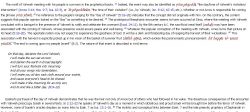
New International Commentary: The Book of Ezekiel (2 vols.)
PRODUCT HIGHLIGHTS:
- Verse-by-verse commentary
- In-depth discussion of textual and critical matters
- Introductions to each book’s authorship, date, purpose, structure, and theology
- Detailed bibliography
DESCRIPTION
This collection includes the two volumes of Daniel Block’s study of Ezekiel from The New International Commentary on the Old Testament
Volume 1
To many modern readers the prophecies of Ezekiel are a mystery. This commentary by Daniel Block—Part I of his two-volume study of the whole book of Ezekiel—seeks to answer the questions that contemporary readers bring to the text by examining the language, the message, and the methods of this obscure and often misunderstood Hebrew prophet. The result of twelve years of study, this volume provides an excellent discussion of the background of Ezekiel and offers a verse-by-verse exposition of each literary/prophetic unit in Ezekiel 1–24 that not only makes clear the prophet’s message to his original readers but also shows that Ezekiel’s ancient wisdom and vision are still very much needed by the church in the twenty-first century.
Volume 2
To many modern readers the prophecies of Ezekiel are a mystery. This commentary by Daniel Block—which completes his two-volume study of the whole book of Ezekiel—seeks to answer the questions that contemporary readers bring to the text by examining the language, the message, and the methods of this obscure and often misunderstood Hebrew prophet. The result of twelve years of study, this volume, like the one on chapters 1–24, provides an excellent discussion of the background of Ezekiel and offers a verse-by-verse exposition of each literary/prophetic unit in Ezekiel 25–48 that not only makes clear the prophet’s message to his original readers but also shows that Ezekiel’s ancient wisdom and vision are still very much needed by the church in the twenty-first century.
….
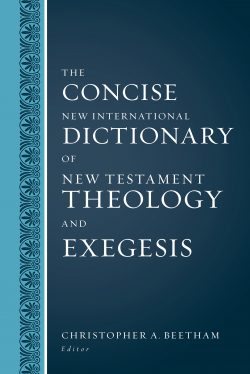
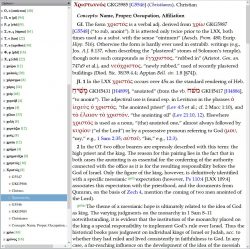
Concise New International Dictionary of New Testament Theology and Exegesis
DESCRIPTION
The Exegesis Quick-Reference Tool Every Pastor, Teacher, Student, and Scholar Needs
The Concise New International Dictionary of New Testament Theology and Exegesis (CNIDNTTE) by Christopher A. Beetham is a significant resource for those looking for a quick-reference guide to aid in exegesis and interpretation. It retains all the essentials of the monumental and magisterial New International Dictionary of New Testament Theology and Exegesis edited by Moises Silva, bringing together its most important elements into one accessible volume. This reference includes the most vital, relevant information needed to delve deep into the study of the Greek words used in Scripture for study of the New Testament–its texts and theology.
This volume offers a wealth of background and information on the meaning of Greek words in the New Testament, as well as related usage in classical Greek sources, the Greek Old Testament (Septuagint), and extrabiblical Second Temple Jewish literature. This significant tool offers the following features:
- All the nearly 800 entries covering over 3,000 Greek words found in the full edition are included and presented in the same order and arrangement
- Retains approximately 60 percent of the original edition, with the emphasis now on synchronic word study and usage in the Greek Old Testament, extrabiblical Second Temple literature, and especially the New Testament
- The unique arrangement according to Greek words and use of English concepts is retained from the full edition and allows all users to access Greek terms regardless of their level of competence in Greek.
- This edition retains the significant semantic-domain tool that directs the reader to all the Greek words that have something to do with a particular English word or concept. For example, under the English words “Resurrection,” there is a list of four Greek words that are related to that topic.
- Discussions reflect the latest in modern scholarship
- Bibliographies retain essential references to other standard lexicons and theological dictionaries
The Concise New International Dictionary of New Testament Theology and Exegesis is the ideal tool for pastors, Bible teachers, students, and scholars engaging in exegesis. It is packed with the essential information needed to study the New Testament.
There is a comparison below of this Concise version and the Full version here.
theWord Features:
- Dictionary topics
- Greek: εὐδόκησα
- Greek Transliteration: archon
- Strong’s Numbers: G25
- Concept(s): Love
- Verse popups
- Fully searchable text
- Footnotes
- Easy navigation of topics via topics tree display.
- Linked to Bible view via Lemma, Word, and Strong’s Numbers
- Special Text Colors
- Normal: Text
- Hyperlink: Glossary | Gen. 9:8
- Page numbers: [piix> | [p9>
- Strong’s Numbers: G25
- Greek Transliteration: archon
- Greek: εὐδόκησα
- Hebrew: יָרֵךְ
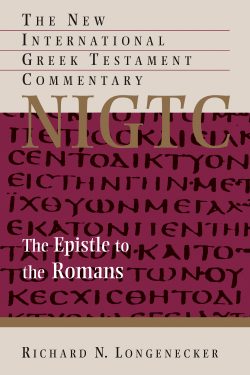
The New International Greek Testament Commentary: The Epistle to the Romans
DESCRIPTION
This highly anticipated commentary on the Greek text of Romans by veteran New Testament scholar Richard Longenecker provides solid scholarship and innovative solutions to long-standing interpretive problems. Critical, exegetical, and constructive, yet pastoral in its application, Longenecker’s monumental work on Romans sets a course for the future that will promote a better understanding of this most famous of Paul’s letters and a more relevant contextualization of its message.
Author:
Richard N. Longenecker (1930–2021) was a distinguished New Testament scholar who taught for many years at Wycliffe College, University of Toronto. He was the author of numerous books, including Paul, Apostle of Liberty; The Christology of Early Jewish Christianity; New Testament Social Ethics for Today; Introducing Romans: Critical Issues in Paul’s Most Famous Letter, and the New International Greek Testament Commentary volume on Romans.
theWord Features:
- Verse popups
- Verse (span) synchronization
- Fully searchable text
- Footnotes
- Pages links
- Index of Ancient Sources
- Easy navigation of topics via topics tree display.
- Special Text Colors
- Normal: Text
- Hyperlink: Gen 3:15
- Page Number: [pg 21>
- Greek: σκανδάλων
- Hebrew: לבנות
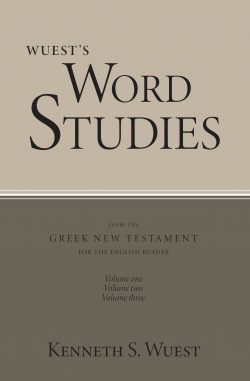
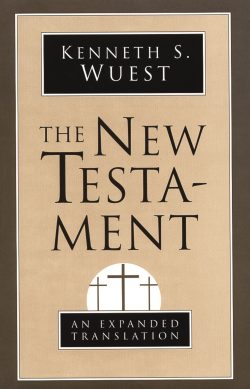
Package: Wuest Word Studies & New Testament Expanded Translation
Kenneth Wuest was a long time Greek teacher at Moody Bible Institute back in 1920’s, ‘30’s, 40’s, and 50’s. (Yeah – he taught almost 30 years). At that time, Moody was one of the leaders in both dispensationalism and fundamentalism.
When he started writing, it was his intent to bring the nuance of the Greek language out for the non-Greek speaking English reader. This reviewer thinks that he hits that mark pretty well.
His first book was entitled Treasures from the Greek New Testament for the English Reader. This was a collection of twelve essays (which became twelve chapters – imagine that!) that are topical. His second book was a commentary on 1Peter entitled First Peter in the Greek New Testament for the English Reader (do you see a common theme?). It is pleasantly verse by verse.
Over the course of his writing career, he wrote commentaries on Mark, Romans, Galatians, Ephesians, Philippians, Colossians, 1Timothy, 2Timothy, Hebrews, 1Peter, 2Peter, 1John, 2John, 3John, & Jude. [If you’re keeping score at home, that means he missed Matthew, Luke, John, Acts, 1Corinthians, 2Corinthians, 1Thessalonians, 2Thessalonians, Titus, Philemon, James, and Revelation.]
In addition to his commentaries, he also wrote six topical books – all revolving around word studies in the Greek New Testament.
 Theological Bias
I’ve already noted that Wuest is both dispensational and evangelical in his doctrinal outlook. I also mentioned that in the era he wrote, Moody was considered a fundamentalist institution. That’s good.
I would like to point out that Wuest was not a KJV lover. He served on the translation team that produced the NASB. He actually published an entire expanded translation of the New Testament. But as you might think with his NASB background, his own translation is based on the Nestle Greek text, and not the Textus Receptus (which is the text behind the KJV). Personal kudos for rejecting the ASV; but he was one of the early proponents within the fundamentalist movement to depart from the KJV. He makes no apologies for correcting “error” in the KJV. For this reason alone, I don’t recommend this resource to anyone not grounded in bibliology.
Entry Length
Again, please note that his NT commentary covers only 15 books of the NT (of 27 total books); but because he left off four of the five longest books in the NT, his commentary actually covers far less than 50% of it. However, where he does have comments, they are more than sufficient. For me, they are right in the sweet spot between “sufficient” and “verbose” (I guess I like ‘em a little longer than sufficient…).
I like to provide an example from Rom 3:24 in these reviews. So here is Wuest on Rom 3:24 –
QUOTATION BEGINS – “Freely” is dōrean [δωρεαν], “freely, for naught, gratis, gratuitously, without just cause.” “Grace” is Charis [Χαρις] which signified in classical authors a favor done out of the spontaneous generosity of the heart without any expectation of return. Of course, this favor was always done to one’s friend, never to an enemy. But when Charis [Χαρις] comes into the New Testament, it takes an infinite leap forward, for the favor God did at Calvary was for those who hated Him. It was a favor clone out of the spontaneous generosity of God’s heart of love with no expectation of return. There are no strings attached to grace. It is given dōrean [δωρεαν], gratuitously. Of course, grace in the form of salvation is so adjusted that the one who receives it, turns from sin to serve the living God and live a holy life, for grace includes not only the bestowal of a righteousness, but the inward transformation consisting of the power of indwelling sin broken and the divine nature implanted, which liberates the believer from the compelling power of sin and makes him hate sin, love holiness, and gives him the power to obey the Word of God.
This grace shown the believing sinner is made possible, Paul says through the redemption which is in Christ Jesus. “Redemption” is apolutrōseōs [ἀπολυτρωσεως], the verbal form of which is apolutroō [ἀπολυτροω], “to redeem by paying the lutron [λυτρον] price.” There are three words translated “redeem,” agorazō [ἀγοραζω], “to buy in the slave market” (1 Cor. 6:20; 7:23, 2 Pet. 2:1), Christ bought us in this slave market of sin by His own blood; believers are His bondslaves; exagorazō [ἐξαγοραζω], “to buy out of the slave market” (Gal. 3:13; 4:5), the redeemed are never to be put up for sale in any slave market again; and litroō [λιτροω], “to set free by paying a price” (Tit. 2:14, 1 Pet. 1:18): the believer is set free from sin and free to live a life pleasing to God in the power of the Holy Spirit. The redemption price, the precious blood of Jesus, makes it possible for a righteous God to justify a believing sinner on the basis of justice satisfied. This Paul proceeds to explain in the next two verses. – QUOTATION ENDS
This might be a little longer than his typical comment, but you get the flavor here of how he writes.
Language Skills Needed
Did you remember the ending phrase in his titles? “…for the English Reader.” While a little bit of Greek is helpful (he does use words like “aorist,” “imperfect,” “middle voice,” and even “pluperfect,”), he actually does a pretty good job of explaining the importance of each of those words in his exposition. So Greek is helpful, yes, but not essential in profiting from this work. HOWEVER: keep reading for more info on the necessity of language skills.
Academic Target
Wuest and I are going to disagree on this. His work; my review. Wuest would tell you that his target was the Bible disciple who wanted to know more about his English Bible by expanding all of the nuances of the Greek into English. Fair enough. I would tell you that Wuest does not like the KJV, believes there to be translation errors in it, and those errors are due to the KJV coming from a corrupt Greek text. Hmmm. I have a problem with that.
Some of his comments are based on the Nestle text, which differs regularly from the TR. A knowledge of Greek will be very helpful – especially to those expositors who, like me, use the KJV/TR. When he makes an argument based on the Nestle text, it will be very helpful to know what the TR instead says. So due to his theological bias, I don’t recommend this resource to anyone who is not clear in his stance on bibliology. I have it tagged above as “Pastoral” for this reason.
And Then There’s All This Topical Content
Let’s not forget that he wrote six topical books, totaling almost another 100 chapters. From a personal perspective, this will be a harder tool to use (how are you going to find his interesting comments on “crowns” in a topical presentation?). But the writing is just as good, even though it may be hard to find.
Contents Conclusion
I like Wuest very much, as a matter of fact. It is too bad he did not finish all of the NT Books. I wish he had. And with the above mentioned foibles in mind, I recommend the use of his writing to you. This is a DDT approved Good Resource.
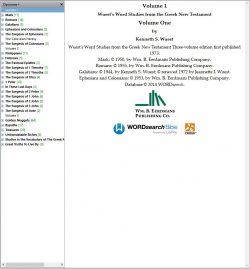
Wuest Word Studies in the Greek New Testament Vols 1-3
DESCRIPTION
These studies and translations of the Greek New Testament are simplified commentaries on the Greek text for the Bible student who is not conversant with the Greek language. The three-volume set includes commentaries on Mark, Romans, Galatians, Ephesians Colossians, Philippians, Hebrews, 1 Timothy, 2 Timothy, Titus, 1 Peter, 2 Peter, 1 John, 2 John, 3 John and Jude; graphic elucidations of selected passages, words, and phrases; and devotional studies on the teachings of Jesus and the apostles.
theWord Features
- Verse popups
- Fully searchable text
- Footnotes
- Easy navigation of topics via topics tree display.
- Special Text Colors
- Normal: Text
- Hyperlink: Luke 20:21
- Page Number: [pg 21>
- Greek: χρησις
- Hebrew: מֶ֫לֶךְ
- Transliterated Greek & Hebrew: euaggelion
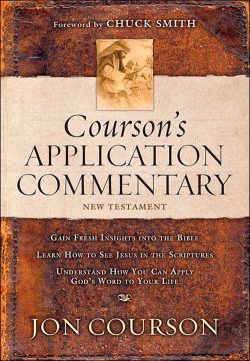
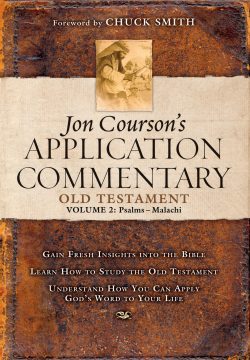
Package: Jon Courson’s Application NT & OT Commentaries
In a unique blend of pertinent information and inspiration, Jon Courson sheds light in a fresh way on the timeless truths of God’s Word. He has amassed a wealth of interesting topics in a very readable and comfortable expositional style. He combines thorough and comprehensive teaching of every paragraph of Scripture in the New Testament along with practical in-depth topical studies.
He has a unique ability to articulate the Bible’s truths with insight, focusing on valid life applications. This commentary is very useful for laymen as well as ministers of the gospel.
About the Author:
Jon Courson is one of the most exhilarating ministers today. In his unique style, Pastor Jon has written an Old Testament commentary that is a scholarly work, but is easy to read and makes practical applications for us in our daily walk with Jesus. This volume begins Jon Courson’s verse-by-verse commentary on the Old Testament. It is your opportunity to study the Bible with one of the great Bible teachers of our time.
See the excellent review below by DoctorDaveT
Basic Greek Package
DESCRIPTION
Intermediate Hebrew Package
DESCRIPTION
Introductory Study Package
DESCRIPTION
Strong’s Number Package
DESCRIPTION
The New International Greek Testament Commentary: The Gospel of Luke
(These are resources that are being developed. There is no release date. Pricing is subject to change.)
Series: The New International Greek Testament Commentary (NIGTC)
The Gospel of Luke was written, says its author, as an historical account of the ministry of Jesus. Not only would it serve as the basis for a sound faith on the part of professing Christians, but it would also claim a place for Christianity in history. Christ’s ministry, as Luke shows, is realized prophecy; it is that time during which God’s promise of salvation was fulfilled. His teachings, healing, and acts of compassion are all part of the good news. In Luke’s Gospel, Christ’s message of salvation is directed to the weak, poor, and needy, with an emphasis on the importance of self-denial and of whole-hearted discipleship. Thus, while Luke is the most conscious historian of the Gospel writers, his history is a vehicle of theological interpretation in which the significance of Jesus is expressed.
In this commentary I. Howard Marshall calls attention to the theological message of Luke the Evangelist. His primary purpose is to exegete the text as it was written by Luke, so that the distinctiveness of Luke’s Gospel may be seen.
Basing his commentary on the third edition of The Greek New Testament, Dr. Marshall also refers to many variant readings which are significant in this study. He provides fairly full information on the meanings of the Greek words used by Luke and shows which words and constructions occur frequently and are therefore characteristic of his style. It is by this meticulous analysis of the Greek that Luke’s theological intentions can be objectively determined.
Author:
I. Howard Marshall (1934–2015) was professor emeritus of New Testament exegesis and honorary research professor at the University of Aberdeen, Scotland. His many books include New Testament Theology: Many Witnesses, One Gospel and Beyond the Bible: Moving from Scripture to Theology.
theWord Features: