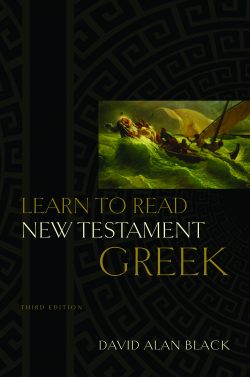
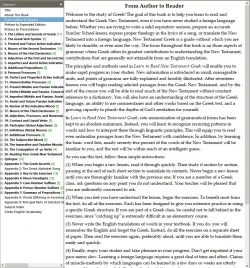
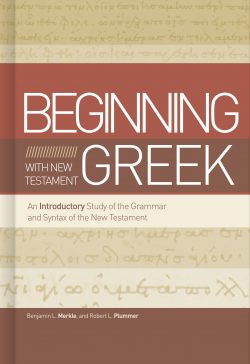
Welcome to the study of Greek! The goal of this book is to help you learn to read and understand the Greek New Testament, even if you have never studied a foreign language before. Whether you are trying to write a solid expository sermon, prepare an accurate Sunday School lesson, express proper theology in the lyrics of a song, or translate the New Testament into a foreign language, New Testament Greek is a guide without which you are likely to stumble, or even miss the way. The focus throughout this book is on those aspects of grammar where Greek offers its greatest contributions to understanding the New Testament, contributions that are generally not attainable from an English translation.
The principles and methods used in Learn to Read New Testament Greek will enable you to make rapid progress in your studies. New information is introduced in small, manageable units, and points of grammar are fully explained and lavishly illustrated. After seventeen lessons you will begin reading selected passages from the Greek New Testament, and by the end of the course you will be able to read much of the New Testament without constant reference to a dictionary. You will also have an understanding of the structure of the Greek language, an ability to use commentaries and other works based on the Greek text, and a growing capacity to plumb the depths of God’s revelation for yourself.
In Learn to Read New Testament Greek, rote memorization of grammatical forms has been kept to an absolute minimum. Instead, you will learn to recognize recurring patterns in words and how to interpret these through linguistic principles. This will equip you to read even unfamiliar passages from the New Testament with confidence. In addition, by learning the basic word lists, nearly seventy-five percent of the words of the New Testament will be familiar to you, and the rest will be within reach of an intelligent guess.
As you use this text, follow these simple instructions:
(1) When you begin a new lesson, read it through quickly. Then study it section by section, pausing at the end of each short section to assimilate its contents. Never begin a new lesson until you are thoroughly familiar with the previous one. If you are a member of a Greek class, ask questions on any point you do not understand. Your teacher will be pleased that you are sufficiently concerned to ask.
(2) When you feel you have understood the lesson, begin the exercises. To benefit most from the text, do all of the exercises. Each has been designed to give you extensive practice in using a specific Greek structure. If you are part of a Greek class, be careful not to fall behind in the exercises, since “catching up” is extremely difficult in an elementary course.
(3) Never write the English translations of words in your textbook. If you do, you will remember the English and forget the Greek. Instead, do all the exercises on a separate sheet of paper. Then read the exercises again, preferably aloud, until you are able to translate them easily and quickly.
(4) Finally, enjoy your studies and take pleasure in your progress. Don’t get impatient if your pace seems slow. Learning a foreign language requires a great deal of time and effort. Claims of miracle-methods by which languages can be learned in a few days or weeks are utterly irresponsible and unfounded. On the other hand, if you make proper use of your instruction, you will be surprised how rapidly you progress. By the end of the course, you will actually be reading your New Testament in the original Greek!










IVP Bible Background Commentary, New Testament 2nd Edition
DESCRIPTION
This revised edition of the standard reference work in its field has been expanded throughout to now provide even more up-to-date information by Craig Keener, one of the leading New Testament scholars on Jewish, Greek and Roman culture.
To understand and apply the Bible well, you need two crucial sources of information. One is the Bible itself. The other is an understanding of the cultural background of the passage you’re reading.
Only with the background can you grasp the author’s original concerns and purposes. This unique commentary provides, in verse-by-verse format, the crucial cultural background you need for responsible–and richer–Bible study. It includes a glossary of cultural terms and important historical figures, maps and charts, up-to-date bibliographies, and introductory essays about cultural background information for each book of the New Testament.
Based on decades of in-depth study, this accessible and bestselling commentary is valuable for pastors in sermon preparation, for Sunday-school and other church teachers as they build lessons, for missionaries concerned not to import their own cultural biases into the Bible, for college and seminary students in classroom assignments, and for everyday Bible readers seeking to deepen and enhance their study of Scripture.
THEWORD ENHANCEMENTS
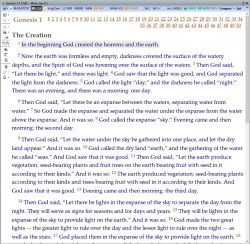
theWord version of this resource is enhanced for your convenience in a Hybrid-form module. It is a book, that acts more like a commentary. Bible passages can be syncronized so that the book follows along as you study verses and passages of the Bible. Most verse references have popups of the verse when hovered. Also Glossary words have links and popups to the Glossary for easy reference of terms marked with *.