
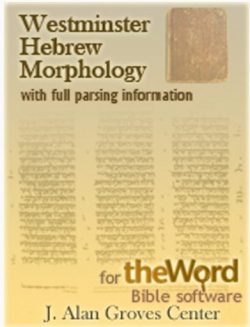
Groves-Wheeler Westminster Hebrew morphology
DESCRIPTION
Groves-Wheeler Westminster Leningrad Codex (WLC) with full parsing information. The complete text of the Hebrew Bible with the Groves-Wheeler Westminster Hebrew Morphology (version 4.22). Includes vowels, cantillation marks, lemmas and full grammatical analysis for each word.
This version allows searching on any feature of the text, including grammar, lemmas, notes, readings (ketiv/qere), homonyms, etc. You can search on consonants only or using vowels and accents. You can perform complex searches combining lemmas and grammar and even editor notes!
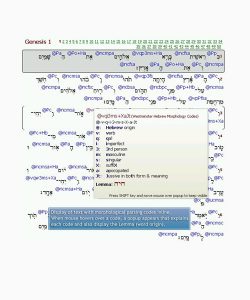
Grammar codes may appear inline with the text or you can completely hide them and have the full grammar information appear when you hover your mouse over the Hebrew words. Along with the Hebrew text, a dictionary provides a comprehensive guide to help you understand the grammar codes and gives a detailed analysis of each grammar tag.
Includes grammatical parsing, lemmas, vowels, cantillation marks, alternate readings (Qere/Ketiv), editor notes.
Schlachter Bibel 2000
It was the first German translation of the last century and was published for the first time in 1905. The Bible of the Swiss preacher Franz Eugen Schlachter (1859-1911) was first revised by the Swiss pastors Linder and Kappeler in 1911 after his death. The second revision was made in 1951 by the Geneva Bible Society. It was a reworking of the original 1905 translation, no revision of the Linder and Kappeler edition.
The renewed revision of the slaughtering Bible of 1951 was commissioned by the Geneva Bible Society in 1995 and published as “Schlachter 2000”. Members of this revision were initially responsible for the direct editing of texts by Rudolf Ebertshäuser (editor), Peter Toscan (coordinator), Karl-Hermann Kauffmann (revision director), and for the New Testament by Professor Herbert Jantzen (Grundtextspezialist Altgriechisch) Liebi (Grundtextspezialist Hebrew) and Dr. Martin Heide (Grundtextspezialist Hebrew). As a rule, the commission was convened on Saturdays in the Freie Brüdergemeinde in Albstadt. Additional employees were, among other things, for the parallel positions Gottfried Maron, the former president of the Geneva Bible Society, with his own team and, in time, Gottfried Wüthrich, The former secretary secretary of the Geneva Bible Society, for the tangents to the old butcher’s version. Electronic processing was carried out by the Free Brotherhood of Albstadt, Jürgen Oberwegner and Willi Welte, after the text of the slaughter-edition 1951 as a basis for processing by the Allgäuer communities around Erwin Keck had been recorded. When exchanging obsolete words, Wilfried Dabnar was involved in computer technology. Technical questions were coordinated by the then president of the Geneva Bible Society, Paul André Eicher. In 2003 the revision was completed after nine years of processing. The new revised slavery Bible uses exclusively the basic texts of the Reformation, ie, the textus Receptus with its variants as a basis. For the tangents to the old butcher’s version. The electronic processing was carried out by the Free Brotherhood of Albstadt, Jürgen Oberwegner and Willi Welte, after the text of the slaughter-edition 1951 as a processing basis of the Allgäuer municipalities around Erwin Keck had been captured. When exchanging obsolete words, Wilfried Dabnar was involved in computer technology. Technical questions were coordinated by the then president of the Geneva Bible Society, Paul André Eicher. In 2003 the revision was completed after nine years of processing. The new revised slavery Bible uses exclusively the basic texts of the Reformation, ie, the textus Receptus with its variants as a basis. For the tangents to the old butcher’s version. The electronic processing was carried out by the Free Brotherhood of Albstadt, Jürgen Oberwegner and Willi Welte, after the text of the slaughter-edition 1951 as a processing basis of the Allgäuer municipalities around Erwin Keck had been captured. When exchanging obsolete words, Wilfried Dabnar was involved in computer technology. Technical questions were coordinated by the then president of the Geneva Bible Society, Paul André Eicher. In 2003 the revision was completed after nine years of processing. The new revised slavery Bible uses exclusively the basic texts of the Reformation, ie, the textus Receptus with its variants as a basis. Jürgen Oberwegner and Willi Welte, after the text of the butcher’s edition 1951 as a basis for processing by the Allgäuer communities around Erwin Keck had been recorded. When exchanging obsolete words, Wilfried Dabnar was involved in computer technology. Technical questions were coordinated by the then president of the Geneva Bible Society, Paul André Eicher. In 2003 the revision was completed after nine years of processing. The new revised slavery Bible uses exclusively the basic texts of the Reformation, ie, the textus Receptus with its variants as a basis. Jürgen Oberwegner and Willi Welte, after the text of the butcher’s edition 1951 as a basis for processing by the Allgäuer communities around Erwin Keck had been recorded. When exchanging obsolete words, Wilfried Dabnar was involved in computer technology. Technical questions were coordinated by the then president of the Geneva Bible Society, Paul André Eicher. In 2003 the revision was completed after nine years of processing. The new revised slavery Bible uses exclusively the basic texts of the Reformation, that is, the Textus Receptus with its variants as a basis. Technical questions were coordinated by the then president of the Geneva Bible Society, Paul André Eicher. In 2003 the revision was completed after nine years of processing. The new revised slavery Bible uses exclusively the basic texts of the Reformation, ie, the textus Receptus with its variants as a basis. Technical questions were coordinated by the then president of the Geneva Bible Society, Paul André Eicher. In 2003 the revision was completed after nine years of processing. The new revised slavery Bible uses exclusively the basic texts of the Reformation, ie, the textus Receptus with its variants as a basis.
Publisher’s website: http://www.societebiblique.com/
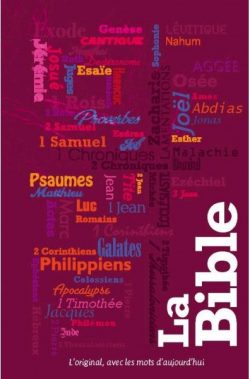
La Bible Segond 21
La version Louis Segond de la Bible est une des plus répandues dans le monde francophone. La Segond 21 est une nouvelle traduction de la Bible, éditée pour la première fois en 2007 par la Société Biblique de Genève, qui s’en inspire. Elle est le fruit de 12 ans de travail sur les textes hébreu, araméen et grec et tient compte des nouvelles informations à disposition. Son objectif ? Proposer une formulation française fidèle à la formulation originale, mais en français courant, d’où la formule «L’original, avec les mots d’aujourd’hui».theWord electronic version includes original Passage Headings and Footnotes.
Site Web de l’éditeur: http://www.societebiblique.com/
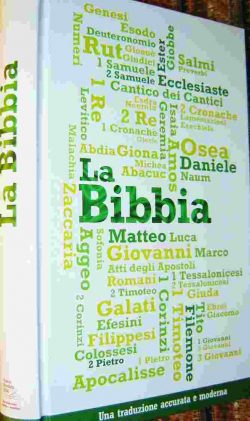
La Sacra Bibbia Nuova Riveduta 2006
Una traduzione accurata e moderna
La versione Nuova Riveduta 2006 è una delle versioni bibliche più diffuse in Italia. Essa si presenta come una revisione della precedente edizione del 1994. La Nuova Riveduta è il frutto di un intenso lavoro di ricerca, di confronto sui testi ebraici e greci e di aggiornamento linguistico sulla base della versione Riveduta del 1924. Essa si colloca nella linea della tradizione del testo tradotto da Giovanni Diodati nel 1607 a Ginevra; allo stesso tempo se ne distingue sia per l’aggiornamento linguistico, sia per la revisione operata sulla base di quei manoscritti greci ed ebraici che non erano disponibili all’epoca del Diodati stesso.
Sito Web dell’editore: http://www.casadellabibbia.it
English
NEW REVISED 2006
an accurate and modern translation
The 2006 New Revised Version is a Bible translation that is widely used in Italy. It is a revision of the 1994 edition. The New Revised Version is the result of intensive linguistic research and translation, comparing the Hebrew and Greek texts and updating language based on the revised version of 1924. It follows the tradition of the 1607 Giovanni Diodati Geneva translation, but at the same time is distinguished by its revisions and updates based on Greek and Hebrew manuscripts that were not available in Diodati’s time.
Publisher’s website: http://www.casadellabibbia.it

Bible Panorama
Part One: A work surveying the scenery of Scripture: Each chapter of each book of the Bible plainly summarised and explained;
Part Two: Enjoying the unhindered view with confidence including Practical topics about the Bible to help you trust and read it. Chapters on why the bible is trustworthy, how to read all of the bible, bible reading schemes, etc.
NET Bible, full notes edition
The NET Bible is a powerful new translation of the Bible (having 60,932 translators’ notes by experts in the original biblical languages). When you combine theWord Bible software program with this Bible, you can easily see the translator’s many notes by simply mousing over the translator’s note’s number, and the actual text will pop up. These translator’s notes are an excellent commentary for Bible students knowing Greek and Hebrew in that they point out the original words, how their underlying forms (grammatical structure) affects the translation of the verse. But at the same time, while this highly technical information is available for the experienced scholar, it is also very clear and understandable for the common Bible student as far as what it means. For example, the moods and tenses of Greek verbs often have comments when they reflect on the meaning of the text. This is very helpful and insightful to common Bible student.
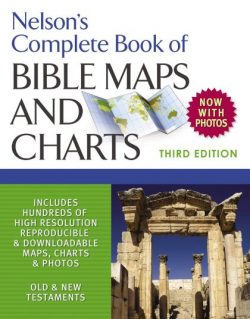
Nelson’s Complete Book of Bible Maps and Charts
Description
This updated edition of Thomas Nelson’s popular Complete Book of Bible Maps and Charts has everything you need to visualize the events, places, and people in the Old and New Testaments.
This updated edition of Thomas Nelson’s popular Complete Book of Bible Maps and Charts has everything you need to visualize the events, places, and people in the Old and New Testaments.
Perfect for small-group leaders, Bible school teachers, or if you’re simply curious about biblical times, Complete Book of Bible Maps and Charts provides a visual overview of the Bible in its entirety. Valuable resources include new, full-color, high-resolution maps and charts along with downloadable PDFs for presentations and classes; tables, charts, and diagrams that organize Bible information for ease of learning and memorization; historical articles providing insight into Bible times; and introductions to each book of the Bible.
An overview of the book from inside theWORD:
theWord Features:
- Illustrations
- Bible Maps
- Bible Charts
- Cross References
- Tables
- Surveys
Nelson’s Complete Book of Bible Maps and Charts has a lot of resources for the pastor, Bible teacher or the Sunday School teacher to help them in their preparations.
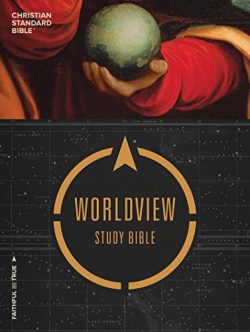
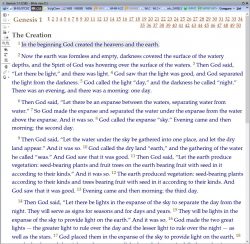
CSB Worldview Study Bible
The CSB Worldview Study Bible brings a fresh new approach to the study of Scripture with a focus on how the truths of the Bible impact one’s worldview. Features include extensive worldview study notes and articles by notable Christian scholars. Guided by general editors David S. Dockery and Trevin K. Wax, the CSB Worldview Study Bible is an invaluable resource and study tool that will help you to discuss, defend, and clearly share with others the truth, hope, and practical compatibility of Christianity in everyday life.
Features include:
- Extensive worldview study notes
- Over 150 articles by notable Christian scholars
- References
theWord special features included in Bible:
- Words of Christ in red (toggle key J)
- Popup footnotes (toggle key F)
- Verse per line and Poetry/Paragraph format (toggle key P)
- Headings (toggle key H)
- Commentary Links in Bible View, linked to Hybrid Notes Module (toggle key L)
- Old Testament quotes in bold (toggle key O)
- Cross-references built into Bible text. (toggle key X)
- Linked to accompanying Hybrid Notes Module via verse synchronization.
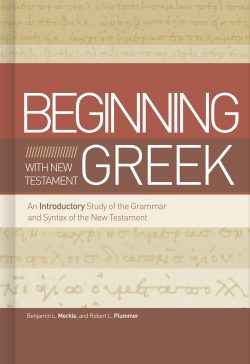
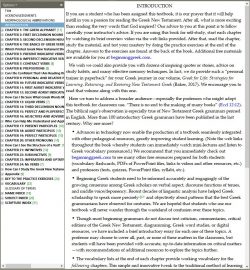
Beginning with New Testament Greek
DESCRIPTION
If you are a student who has been assigned this textbook, it is our prayer that it will help instill in you a passion for reading the Greek New Testament. After all, what is more exciting than reading the very words that God inspired? Our advice to you at this point is to follow carefully your instructor’s advice. If you are using this book for self-study, start each chapter by watching its brief overview video via the web links provided. After that, read the chapter, study the material, and test your mastery by doing the practice exercises at the end of the chapter. Answers to the exercises are found at the back of the book. Additional free materials are available for you at beginninggreek.com.
We wish we could also provide you with dozens of inspiring quotes or stories, advice on study habits, and many effective memory techniques. In fact, we do provide such a “personal trainer in paperback” for your Greek journey in our volume, Greek for Life: Strategies for Learning, Retaining, and Reviving New Testament Greek (Baker, 2017). We encourage you to read that volume along with this one.
Here we turn to address a broader audience—especially the professors who might adopt this textbook for classroom use. “There is no end to the making of many books” (Eccl 12:12). The biblical sage’s observation is especially true of New Testament Greek grammars penned in English. More than 100 introductory Greek grammars have been published in the last century. Why one more?
- Advances in technology now enable the production of a textbook seamlessly integrated with other pedagogical resources, greatly improving student learning. (Note the web links throughout the book whereby students can immediately watch mini-lectures and listen to Greek vocabulary pronounced.) We recommend that you immediately check out beginninggreek.comto see many other free resources prepared for both students (vocabulary flashcards, PDFs of PowerPoint files, links to videos and other resources, etc.) and professors (tests, quizzes, PowerPoint files, syllabi, etc.).
- Beginning Greek students need to be informed accurately and engagingly of the growing consensus among Greek scholars on verbal aspect, discourse functions of tenses, and middle voice/deponency. Recent decades of linguistic analysis have helped Greek scholarship to speak more precisely and objectively about patterns that the best Greek grammarians have observed for centuries. We are hopeful that students who use our textbook will never wander through the wasteland of confusion over these topics.
- Though most beginning grammars do not discuss text criticism, commentaries, critical editions of the Greek New Testament, diagramming, Greek word studies, or digital resources, we have included a brief introductory essay for each one of these topics. A professor may choose to cover all, part, or none of these matters in the classroom, but students will have been provided with accurate, up-to-date information on critical matters—with recommendations of additional resources to explore the topics further.
- The vocabulary lists at the end of each chapter provide working vocabulary for the followingchapters. This simple and innovative tweak to the traditional method of learning Greek vocabulary enables students to focus on new grammatical concepts without the distraction of learning many new words at the same time.
- Without sacrificing accuracy or essential detail, this textbook streamlines and consolidates essential Greek grammar into 24 chapters—giving professors maximum flexibility in choosing to cover the material in one or two semesters.
Though not original to our grammar, we also think the following features help increase its pedagogical effectiveness:
- Each chapter begins with a “significance” section—looking at specific text from the Greek New Testament that illustrates the meaning payoff of the new grammatical category that is being introduced.
- Chapters contain multiple practice exercises that isolate specific new skills before applying them to translation sentences.
- All translation sentences come directly from the Greek New Testament—a great encouragement to students who are learning Greek in order to read the Bible more faithfully. If you find the exercises at the end of the chapter are taking your students too long, feel free to assign only a percentage of them.
- An answer key is provided in the back of the book, allowing students to check their work immediately.
We love seeing students ablaze with a passion to read, understand, believe, obey, enjoy, and teach the Greek New Testament. It is our prayer and hope that this textbook aids in igniting that fire in many hearts.
theWord Features
- Verse popups
- Fully searchable text
- Footnotes
- Pages links
- Easy navigation of topics via topics tree display.
- Glossary of terms
- Name Index
- Subject Index
- Scripture Index
- Special Text Colors
- Normal: Text
- Hyperlink: LXX| Luke 20:21
- Page Number: [p21>
- Greek: Καλλίμαχος
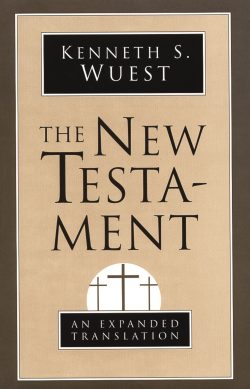
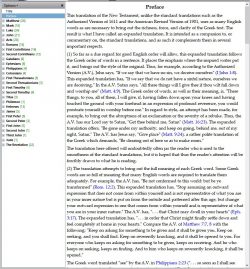
The New Testament An Expanded Translation by Kenneth Wuest (Commentary Style)
DESCRIPTION
This resource is laid out in a commentary style (in the book view NOT Bible view) format due to its expanded nature.
Unlike other versions of the New Testament, this translation uses as many English words as are necessary to bring out the richness, force, and clarity of the Greek Text. Intended as a companion to, or commentary on, the standard translations, Wuest’s “expanded translation” follows the Greek word order and especially reflects emphases and contrasts indicated by the original text.
theWord Features:
- Expanded Translation in Commentary format
- Verse popups
- Fully searchable text
- Footnotes
- Easy navigation of topics via topics tree display.
- Linked to Bible View
- Special Text Colors
- Normal: Text
- Hyperlink: Luke 20:21
- Greek: χρησις
- Transliterated Greek: euaggelion

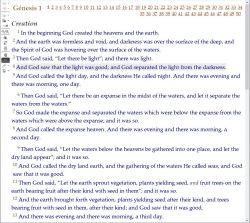
Legacy Standard Bible and Dictionary
DESCRIPTION
Bundle contents:
- LSB
- LSBHGD
In the history of English Bible translations, the King James Version is the most well-known. The time-honored version of 1611, itself a revision of the Bishops’ Bible of 1568, became the basis for the English Revised Version, which appeared in 1881 (New Testament) and 1885 (Old Testament). Its American counterpart, a product of both British and American scholarship, was published in 1901. Recognizing the values of the American Standard Version, The Lockman Foundation felt an urgency to preserve the ASV while incorporating recent discoveries of Hebrew and Greek textual sources and rendering it into more current English. This resulted in the New American Standard Bible, a translation based upon the time-honored principles of translation of the ASV and KJV, along with other linguistic tools and biblical scholarship.
The Legacy Standard Bible reflects another iteration of such preservation and refinement. Worked on by a core translation team in conjunction with pastors and educators from different countries, it is designed to honor, maintain, and advance the tradition represented by the NASB.
theWord Features
LSB
- Searchable text (via regular text and Strong’s Numbers)
- Strong’s Numbers
- Words of Jesus in Red
- Headings
- Paragraphs
- Cross references
- Footnotes
- Strong’s Numbers linked to LSBHGD Dictionary
LSBHGD Dictionary
(Dictionary is part of a bundle with the LSB, and cannot be purchased separately.)
- Fully searchable text
- Easy navigation via topics tree display.
- Strong’s Numbers
- Greek Lemmas
- Hebrew Lemmas
- Special Text Colors
- Normal: Text
- Usage: LSB Usage
- Hyperlink: G10
- Transliteration: Melek
- Hebrew: מֶלֶךְ
- Greek: κοδράντης
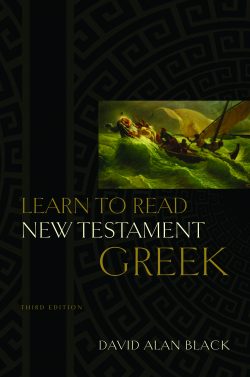
Learn to Read New Testament Greek
DESCRIPTION
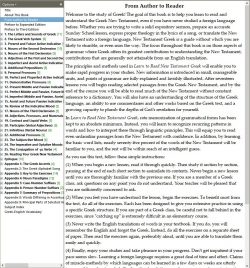
Welcome to the study of Greek! The goal of this book is to help you learn to read and understand the Greek New Testament, even if you have never studied a foreign language before. Whether you are trying to write a solid expository sermon, prepare an accurate Sunday School lesson, express proper theology in the lyrics of a song, or translate the New Testament into a foreign language, New Testament Greek is a guide without which you are likely to stumble, or even miss the way. The focus throughout this book is on those aspects of grammar where Greek offers its greatest contributions to understanding the New Testament, contributions that are generally not attainable from an English translation.
The principles and methods used in Learn to Read New Testament Greek will enable you to make rapid progress in your studies. New information is introduced in small, manageable units, and points of grammar are fully explained and lavishly illustrated. After seventeen lessons you will begin reading selected passages from the Greek New Testament, and by the end of the course you will be able to read much of the New Testament without constant reference to a dictionary. You will also have an understanding of the structure of the Greek language, an ability to use commentaries and other works based on the Greek text, and a growing capacity to plumb the depths of God’s revelation for yourself.
In Learn to Read New Testament Greek, rote memorization of grammatical forms has been kept to an absolute minimum. Instead, you will learn to recognize recurring patterns in words and how to interpret these through linguistic principles. This will equip you to read even unfamiliar passages from the New Testament with confidence. In addition, by learning the basic word lists, nearly seventy-five percent of the words of the New Testament will be familiar to you, and the rest will be within reach of an intelligent guess.
As you use this text, follow these simple instructions:
(1) When you begin a new lesson, read it through quickly. Then study it section by section, pausing at the end of each short section to assimilate its contents. Never begin a new lesson until you are thoroughly familiar with the previous one. If you are a member of a Greek class, ask questions on any point you do not understand. Your teacher will be pleased that you are sufficiently concerned to ask.
(2) When you feel you have understood the lesson, begin the exercises. To benefit most from the text, do all of the exercises. Each has been designed to give you extensive practice in using a specific Greek structure. If you are part of a Greek class, be careful not to fall behind in the exercises, since “catching up” is extremely difficult in an elementary course.
(3) Never write the English translations of words in your textbook. If you do, you will remember the English and forget the Greek. Instead, do all the exercises on a separate sheet of paper. Then read the exercises again, preferably aloud, until you are able to translate them easily and quickly.
(4) Finally, enjoy your studies and take pleasure in your progress. Don’t get impatient if your pace seems slow. Learning a foreign language requires a great deal of time and effort. Claims of miracle-methods by which languages can be learned in a few days or weeks are utterly irresponsible and unfounded. On the other hand, if you make proper use of your instruction, you will be surprised how rapidly you progress. By the end of the course, you will actually be reading your New Testament in the original Greek!
theWord Features
- Verse popups
- Fully searchable text
- Footnotes
- Section links
- Easy navigation of topics via topics tree display.
- Special Text Colors
- Normal: Text
- Hyperlink: §15| Luke 20:21
- Greek: Καλλίμαχος

Herziene Staten Vertaling
- Informatie Herziene StatenvertalingDe in 2010 verschenen Herziene Statenvertaling is een herziening van de aloude Statenvertaling uit 1637. Deze herziening is tot stand gekomen onder verantwoordelijkheid van het bestuur van de Stichting Herziening Statenvertaling, in opdracht van het hoofdbestuur van de Gereformeerde Bond. Het doel van deze herziening was om de huidige en komende generatie bij de Statenvertaling te bewaren. Er is dan ook naar gestreefd om door deze herziening de betrouwbaarheid te behouden en de verstaanbaarheid van de Statenvertaling te vergroten.De eerste editie van de Herziene Statenvertaling verscheen in 2010 en is herkenbaar in het colofon met de aanduiding: Tekst © 2010 Stichting HSV. Op de tekst zijn vele positieve reacties gekomen en allerlei suggesties gekomen van mensen die de tekst grondig hebben gelezen. Al die opmerkingen zijn verzameld en een werkgroep heeft gekeken welke reacties zouden kunnen worden doorgevoerd in de tekst en de voetnoten. De aangevulde editie is te herkennen aan het colofon: Tekst © 2010/2016 Stichting HSV.The Word Features:Deze tekst is met toestemming van Jongbloed Media omgezet voor het gebruik in The Word Bijbelsoftware met de volgende features:
- Headings | Koppen
- Footnotes | Voetnoten
- Cross References | Kruisverwijzing
Copyright:
Copyright © Stichting HSV 2010 / 2016
Colofon:
Tekst © 2010/2016 Stichting HSV.
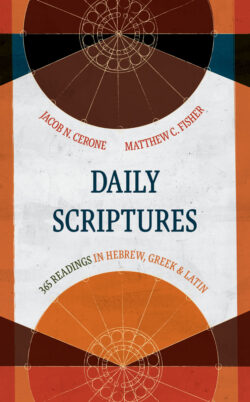
Daily Scriptures – 365 Readings in Hebrew, Greek, and Latin
DESCRIPTION
Pastors, students, and scholars not in the midst of language coursework often find it difficult to maintain their knowledge of biblical languages like Hebrew, Greek, and Latin. For those looking to do so in a meaningful but manageable way, this devotional offers 365 short daily readings, pairing an Old Testament passage in Hebrew and Greek with a corresponding New Testament passage in Greek and Latin. Lexical notes in English are included as a way of facilitating a comfortable reading experience that will build one’s confidence and ability in reading the Hebrew Bible, the Septuagint, the Greek New Testament, and the Latin Vulgate.
“Our goal and our purpose for this volume is to keep you in the languages, keep you fed in the Word, and hopefully spark a desire to explore more deeply how the New Testament at its core relies upon the Old Testament Scriptures.”
— from the introduction
theWord Features:
-
Devotional 365-day synchronization
-
Date and topic-tree navigation
-
Verse popups and Bible links
-
Fully searchable reading and note text
-
Exact single-footnote popups
-
Hebrew, Greek, and Latin source text
-
Native tables and images
-
Special Text Colors
-
Normal: Text
-
Bible link: Psalm 110:1
-
Greek: Εἶπεν ὁ κύριος τῷ κυρίῳ μου
-
Hebrew: נְאֻם יְהוָה לַאדֹנִי
-
Latin: qui cum sit splendor gloriae
-
Premium Feature: Inline Bible Search Helper
Description:
This is still a work in progress feature and subject to change.
(Note: Premium Features are not needed to use theWord it still maintains existing functionality this just adds special extended features.)
- Bible Background Indexer
- Indexes the Bibles to provide much internal data (Original Word, Strong, Lemma, Morphology). This is required for the use of the Inline Helper, Bible Search Helper.
- .morph files (May be included with their Bibles or this Premium feature (to decide)
- Used for Definitions of the Morphology code and Morphology Builder
- Bible View – Top translation words: for Bibles with Strong’s #/Lemma
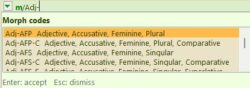
- Bible Search – inline helper (as you type it gives you a list of available terms.)
- Auto complete for Original Words (English, Hebrew, Greek, Main Text of the Bible)
- Auto complete for Strongs (H#, G#)
- Auto complete for Lemma (Hebrew/Greek)
- Auto complete for Morphology with expanded definition (RMAC for NA28, BYZa, SBLGNT; WHMC for WHM 4.22; BHSMorphoogy for BHS5/ETCBC; BSB Morphology for BSBHebInt, BSBGrkInt, BSBRevInt; PMAC for lxx;
- Preferences
- Settings for Inline Bible Search Helper
New International Version 2011 (NIV)
Getting the words right means being true to the original Greek, Hebrew, and Aramaic of the Bible. But it also means being true to the reader — capturing the Bible’s original meaning in natural, everyday English.
That’s what sets the NIV Bible apart. It doesn’t sacrifice precision for clarity or the other way around. It delivers both, all in a Bible translation you’ll love to read.
THE NIV IS…
ACCURATE
The NIV translators are united by their conviction that the Bible is God’s inspired Word. That, along with their years of studying biblical languages, helps them to capture subtle nuances and the depth of meaning in the Bible. (More)
CLEAR
If the first recipients understood God’s Word when they heard it, so should you. That’s the driving force behind the NIV’s commitment to clarity. The Bible should be every bit as clear to you as it was to its original audience. (More)
BEAUTIFUL
Bible reading isn’t just a solo exercise; it’s meant to be a shared experience. That’s why the NIV translators prioritize literary beauty, resulting in a Bible translation that’s suitable for public reading and use in churches. (More)
TRUSTWORTHY
The NIV is translated by an independent, self-governing team of Bible scholars. No publisher, commercial or otherwise (not even us!), can tell them how to translate God’s Word. The translators come from dozens of denominations and churches, and they can only make changes to the text if 70% of the committee agrees — safeguarding against theological bias. (More)
There are plenty of things to wrestle with in the Bible.
Your translation shouldn’t be one of them.
(taken from https://www.biblica.com/bible/niv-bible/)
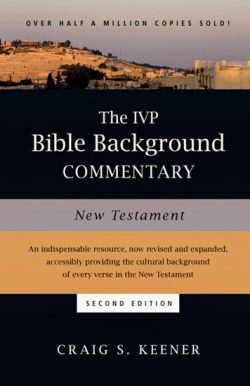
IVP Bible Background Commentary, New Testament 2nd Edition
DESCRIPTION
This revised edition of the standard reference work in its field has been expanded throughout to now provide even more up-to-date information by Craig Keener, one of the leading New Testament scholars on Jewish, Greek and Roman culture.
To understand and apply the Bible well, you need two crucial sources of information. One is the Bible itself. The other is an understanding of the cultural background of the passage you’re reading.
Only with the background can you grasp the author’s original concerns and purposes. This unique commentary provides, in verse-by-verse format, the crucial cultural background you need for responsible–and richer–Bible study. It includes a glossary of cultural terms and important historical figures, maps and charts, up-to-date bibliographies, and introductory essays about cultural background information for each book of the New Testament.
Based on decades of in-depth study, this accessible and bestselling commentary is valuable for pastors in sermon preparation, for Sunday-school and other church teachers as they build lessons, for missionaries concerned not to import their own cultural biases into the Bible, for college and seminary students in classroom assignments, and for everyday Bible readers seeking to deepen and enhance their study of Scripture.
THEWORD ENHANCEMENTS
theWord version of this resource is enhanced for your convenience in a Hybrid-form module. It is a book, that acts more like a commentary. Bible passages can be syncronized so that the book follows along as you study verses and passages of the Bible. Most verse references have popups of the verse when hovered. Also Glossary words have links and popups to the Glossary for easy reference of terms marked with *.
New International Commentary: The Epistles of John
PRODUCT HIGHLIGHTS:
DESCRIPTION
The three Epistles of John, according to I. Howard Marshall, are concerned with the fundamentals of Christian belief and life—faith and love. The reader who grasps the message of these short but essential letters will have a sound basis in Christian doctrine. This group of Epistles, says Marshall, is also a good starting point for the study of the Gospel of John. This important commentary, then, was written not only so that students of the Bible might master the content of John’s Epistles, but that they might come to a proper understanding of Johannine theology as a whole.
This volume includes an “invitation” to general readers and an “introduction” addressed to students and specialists. Another fresh feature is a rearrangement of the traditional order of the three letters: 2 John and 3 John are studied before 1 John. This structure assures that the two shorter letters are not relegated to the position of appendices but are treated as important documents of early Christianity in their own right.
See excerpt of NIC Epistles of John
….