
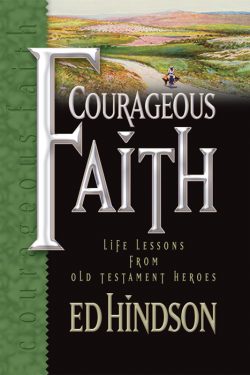
Courageous Faith: Life Lessons from Old Testament Heroes
DESCRIPTION
Obstacles* Battles* Weakness* Fears*
Learn to face life’s greatest challenges with courageous faith in the power of God.
Faith is the key that unlocks the power of God in our lives. It enables us to live by His promises and experience His blessings in our personal lives. In COURAGEOUS FAITH, Ed Hindson encourages us to live beyond the normal limits of life and experience the unlimited power of God on a regular basis. based on the lives of the Hebrews heroes of the Old testament, this exciting book challenges us to overcome our barriers, conquer our fears, realize our goals, and start over when we fail. Relive the greatest moments of faith and triumph in the lives of the men of God who dared to believe His promises in their lives.
This practical and powerful study is based on the lives of the Hebrew heroes who dared to believe that God keeps His promises
ABRAHAM The Journey of Faith SAMSON Making Them Your Strengths
JACOB Hanging Tough in the Tough Times BOAZ Especially those Who are Different
JOSEPH Starting Over When it All Falls Apart DAVID Confidence in the Face of Danger
MOSES Overcoming Your Past JONATHAN Value of True Loyalty
JOSHUA Conquering The Opposition DANIEL Developing Spiritual Determination
GIDEON Overcoming Your Fears NEHEMIAH Leaving a Legacy You Can Be proud Of
JEPHTHAH Even When it Costs You
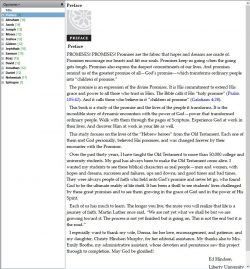
theWord Features:
- Verse popups (Nehemiah 9:1)
- Fully searchable text
- Easy navigation of topics via topics tree display.
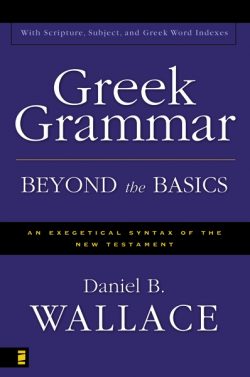

Greek Grammar Beyond the Basics
DESCRIPTION
The first textbook that systematically links syntax and exegesis of the New Testament—perfect for students of Greek who are “second-year” or at an intermediate level.
For seminary students, the goal of studying Greek grammar in the first place is to ultimately get beyond the grammar itself and understand it well enough to use it in the accurate exegesis of biblical texts.
Greek Grammar Beyond the Basics—the most up-to-date Greek grammar available—integrates the technical requirements for proper Greek interpretation with the actual interests and needs of Bible students. It explores numerous syntactical categories, some of which have not previously been dealt with in print, and has a number of distinguishing features, including:
Exegetically significant illustrations, discussed in depth.
Semantic situations—or contexts for simple semantics—are developed and analyzed.
Expanded definitions and numerous examples and syntactical categories.
Grammatical statistics listed at the beginning of major sections.
Scores of charts, tables, and graphs.
Sound exegesis requires that the exegete consider grammar within a larger framework that includes context, lexeme, and other linguistic features. This textbook faithfully equips intermediate Greek students with the skills they need to do exegesis of biblical texts in a way that is faithful to their intended meaning.
The expanded edition contains a subject index, a Greek word index, and page numbers in the Syntax Summary section.
About the Author
Daniel B. Wallace (PhD, Dallas Theological Seminary) is professor of New Testament at Dallas Theological Seminary. He is a noted textual critic, serving as head of the Center for the Study of New Testament Manuscripts, and is author of Greek Grammar beyond the Basics, Basics of New Testament Syntax, and (with Grant Edwards) of A Workbook for New Testament Syntax.
theWord Features:
- Verse popups
- Fully searchable text
- Footnotes
- Page Number: [pg21>
- Page links in index
- Easy navigation of topics via topics tree display.
- Greek words index
- Subject index
- Verse page index
- Syntax Summaries
- Cheat Sheet
- Special text colors
- Normal: Text
- Hyperlink: Luke 20:21
- Greek: χρησις
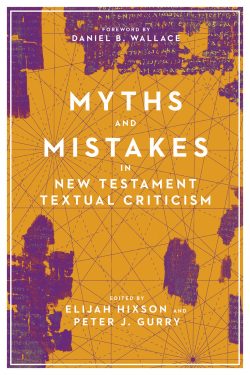
Myths and Mistakes in New Testament Textual Criticism
DESCRIPTION
Since the unexpected popularity of Bart Ehrman’s bestselling Misquoting Jesus, textual criticism has become a staple of Christian apologetics.
Ehrman’s skepticism about recovering the original text of the New Testament does deserve a response. However, this renewed apologetic interest in textual criticism has created fresh problems for evangelicals. An unfortunate proliferation of myths, mistakes, and misinformation has arisen about this technical area of biblical studies.
In this volume Elijah Hixson and Peter Gurry, along with a team of New Testament textual critics, offer up-to-date, accurate information on the history and current state of the New Testament text that will serve apologists and Christian students even as it offers a self-corrective to evangelical excesses.
Around 367 pages.
theWord Features
- Verse popups
- Fully searchable text
- Footnote(s)
- Easy navigation of topics via topics tree display.
- Special Text Colors
- Normal: Text
- Pages: [p1>
- Hyperlink: Link | Jn 3:36
- Greek: λογος
- Hebrew: א
- Sahidic: аϥϯпЄЧОУОЄІ ЄРОЧ
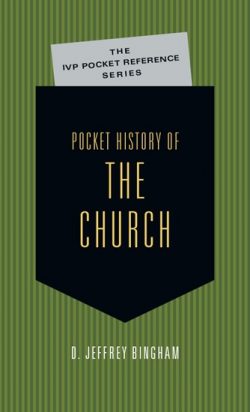
Pocket History of the Church
DESCRIPTION
The story of Christianity is a fascinating tale. Here we find drama, vision and expansion along with failure, setbacks and tragedy. Yet during the past two thousand years the power of Jesus is felt throughout the interplay of human actors and the forces of world events.
How can you grasp the story played out on such a gigantic stage? This book is an ideal place to start. D. Jeffrey Bingham has skillfully selected the key people and episodes to tell a grand and humbling story. From Roman persecution to the early creeds, from the monastic movement to the Reformation, from the rise of liberalism to missionary expansion, he chronicles the ups and downs of a people and a faith.
This pocket history has been crafted for students, pastors and other busy people who want an informed, clear and concise presentation that feeds the mind and moves the heart. It is an account that nurtures the Christian virtues of faith, hope and love. For Bingham aims not only to uncover the treasures of the church’s past but also to show how history aids your own spiritual journey today.
theWord Features
- Verse popups
- Fully searchable text
- FootNote(s)
- Easy navigation of topics via topics tree display.
- Special Text Colors
- Normal: Text
- Hyperlink: Link
- Page Number: [pg1>
Pocket Dictionary of Christian Spirituality
DESCRIPTION
The Pocket Dictionary of Christian Spirituality is an A to Z introduction and resource for curious newcomers and novice students of spirituality. From our first call to Abba until we arrive at Zion, the heavenly Jerusalem, Don Thorsen charts the Christian spiritual pilgrimage through its many traditions, schools of thought, and tested practices.
Among the over 300 definitions you’ll find
- terms and ideas
- traditions and movements
- practices and rituals
- texts and theology
A reliable guide and launching pad for learning, the Pocket Dictionary of Christian Spirituality is a basic resource for the pilgrimage travel bag.
theWord Features
- Verse popups
- Fully searchable text
- Easy navigation of topics via topics tree display.
- Special Text Colors
- Normal: Text
- Hyperlink: Link | Jn 3:36
- Page Number: [pg1>
Pocket Dictionary of Biblical Studies
DESCRIPTION
So many words about the Word. The study of anything seems to generate its own special vocabulary, and biblical studies is no different. What’s more, it’s got nearly a two-thousand-year lead on you! How can you catch up? Here is the answer!
If you are puzzled by parataxis or rankled by recensions, the Pocket Dictionary of Biblical Studies is the companion you need. Whether you are studying Old Testament or New Testament or both at once, this little book is your private tutor, your ever-ready guide to over three hundred biblical-studies terms. Here’s your glossary for reading course textbooks, your decoder for listening to lectures, your review sheet for cramming for finals and your “help” key for writing research papers.
Among the more than 300 terms defined you’ll discover
- types of biblical criticism, from genre criticism to tradition criticism
- Greek and Latin terms, from agrapha to vaticinium ex eventu
- German terms, from Frühkatholizismus to Wissenschaft
- ancient texts, from Aleppo Codex to Zadokite Document
- literary features, from acrostic to woe oracle
- theories, from the Augustinian hypothesis to the Yahwist source
- textual criticism terms, from codex to Western text
Written by Arthur G. Patzia and Anthony J. Petrotta, two biblical studies professors who know what you need to know, Pocket Dictionary of Biblical Studies will be your essential guide into a fascinating world of understanding.
theWord Features
- Verse popups
- Fully searchable text
- Easy navigation of topics via topics tree display.
- Special Text Colors
- Normal: Text
- Hyperlink: Link | Jn 3:36
- Greek: λογος
- Hebrew: א
Pocket Dictionary of Theological Terms
DESCRIPTION
Beginning to study theology is like stepping into a conversation that has been going on for two thousand years.
How do you take part in this conversation–or even make sense of it–if you don’t understand the vocabulary or know the contributions made by other participants?
The Pocket Dictionary of Theological Terms is the perfect companion to your theological studies. Among its three hundred-plus definitions are
- English terms, from accomodation to wrath of God
- foreign terms, from a posteriori to via media
- theological movements and traditions, from the Alexandrian School to Wesleyanism
- theologians, from Anselm of Canterbury to Ulrich Zwingli
Here is an affordable and easily accessible resource for your theological readings, lectures and writing assignments. It’s a must-have for every beginning theological student!
theWord Features
- Verse popups
- Fully searchable text
- Easy navigation of topics via topics tree display.
- Special Text Colors
- Normal: Text
- Hyperlink: Link | Jn 3:36
Pocket Dictionary of Apologetics and Philosophy of Religion
DESCRIPTION
For philosophers, the pursuit of truth travels on precise definitions. For Christian apologists, the defense of the faith is founded on the defining Word. And for beginning students of either discipline, the difference between success and frustration begins with understanding the terms and ideas and identifying the thinkers and movements.
The Pocket Dictionary of Apologetics Philosophy of Religion is designed to be a companion to your study of these two related disciplines. Among its 300 entries are
- terms, from a posteriori to worldview
- apologists, from Abelard to Van Til
- philosophers of religion, from Alston to Wolterstorff
- movements, from analytic philosophy to voluntarism
- apologetic arguments, from the cosmological to the wager
- theologies, from Arminianism to Zoroastrianism
Here is an affordable and easily accessible “help key” for your readings, lectures, writing assignments and exam preparation. It’s a must-have study aid for any student who expects to cogitate on coherentism or ruminate on Ricouer.
theWord Features
- Verse popups
- Fully searchable text
- Easy navigation of topics via topics tree display.
- Special Text Colors
- Normal: Text |
- Hyperlink: Link | Jn 3:36
Pocket Guide to World Religions
DESCRIPTION
Have you ever wondered . . .
- what the red dot on an Indian woman’s forehead means?
- whether all Buddhist monks practice martial arts?
- if the Emperor of Japan is still considered a god?
Here is a concise, informative guide for anyone looking for answers to basic questions about the world’s varied religions. In short, incisive chapters, Winfried Corduan introduces readers to twelve of the world’s major religions, including Baha’i, Buddhism, Christianity, Confucianism, Daoism, Hinduism, Islam, Jainism, Judaism, Parsi, Shinto and Sikhism. For each, he offers brief descriptions of its name, numbers and distribution, key symbols, history, Scriptures, major beliefs, subgroups, worship practices, home practices, clothing, diet and calendar. Also included are even briefer descriptions of sixteen new religious movements and traditional or tribal religions.
This book is for students, pastors and other busy people who want the quick, bare-facts scoop on current religions.
theWord Features
- Fully searchable text
- Easy navigation of topics via topics tree display.
- Special Text Colors
- Normal: Text
- Hyperlink: Link
- Page Number: [pg1>
Advance Hebrew Package
DESCRIPTION
Pocket Dictionary of the Reformed Tradition
DESCRIPTION
Beginning to study Reformed theology is like stepping into a family conversation that has been going on for five hundred years. How do you find your bearings and figure out how to take part in this conversation without embarrassing yourself?
The Pocket Dictionary of the Reformed Tradition takes on this rich, boisterous and varied tradition in its broad contours, filling you in on its common affirmations as well as its family tensions. Here you will find succinct and reliable entries on
- Latin terms, such as ad fontes and sola fide
- Theologians, from Calvin to Torrance
- Confessions, such as the Belgic and Westminster
- Doctrines, such as atonement and sanctification
- Apologists, such as Francis Schaeffer and Cornelius Van Til
And much more.
The Pocket Dictionary of the Reformed Tradition is ready to assist you over the rough parts of readings, lectures, conversations and blogs. It will also be a companionable and concise introduction to one of the great Christian traditions.
theWord Features
- Verse popups
- Fully searchable text
- Easy navigation of topics via topics tree display.
- Special Text Colors
- Normal: Text
- Hyperlink: Link
Pocket Dictionary for the Study of New Testament Greek
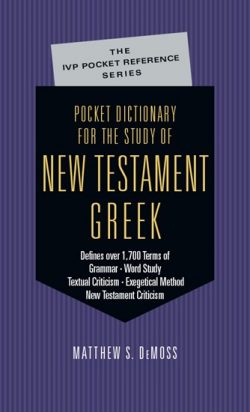
DESCRIPTION
If you are beginning your study of New Testament Greek or Greek exegesis, this book is for you!
From ablative to zeugma, it defines the tangled terms that infest Greek textbooks, grammars and lexicons.
Here is the book to deliver you from late-night ponderings of the predicate and frantic fumings over the fricative. It is the indispensable lexicon to that third language that is neither Greek nor recognizable English: the technical vocabulary of grammarians, lexicographers, linguists and Greek instructors. What’s more, this pocket dictionary gives you the inside edge on the terminology of exegesis, textual criticism and biblical criticism.
Careful definitions, helpful examples and copious cross-references make this economically priced, brief dictionary easy to use. And its convenient size will make it a constant companion in your study of the Greek New Testament.
theWord Features
- Verse popups
- Fully searchable text
- FootNote(s)
- Easy navigation of topics via topics tree display.
- Special Text Colors
- Normal: Text
- Hyperlink: Link
- Page Number: [pg1>
- Greek: λογος
- Hebrew: א
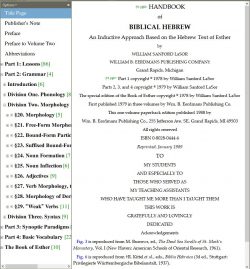
Handbook of Biblical Hebrew
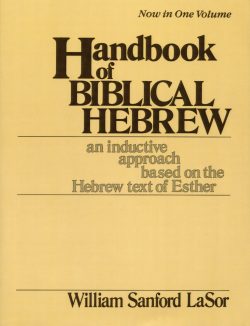
DESCRIPTION
The Handbook, designed as a complete tool for the student of Biblical Hebrew, is the result of over twenty- five years of teaching the language. While it is primarily intended for use in Hebrew courses, it is also an excellent tool for a refresher course or useful as a basic grammatical reference work to aid the exegete. Similar in format to the author’s Handbook of New Testament Greek, it combines reading lessons (vol. 1) with grammar, paradigms, and basic vocabulary (vol. 2). William LaSor uses the inductive method, studying directly from the text, rather than the conventional method of language study in which beginning students learn the rules of grammar and syntax and memorize vocabulary, often without reading the actual text. Instead of memorizing numerous forms that will never be encountered in actual reading, the student learns only what he or she encounters.
The lessons are based on the Hebrew text of Esther, chosen because it presents little difficulty in theological or textual matters and has an excellent vocabulary. LaSor has included readings from other portions of the Bible, such as several chapters from Genesis, to introduce the student to Hebrew other than that found in Esther.
The diligent student of this method will learn not only the elements of Hebrew but also how to inductively study the language and how to learn by induction what the Hebrew text says.
theWord Features
- Verse popups
- Fully searchable text
- FootNotes
- Easy navigation of topics via topics tree display.
- Hebrew Lemmas: אָב
- Special Text Colors
- Normal: Text
- Hyperlink: §11.325| Esther 1:2BHS
- Page Number: [v2 pg1>
- Latin: plene
- Transliteration: bay-yā-mîym
- Hebrew: בַּיָּמִ֖ים
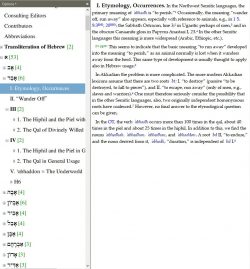
Theological Dictionary of the Old Testament, Volumes 1 – 17
DESCRIPTION
Series Editors: G. Johannes Botterweck, Helmer Ringgren, Heinz-Josef Fabry
This multivolume work is still proving to be as fundamental to Old Testament studies as its companion set, the Kittel-Friedrich Theological Dictionary of the New Testament, has been to New Testament studies.
Beginning with ‘ābh (‘āb), “father,” and continuing through the alphabet, the TDOT volumes present in-depth discussions of the key Hebrew and Aramaic words in the Old Testament. Leading scholars of various religious traditions (including Roman Catholic, Lutheran, Reformed, Anglican, Greek Orthodox, and Jewish) and from many parts of the world (Denmark, France, Germany, Great Britain, Greece, Israel, Italy, the Netherlands, Norway, Sweden, Switzerland, and the United States) have been carefully selected for each article by editors Botterweck, Ringgren, and Fabry and their consultants, George W. Anderson, Henri Cazelles, David Noel Freedman, Shemaryahu Talmon, and Gerhard Wallis.
The intention of the writers is to concentrate on meaning, starting from the more general, everyday senses and building to an understanding of theologically significant concepts. To avoid artificially restricting the focus of the articles, TDOT considers under each keyword the larger groups of words that are related linguistically or semantically. The lexical work includes detailed surveys of a word’s occurrences, not only in biblical material but also in other ancient Near Eastern writings. Sumerian, Akkadian, Egyptian, Ethiopic, Ugaritic, and Northwest Semitic sources are surveyed, among others, as well as the Qumran texts and the Septuagint; and in cultures where no cognate word exists, the authors often consider cognate ideas.
TDOT’s emphasis, though, is on Hebrew terminology and on biblical usage. The contributors employ philology as well as form-critical and traditio-historical methods, with the aim of understanding the religious statements in the Old Testament. Extensive bibliographical information adds to the value of this reference work.
This English edition attempts to serve the needs of Old Testament students without the linguistic background of more advanced scholars; it does so, however, without sacrificing the needs of the latter. Ancient scripts (Hebrew, Greek, etc.) are regularly transliterated in a readable way, and meanings of foreign words are given in many cases where the meanings might be obvious to advanced scholars. Where the Hebrew text versification differs from that of English Bibles, the English verse appears in parentheses. Such features will help all earnest students of the Bible to avail themselves of the manifold theological insights contained in this monumental work.
Note: Print edition is 17 volumes.
Print pages/price per volume on 12/11/2021 from Eerdmans.com
Volume I: 501pgs, $66.50
Volume II: 508pgs, $75.00
Volume III: 483pgs, $66.50
Volume IV: 513pgs, $75.00
Volume V: 543pgs, $76.50
Volume VI: 513pgs, $76.50
Volume VII: 578pgs, $66.50
Volume VIII: 584pgs, $76.50
Volume IX: 589pgs, $76.50
Volume X: 616pgs, $76.50
Volume XI: 639pgs, $66.50
Volume XII: 636pgs, $67.50
Volume XIII: 677pgs, $79.50
Volume XIV: 726pgs, $84.50
Volume XV: 821pgs, $68.50
Volume XVI: 932pgs, $75.00
Volume XVII: 845pgs, $75.00
Total print pages: 10,704
Total print price: $1,248.50
theWord Features
- Verse popups
- Fully searchable text
- Footnotes
- Easy navigation of topics via topics tree display.
- Hebrew Lemmas: אָב
- Aramaic Lemmas: שׂגי
- Strong’s Numbers: H1
- Special Text Colors
- Normal: Text
- Hyperlink: lit | Luke 20:21
- Page Number: [v1 pg21>
- Latin: septuaginta
- Transliteration: môrāʾ
- Hebrew: אָב
- Aramaic: שׂגי
- Greek: σαμβύκη

Wuest Word Studies in the Greek New Testament Vols 1-3
DESCRIPTION
These studies and translations of the Greek New Testament are simplified commentaries on the Greek text for the Bible student who is not conversant with the Greek language. The three-volume set includes commentaries on Mark, Romans, Galatians, Ephesians Colossians, Philippians, Hebrews, 1 Timothy, 2 Timothy, Titus, 1 Peter, 2 Peter, 1 John, 2 John, 3 John and Jude; graphic elucidations of selected passages, words, and phrases; and devotional studies on the teachings of Jesus and the apostles.
theWord Features
- Verse popups
- Fully searchable text
- Footnotes
- Easy navigation of topics via topics tree display.
- Special Text Colors
- Normal: Text
- Hyperlink: Luke 20:21
- Page Number: [pg 21>
- Greek: χρησις
- Hebrew: מֶ֫לֶךְ
- Transliterated Greek & Hebrew: euaggelion
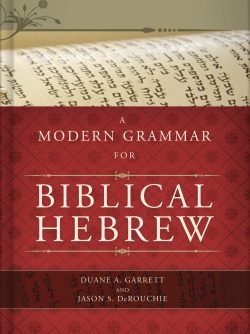
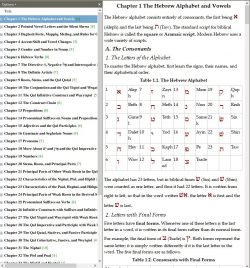
A Modern Grammar for Biblical Hebrew
DESCRIPTION
A Modern Grammar for Biblical Hebrew and its accompanying materials are designed for a two-semester course of study. The textbook’s structure, however, is intentionally set up to allow maximal use in both traditional and non-traditional academic settings. The format of the material gives instructors numerous options for customizing their syllabi.
theWord Features
- Verse popups
- Fully searchable text
- Footnotes
- Easy navigation of topics via topics tree display.
- Special Text Colors
- Normal: Text
- Hyperlink: LXX| Luke 20:21
- Page Number: [pg 21>
- Hebrew: מֶ֫לֶךְ
Package: Exploring the Bible
$159.50Original price was: $159.50.$95.70Current price is: $95.70. Add to cart