
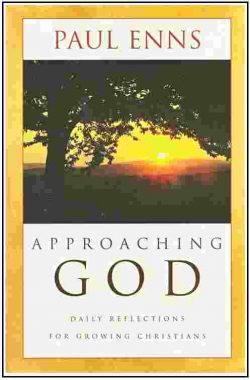
Approaching God
A year’s worth of devotional reading ideal for learning the basics of Christian doctrine. Covering the entire summary of basic Christian doctrine from bibliology to eschatology, Approaching God is organized systematically and divided into 365 portions for daily reading. Enns uses everyday illustrations and non-theology language, resulting in a highly readable and inviting format.
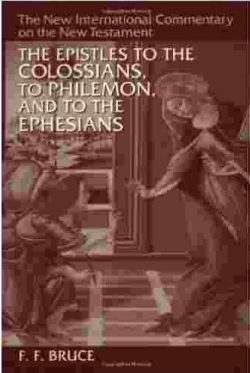
New International Commentary: The Epistles to the Colossians, to Philemon and to the Ephesians
PRODUCT HIGHLIGHTS:
- Verse-by-verse commentary
- In-depth discussion of textual and critical matters
- Introductions to each book’s authorship, date, purpose, structure, and theology
- Detailed bibliography
DESCRIPTION
This collection of three commentaries in one volume completes F. F. Bruce’s lifelong study of Paul’s writings. With the publication of this volume, Bruce—one of the most respected New Testament scholars in the world—finished writing commentaries on all the Pauline epistles except the Pastorals.
According to Bruce, there are important reasons for linking Colossians, Philemon, and Ephesians together in one work. The study of both Ephesians and Colossians, says Bruce, confirms his belief that Ephesians continues the line of thought followed in Colossians—in particular because it draws out the implications of Christ’s cosmic role (set forth in Colossians) for the church, which is his body. At the same time Ephesians constitutes the crown of Paulinism, gathering up the main themes of the apostle’s teaching into a unified presentation sub specie aeternitatis. The letter to Philemon, too, has a close association to Colossians, and is appropriately included in this volume.
….
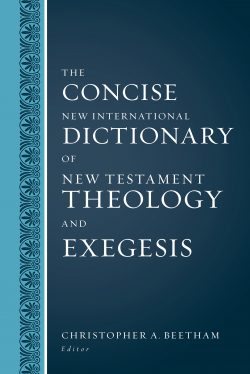
Concise New International Dictionary of New Testament Theology and Exegesis
DESCRIPTION
The Exegesis Quick-Reference Tool Every Pastor, Teacher, Student, and Scholar Needs
The Concise New International Dictionary of New Testament Theology and Exegesis (CNIDNTTE) by Christopher A. Beetham is a significant resource for those looking for a quick-reference guide to aid in exegesis and interpretation. It retains all the essentials of the monumental and magisterial New International Dictionary of New Testament Theology and Exegesis edited by Moises Silva, bringing together its most important elements into one accessible volume. This reference includes the most vital, relevant information needed to delve deep into the study of the Greek words used in Scripture for study of the New Testament–its texts and theology.
This volume offers a wealth of background and information on the meaning of Greek words in the New Testament, as well as related usage in classical Greek sources, the Greek Old Testament (Septuagint), and extrabiblical Second Temple Jewish literature. This significant tool offers the following features:
- All the nearly 800 entries covering over 3,000 Greek words found in the full edition are included and presented in the same order and arrangement
- Retains approximately 60 percent of the original edition, with the emphasis now on synchronic word study and usage in the Greek Old Testament, extrabiblical Second Temple literature, and especially the New Testament
- The unique arrangement according to Greek words and use of English concepts is retained from the full edition and allows all users to access Greek terms regardless of their level of competence in Greek.
- This edition retains the significant semantic-domain tool that directs the reader to all the Greek words that have something to do with a particular English word or concept. For example, under the English words “Resurrection,” there is a list of four Greek words that are related to that topic.
- Discussions reflect the latest in modern scholarship
- Bibliographies retain essential references to other standard lexicons and theological dictionaries
The Concise New International Dictionary of New Testament Theology and Exegesis is the ideal tool for pastors, Bible teachers, students, and scholars engaging in exegesis. It is packed with the essential information needed to study the New Testament.
There is a comparison below of this Concise version and the Full version here.
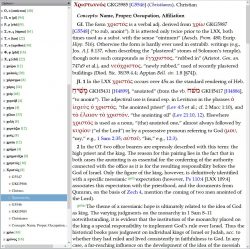
theWord Features:
- Dictionary topics
- Greek: εὐδόκησα
- Greek Transliteration: archon
- Strong’s Numbers: G25
- Concept(s): Love
- Verse popups
- Fully searchable text
- Footnotes
- Easy navigation of topics via topics tree display.
- Linked to Bible view via Lemma, Word, and Strong’s Numbers
- Special Text Colors
- Normal: Text
- Hyperlink: Glossary | Gen. 9:8
- Page numbers: [piix> | [p9>
- Strong’s Numbers: G25
- Greek Transliteration: archon
- Greek: εὐδόκησα
- Hebrew: יָרֵךְ
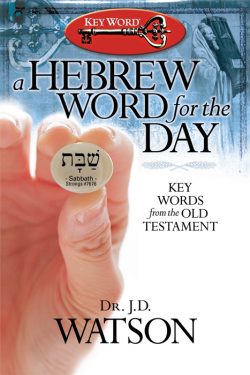
A Hebrew Word for the Day, Key Words from the Old Testament
DESCRIPTION
Unearth the wealth of treasures “buried” in the original language of Scripture! Watson’s 365-day devotional helps those who don’t know Hebrew achieve greater understanding of the Old Testament. Each entry includes a brief word study, a practical application for daily living, and related verses for further exploration. Includes Scripture, English, Hebrew, and Strong’s numbering indexes. The original volume is 384 pages, softcover from AMG, however this is a digital resource for theWord Bible Software.
Publisher’s Description
The purpose of A Hebrew Word for the Day is to share the richness of the Hebrew language words used in the Old Testament and help make them practical in the reader’s Christian living. Simply because words matter, the words of the Bible matter most. And in a day when words don’t seem to mean much, the need for precision in Christian doctrine and practice has never been more critical.
For each day of the year, Watson presents a brief word study and then offers an application to make that particular Hebrew word become real for practical living. To aid reinforcement, each day’s devotion ends with Scriptures for study to apply the truth learned that day.
Doc Watson fulfills his desire of many years to provide daily devotions that not only contain deep spiritual truth, but also are easy to read and understand. In our day of Relativism, the absolutes of God’s Word (and words) are desperately needed. These brief devotionals will enrich the mind, stir the soul, and empower the life of God’s people.
theWord Features:
- Devotional 366 daily sync
- Verse popups
- Fully searchable text
- Footnotes
- Easy navigation of topics via topics tree display.
- Scripture Index
- English Word Index
- Greek & Hebrew Word Index
- Strong’s Number Index
- Special Text Colors
- Normal: Text
- Hyperlink: H3845| Gen. 9:8
- Greek Transliteration: archon
- Hebrew Transliteration: YHWH
- Greek: εὐδόκησα
- Hebrew: יְהוָה
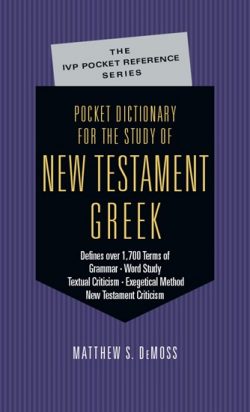
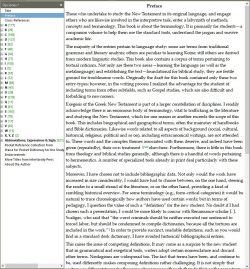
Pocket Dictionary for the Study of New Testament Greek
DESCRIPTION
If you are beginning your study of New Testament Greek or Greek exegesis, this book is for you!
From ablative to zeugma, it defines the tangled terms that infest Greek textbooks, grammars and lexicons.
Here is the book to deliver you from late-night ponderings of the predicate and frantic fumings over the fricative. It is the indispensable lexicon to that third language that is neither Greek nor recognizable English: the technical vocabulary of grammarians, lexicographers, linguists and Greek instructors. What’s more, this pocket dictionary gives you the inside edge on the terminology of exegesis, textual criticism and biblical criticism.
Careful definitions, helpful examples and copious cross-references make this economically priced, brief dictionary easy to use. And its convenient size will make it a constant companion in your study of the Greek New Testament.
theWord Features
- Verse popups
- Fully searchable text
- FootNote(s)
- Easy navigation of topics via topics tree display.
- Special Text Colors
- Normal: Text
- Hyperlink: Link
- Page Number: [pg1>
- Greek: λογος
- Hebrew: א
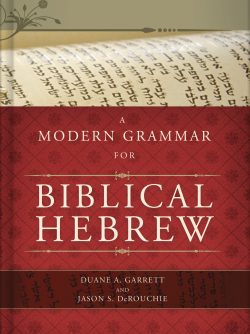
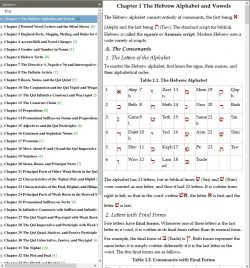
A Modern Grammar for Biblical Hebrew
DESCRIPTION
A Modern Grammar for Biblical Hebrew and its accompanying materials are designed for a two-semester course of study. The textbook’s structure, however, is intentionally set up to allow maximal use in both traditional and non-traditional academic settings. The format of the material gives instructors numerous options for customizing their syllabi.
theWord Features
- Verse popups
- Fully searchable text
- Footnotes
- Easy navigation of topics via topics tree display.
- Special Text Colors
- Normal: Text
- Hyperlink: LXX| Luke 20:21
- Page Number: [pg 21>
- Hebrew: מֶ֫לֶךְ
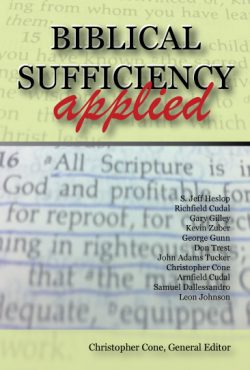
Biblical Sufficiency Applied
Description
God-breathed. Profitable. These two words Paul conveys in 2 Timothy 3:16 to describe the word of God. That the Text is God-breathed attests to its authority, and that it is profitable attests to its sufficiency. The authority of Scripture has no limit for the believer – in its pages God demands complete submission of His children. Likewise the sufficiency of Scripture reaches to the farthest corners of the believer’s position and practice.
Paul describes the purpose of Scripture’s inspiration: “that the man of God may be adequate, equipped for every good work” (2 Tim 3:17). God’s word is sufficient for the equipping of His people for the works He has planned for them (Eph 2:10). The divine prescriptions explain the believer’s course of action, oftentimes revealing the rationale for the action, and always pointing to the enablement needed and provided. In short, the true knowledge of Him provides everything pertaining to life and godliness (2 Pet 1:3).
As such, we can rely on Scripture in every area of life. We will find no topic out of bounds, and no subject so controversial as to be avoided or lacking illumination in the pages of the Bible. Biblical Sufficiency Applied is an effort on the part of its several contributors to consider certain areas of contemporary controversy in the light of Scripture. We hope and pray that God uses this work both to challenge and encourage the reader to seek the answers in Scripture, and to be confident in the Biblical record as sufficient for every aspect of the believer’s life.
theWord Features:
- Verse popups
- Fully searchable text
- Footnotes
- Easy navigation of topics via topics tree display.
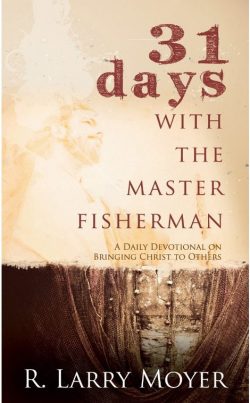
31 days with the Master Fisherman
Written in a one month, daily devotional format, this book will encourage all believers to join in the Great Commission to share the Good News.
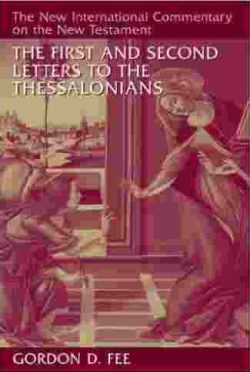
New International Commentary: The First and Second Epistles to the Thessalonians
PRODUCT HIGHLIGHTS:
- Verse-by-verse commentary
- In-depth discussion of textual and critical matters
- Introductions to each book’s authorship, date, purpose, structure, and theology
- Detailed bibliography
DESCRIPTION
In this commentary Gordon Fee aims first and foremost to offer a fresh exposition of the text of 1 and 2 Thessalonians. He shows the reader what is in the biblical text, what the text meant in the first century, and what it means now. Fee reveals the logic of each argument or narrative before moving on to the details of each verse, and he concludes each section with a theological-practical reflection on the meaning of the text today. Among other things, Fee explores the occasion for writing for each epistle, restoring 2 Thessalonians to the place it deserves as a full companion to the first letter, rather than merely a tagalong to 1 Thessalonians.
….
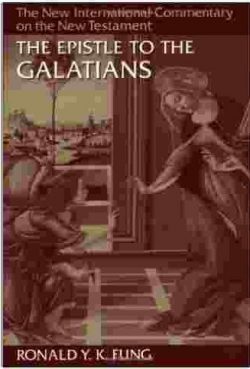
New International Commentary: The Epistle to the Galatians
PRODUCT HIGHLIGHTS:
- Verse-by-verse commentary
- In-depth discussion of textual and critical matters
- Introductions to each book’s authorship, date, purpose, structure, and theology
- Detailed bibliography
DESCRIPTION
This commentary by Ronald Y.K. Fung has been added to the NICNT series to address significant new questions regarding the study of Galatians that have arisen since the publication of Herman N. Ridderbos’s commentary—the original NICNT volume on Galatians—in 1953.
Begun under the mentorship of F.F. Bruce at the University of Manchester, England, Fung’s work on Galatians offers solid, reliable exposition of the text while also providing a fresh assessment of the large number of interpretive questions—past and present—raised by Paul’s letter. This work also examines Galatians specifically as Paul’s most direct defense and exposition of justification by faith, which Fung says is the central motif of Paul’s understanding of the Gospel.
….
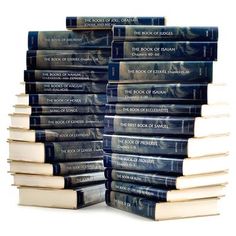
New International Commentary on the Old Testament (22 vols.)
PRODUCT HIGHLIGHTS:
- Verse-by-verse commentary
- In-depth discussion of textual and critical matters
- Introductions to each book’s authorship, date, purpose, structure, and theology
- Detailed bibliography
DESCRIPTION
This collection includes all of the volumes from The New International Commentary on the Old Testament to provide an exposition of Scripture that is thorough and abreast of modern scholarship, yet at the same time loyal to Scripture as the infallible Word of God. This conviction, shared by all contributors to The New International Commentary on the Old Testament, defines the goal of this ambitious series.
This decades-long project has become recognized by scholars, pastors, and serious Bible students as critical yet orthodox commentary marked by solid biblical scholarship within the evangelical Protestant tradition. The New International Commentary on the Old Testament serves as authoritative scriptural guides, bridging the cultural gap between today’s world and the Bible’s. Each volume in the NICOT aims to help us hear God’s word as clearly as possible.
Scholars, pastors, and serious Bible students will welcome the fresh light that this commentary series casts on ancient yet familiar biblical texts. The contributors apply their proven scholarly expertise and wide experience as teachers to illumine our understanding of the Old Testament. Gifted writers, they present the results of the best recent research in an interesting, readable, and thought-provoking manner.
Each commentary opens with an introduction to the biblical book in question, looking especially at questions concerning its background, authorship, date, purpose, structure, and theology. A select bibliography also points readers to resources for their own study. The author’s own translation from the original Hebrew and Greek texts forms the basis of the commentary proper. Verse-by-verse comments nicely balance the in-depth discussions of technical matters—such as textual criticism and critical problems—with exposition of the biblical writer’s theology and its implications for the life of faith today.
….
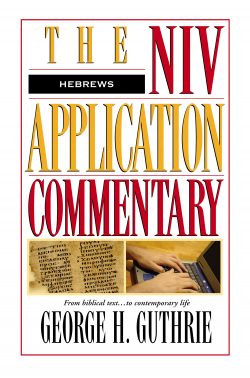
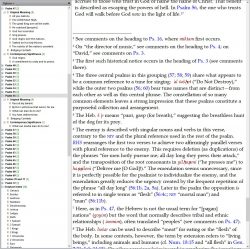
NIV Application Commentary: Hebrews
DESCRIPTION
The Bringing the Bible to Life provides an introduction to the biblical book, six to twelve sessions with discussion questions, and a closing section that assists the reader in responding to God’s Word in a group or individually.
8 Sessions on Hebrews Include:
-Pay Attention: Jesus is Great!
-Hang On: Jesus Is One of Us!
-Be Careful to Learn from the Past
-Draw Near Because We Have a Better Priest
-Encourage One Another, for God Is Faithful
-Keep Going: It Really Matters!
-Run the Race: The Torch Is Now Yours!
-Be Holy: God Will Be Pleased
Book Summary
The NIV Application Commentary helps readers with the vital task of bringing the ancient message of the Bible into a contemporary context. It gives preachers and teachers the tools, ideas, and insights they need to communicate God’s Word with the same powerful impact it had when it was first written.
About the Book
The NIV Application Commentary helps you communicate and apply biblical text effectively in today’s context.
To bring the ancient messages of the Bible into today’s context, each passage is treated in three sections:
- Original Meaning. Concise exegesis to help readers understand the original meaning of the biblical text in its historical, literary, and cultural context.
- Bridging Contexts. A bridge between the world of the Bible and the world of today, built by discerning what is timeless in the timely pages of the Bible.
- Contemporary Significance. This section identifies comparable situations to those faced in the Bible and explores relevant application of the biblical messages. The author alerts the readers of problems they may encounter when seeking to apply the passage and helps them think through the issues involved.
This unique, award-winning commentary is the ideal resource for today’s preachers, teachers, and serious students of the Bible, giving them the tools, ideas, and insights they need to communicate God’s Word with the same powerful impact it had when it was first written.
theWord Features:
- Verse popups
- Verse (span) synchronization
- Fully searchable text
- Footnotes
- Pages links
- Easy navigation of topics via topics tree display.
- Scripture Index
- Subject Index
- Special Text Colors
- Normal: Text
- Hyperlink: Glossary | Gen. 9:8
- Page Number: [pg 21>
- Greek Transliteration: archon
- Greek: εὐδόκησα
Note: Does not display commentary under Bible text.
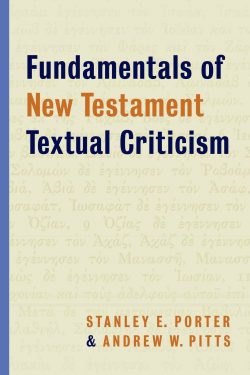
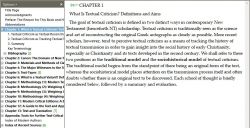
Fundamentals of New Testament Criticism
DESCRIPTION
theWord Features
- Verse popups
- Footnote popups
- Terms explained popups
- Fully searchable text
- Easy navigation via topics tree display.
- Special Text Colors
- Normal: Text
- Hyperlink: Nom | Rev. 7:12
- Page Number: [pg 21>
- Latin: exempli gratia
- Transliteration: ang-gelos
- Greek: σωμάτων
- Hebrew: א
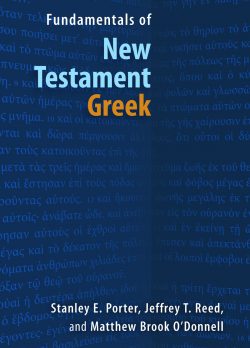
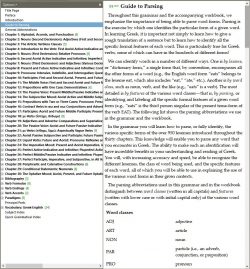
Fundamentals of New Testament Greek
DESCRIPTION
Request instructor resources
Get the workbook
“We know that this book works and will take students to a level not often achieved through other beginning textbooks.” So say Stanley Porter and his coauthors in the preface to their Fundamentals of New Testament Greek — an ambitious, comprehensive introduction to the grammar and vocabulary of the Greek New Testament.
This first-year Greek textbook discusses all the forms and basic syntax of Koine Greek, complete with extensive paradigms, examples, and explanations. Porter, Reed, and O’Donnell’s Fundamentals of New Testament Greek features pedagogically sound and linguistically informed techniques of language instruction. The volume introduces the individual words and grammatical details of Greek, sensitive to their frequency of use in the New Testament, reinforcing for students the elements that they will most often encounter. Grammatical forms, including the less common ones, are analyzed and explained in detail, often with illustrative examples from the Greek New Testament. The authors include complete paradigms and give numerous examples; the vocabulary list includes nearly one thousand words, which are introduced throughout the book’s thirty chapters.
Students who complete this text will be able to move directly into Greek exegesis courses and more advanced Greek-language courses. Fundamentals of New Testament Greek will prove invaluable for gaining a thorough foundational understanding of New Testament Greek, including full exposure to the formation, accenting, and semantics of its complex verbal system.
Read more about the book in a blog post by its editor, Craig Noll, on EerdWord.
theWord Features
- Verse popups
- Footnote popups
- Terms explained popups
- Fully searchable text
- Easy navigation via topics tree display.
- Lemmas (which can be used with Bibles that have Lemmas)
- Special Text Colors
- Normal: Text
- Hyperlink: Nom | Rev. 7:12
- Page Number: [pg 21>
- Latin: exempli gratia
- Transliteration: ang-gelos
- Greek: σωμάτων
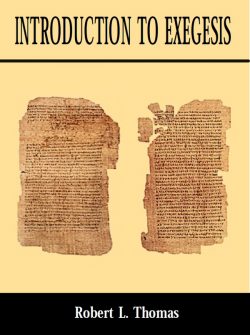
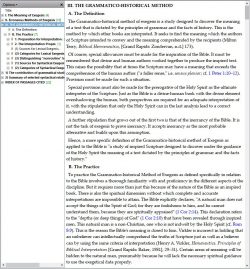
Introduction to Exegesis
Description
“Dr. Robert Thomas has written this very powerful introduction to exegesis. True biblical understanding and interpretation lies in solid biblical exegesis. This significant work goes to the very heart of the matter beginning with a very accurate meaning of biblical exegesis. Dr. Thomas takes the reader through a very systematic study of the grammatical-historical method. This book is highly recommended for any student of the Greek New Testament.”
David Olander, Ph.D, Th.D, Professor of Biblical Languages at Tyndale Theological Seminary & Biblical Institute (Ft. Worth, TX).
This wonderful resource includes a great deal of Greek Grammar content and includes the page numbers of, . . . “the work by H. E. Dana and Julius R. Mantey, A Manual Grammar of New Testament Greek (New York: Macmillan, 1957). . .” so it can be used side by side.
theWord Features:
- Verse popups
- Fully searchable text
- Footnotes
- Cited passages page links
- Easy navigation of topics via topics tree display.

People in the Bible: Elijah
Description
When Elijah lived in Israel in 900 BC, truth was being compromised and the people had departed from the worship of the one true God. It was a multi-faith society. There was immorality at the highest level. Toleration trumped truth. True prophets were being persecuted. It was much like Western society today. What can Christians do in such a spiritual and moral climate? Elijah is our great example and inspiration as we dare to contend for the truth, even taking on the religious establishment if necessary. What could be more timely or relevant for the Christian church at the present time?
theWord Features:
- Verse popups
- Fully searchable text
- Footnotes
- Easy navigation of topics via topics tree display.
People in the Bible: Abraham
Description
Abraham was called from a pagan background to become a spiritual catalyst in God’s plan for the salvation of the world. But what kind of man was he? The Bible describes several important experiences that he went through and how in most of them he revealed that he was the friend of God. Some of those experiences were pleasant for him, whereas others were very difficult. Yet in all of them he has left an example for those who, like him, are travelling to the city that God has prepared for those who love him.
In this book, Malcolm Maclean considers those events in the life of Abraham and explains their relevance for believers in Jesus today.
theWord Features:
- Verse popups
- Fully searchable text
- Footnotes
- Easy navigation of topics via topics tree display.
Hebrews a verse by verse commentary by John Cook
Description
John Cook was a true son of Texas. Born here in 1954, John grew up in a Christian family and was riding bulls in rodeos while still in high school. After graduation, John honorably served in the Army, in both South Korea and Germany. Following his enlistment in the Army, John returned to Texas, got married and moved to Oklahoma to work in the oil fields while raising a family.
John Cook was also a true, born again, child of God. He and his wife Pam raised their children in the church and it was during this period of his life that John started questioning some of the teachings coming from the pulpit in his church.
However, he did not feel qualified to debate these teachings with the pastor. This was when he decided it was time to go to Bible college.
John arrived at Tyndale Theological Seminary and Biblical Institute about six months after I did. As students, sharing many of the same classes, and as members of Seminary Bible Fellowship Church (later renamed Tyndale Bible Church), we quickly became friends. Little did we know that, together, we would pursue bachelors, masters, and doctoral degrees.
Throughout our course of studies, John took particular interest in the biblical languages and Latin. Tyndale has always emphasized the study of the original biblical languages: Hebrew, Aramaic and Greek, but John pursued additional studies past those required by his program, eventually taking, I believe, every language course offered, including those from guest lecturers.
His greatest love was biblical Greek, and during his course of studies, John started working at Tyndale as the school Registrar. After graduation he began teaching Greek and Theology to undergraduate, graduate, and seminary level students.
John rose to become Vice President of Tyndale Theological Seminary and, to help our educational efforts, moved with his wife, Pam, to Louisiana, where he established and oversaw a branch campus of Tyndale for a few years before he retired. He came back to Texas, but our Lord saw fit to take our brother to his heavenly home at the young age of 58.
It was during his years at Tyndale that John wrote this commentary on the book of Hebrews. Even to an excellent Greek exegete like John, the book of Hebrews presents its challenges, not the least of which is deciding on who the author was and to whom it was written: unsaved Jews, saved Jews, or a combination of both.
These were the types of challenges that John liked the most, and in this volume you will find an excellent commentary, worthy of your time, written by my friend and colleague, whom I look forward to seeing again!
Patrick E. Belvill
Hurst, Texas
“Now the God of peace, that brought again from the dead our Lord Jesus, that great shepherd of the sheep, through the blood of the everlasting covenant,
Make you perfect in every good work to do his will, working in you that which is wellpleasing in his sight, through Jesus Christ; to whom be glory for ever and ever. Amen.” Heb. 13:20-21
John Cook (1954-2012) was Vice President of Tyndale Theological Seminary and Biblical Institute and a Professor of Greek and Theology. He received his Bachelors (Dip.Th.S.), from Tyndale Biblical Institute and his Masters (M.T.S.), and Doctor of Theology (Th.D.), degrees from Louisiana Baptist Theological Seminary.
theWord Features:
Note: Does not display commentary under Bible text.