
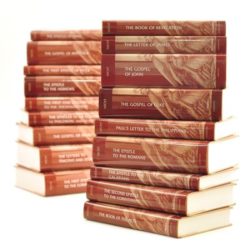
New International Commentary on the New Testament (18 vols.)
PRODUCT HIGHLIGHTS:
- Verse-by-verse commentary
- In-depth discussion of textual and critical matters
- Introductions to each book’s authorship, date, purpose, structure, and theology
- Detailed bibliography
DESCRIPTION
This collection includes all of the volumes from The New International Commentary on the New Testament to provide an exposition of Scripture that is thorough and abreast of modern scholarship, yet at the same time loyal to Scripture as the infallible Word of God. This conviction is shared by all contributors to The New International Commentary on the New Testament and defines the goal of this ambitious series.
This decades-long project has become recognized by scholars, pastors, and serious Bible students as critical yet orthodox commentary marked by solid biblical scholarship within the evangelical Protestant tradition. The New International Commentary on the New Testament serves as an authoritative guide to the text of Scripture, bridging the cultural gap between today’s world and the world of the Bible. Each volume in the NICNT aims to help us hear God’s word as clearly as possible.
Scholars, pastors, and serious Bible students will welcome the fresh light that this commentary series casts on ancient yet familiar biblical texts. The contributors apply their proven scholarly expertise and wide experience as teachers to illumine our understanding of the New Testament. As gifted writers, they present the results of the best recent research in an interesting, readable, and thought-provoking manner.
Each commentary opens with an introduction to the biblical book, looking especially at questions concerning its background, authorship, date, purpose, structure, and theology. A select bibliography also points readers to resources for their own study. The author’s own translation from the original Hebrew and Greek texts forms the basis of the commentary proper. Verse-by-verse comments nicely balance the in-depth discussions of technical matters—such as textual criticism and critical problems—with exposition of the biblical writer’s theology and its implications for the life of faith today.
….
New International Commentary on the Old and New Testament (40 vols.)
PRODUCT HIGHLIGHTS:
- Verse-by-verse commentary
- In-depth discussion of textual and critical matters
- Introductions to each book’s authorship, date, purpose, structure, and theology
- Detailed bibliography
DESCRIPTION
This massive collection combines The New International Commentary on the Old Testament and The New International Commentary on the New Testament to provide an exposition of Scripture that is thorough and abreast of modern scholarship, yet at the same time loyal to Scripture as the infallible Word of God. This conviction, shared by all contributors to The New International Commentary on the Old Testament and The New International Commentary on the New Testament, and defines the goal of this ambitious series of commentaries.
This decades-long project has become recognized by scholars, pastors, and serious Bible students as critical yet orthodox commentary marked by solid biblical scholarship within the evangelical Protestant tradition. The New International Commentary on the Old Testament and The New International Commentary on the New Testament serve as authoritative scriptural guides, bridging the cultural gap between today’s world and the Bible’s. Each volume in the NICOT and the NICNT aims to help us hear God’s word as clearly as possible.
Scholars, pastors, and serious Bible students will welcome the fresh light that this commentary series casts on ancient yet familiar biblical texts. The contributors apply their proven scholarly expertise and wide experience as teachers to illumine our understanding of the Old and New Testaments. Gifted writers, they present the results of the best recent research in an interesting, readable, and thought-provoking manner.
Each commentary opens with an introduction to the biblical book in question, looking especially at questions concerning its background, authorship, date, purpose, structure, and theology. A select bibliography also points readers to resources for their own study. The author’s own translation from the original Hebrew and Greek texts forms the basis of the commentary proper. Verse-by-verse comments nicely balance the in-depth discussions of technical matters—such as textual criticism and critical problems—with exposition of the biblical writer’s theology and its implications for the life of faith today.
….
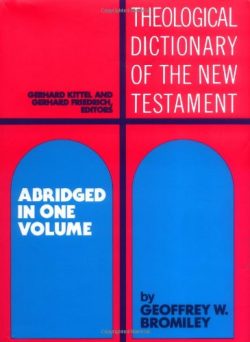
Theological Dictionary of the NT: Abridged in One Volume (TDNTa)
This dictionary is a landmark Greek dictionary which has come to us through a lot of people and years of scholarship dedicated to making this scholarly work available. One of the neat features about this work is that it has Strongs numbers, so those who are not proficient in the Greek language can still use the work, working off of the Strong’s Greek Numbers.
Note that there is a foundational work back to Gerhard Kittel, and thus that work is called “Big Kittels” or just “Kittel”, and there is the present work we are offering which is abridged, and called “Little Kittels”. The unabridged Kittel is very large, and has very long and detailed studies on each word, including a lot of linguistics, Greek, German, Latin, Hebrew, etc. It is a very scholarly work, and understood best “by scholars” (very educated scholars at that). Little Kittel though has been edited so as to delete most of that, and leave a simple work that most laymen could understand (and most Bible students with normal Greek abilities, or no Greek abilities at all, in the style of Strong’s Lexicon perhaps).
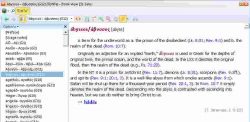
For actual samples of articles in the dictionary, click on the image at left (a popup viewer should open) and then use the left-right arrow keys on the keyboard, or click on the far left or far right arrows on the image itself.
The samples are:
ábyssos/άβυσσος [abyss]
agathós/αγαθός [good],
ángelos/άγγελος [messenger, angel],
kýrios/κύριος [Lord, lord], -searching dictionary for a word
kýrios/κύριος [Lord, lord], – searching using Strongs Number
mágos/μάγος [magician, Magus],
méli/μέλι [honey]
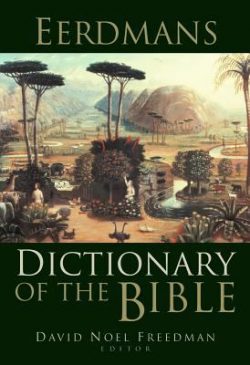
Eerdmans Dictionary of the Bible
Nearly 5,000 articles written by 600 first-rate Bible authorities thoroughly explaining books, persons, places and significant terms of the Bible. The Dictionary also explores the background of each biblical book and related writings and discusses cultural, natural, geographical, and literary phenomena–matters that Bible students at all levels may encounter in reading or discussion.
The Eerdmans Dictionary of the Bible gathers nearly 5,000 alphabetically ordered articles that thoroughly yet clearly explain all the books, persons, places, and significant terms found in the Bible. The Dictionary also explores the background of each biblical book and related writings and discusses cultural, natural, geographical, and literary phenomena—matters that Bible students at all levels may encounter in reading or discussion.
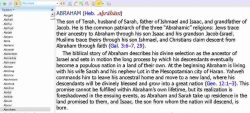
For actual samples of articles in the dictionary, click on the image at left (a popup viewer should open) and then use the left-right arrow keys on the keyboard, or click on the far left or far right arrows on the image itself.
The samples are:
abraham
Agriculture
alpha and omega
amos, book of
anathema
apostle
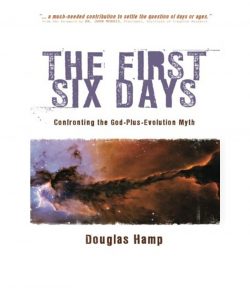
The First Six Days: Confronting the God-Plus-Evolution Myth
A powerful examination of the biblical, linguistic, historical and archaeological evidence affirming that the creation days of Genesis were nothing but real and literal days. If you think that God worked through evolution, read this book and be challenged. If you believe that God created in a literal six days, read this book and be strengthened.
Douglas Hamp’s work The First Six Days is a much needed contribution to settle the question of days or ages. As a Hebrew language specialist trained at the Hebrew University of Jerusalem, he demonstrates convincingly from the pages of Scripture that the days of the Genesis creation account are literal days. He also carefully clarifies some misrepresentations of what day means in Hebrew. This is followed up by a stimulating review of the literal, six-day position held by ancient Jewish and Christian interpreters as well as archaeological corroboration of the biblical record.
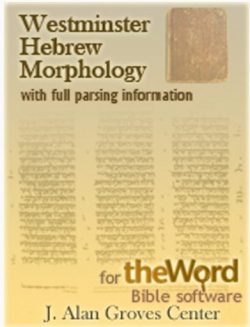
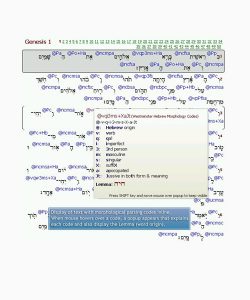
Groves-Wheeler Westminster Hebrew morphology
DESCRIPTION
Groves-Wheeler Westminster Leningrad Codex (WLC) with full parsing information. The complete text of the Hebrew Bible with the Groves-Wheeler Westminster Hebrew Morphology (version 4.22). Includes vowels, cantillation marks, lemmas and full grammatical analysis for each word.
This version allows searching on any feature of the text, including grammar, lemmas, notes, readings (ketiv/qere), homonyms, etc. You can search on consonants only or using vowels and accents. You can perform complex searches combining lemmas and grammar and even editor notes!
Grammar codes may appear inline with the text or you can completely hide them and have the full grammar information appear when you hover your mouse over the Hebrew words. Along with the Hebrew text, a dictionary provides a comprehensive guide to help you understand the grammar codes and gives a detailed analysis of each grammar tag.
Includes grammatical parsing, lemmas, vowels, cantillation marks, alternate readings (Qere/Ketiv), editor notes.
New International Commentary on the Old Testament (22 vols.)
PRODUCT HIGHLIGHTS:
DESCRIPTION
This collection includes all of the volumes from The New International Commentary on the Old Testament to provide an exposition of Scripture that is thorough and abreast of modern scholarship, yet at the same time loyal to Scripture as the infallible Word of God. This conviction, shared by all contributors to The New International Commentary on the Old Testament, defines the goal of this ambitious series.
This decades-long project has become recognized by scholars, pastors, and serious Bible students as critical yet orthodox commentary marked by solid biblical scholarship within the evangelical Protestant tradition. The New International Commentary on the Old Testament serves as authoritative scriptural guides, bridging the cultural gap between today’s world and the Bible’s. Each volume in the NICOT aims to help us hear God’s word as clearly as possible.
Scholars, pastors, and serious Bible students will welcome the fresh light that this commentary series casts on ancient yet familiar biblical texts. The contributors apply their proven scholarly expertise and wide experience as teachers to illumine our understanding of the Old Testament. Gifted writers, they present the results of the best recent research in an interesting, readable, and thought-provoking manner.
Each commentary opens with an introduction to the biblical book in question, looking especially at questions concerning its background, authorship, date, purpose, structure, and theology. A select bibliography also points readers to resources for their own study. The author’s own translation from the original Hebrew and Greek texts forms the basis of the commentary proper. Verse-by-verse comments nicely balance the in-depth discussions of technical matters—such as textual criticism and critical problems—with exposition of the biblical writer’s theology and its implications for the life of faith today.
….