
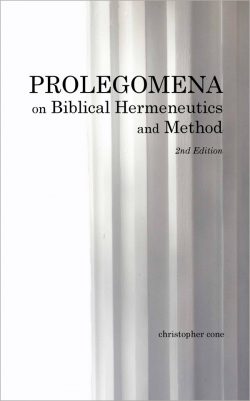
Prolegomena on Biblical Hermeneutics and Method
Description
proh-li-gom– uh-nah
From the Greek pro (before) and legomen (we speak), prolegomena refers to preliminary or introductory words on a course of study.
Prolegomena on Biblical Hermeneutics and Method, 2nd Edition, explores four important pillars that support a Biblical theology, and provides guidance on how we can study and understand the Bible for ourselves, along with background on how others have understood the Bible throughout history.
Christopher Cone, Th.D., Ph.D., is President of Tyndale Theological Seminary & Biblical Institute (DFW, TX), teaches there as Professor of Bible & Theology, and serves as a pastor of Tyndale Bible Church. He has authored and edited several books, including: The Bible in Government and Society, Biblical Sufficiency Applied, Practical Aspects of Pastoral Theology, Life Beyond the Sun: An Introduction to Worldview & Philosophy Through the Lens of Ecclesiastes, Dispensationalism Tomorrow & Beyond: A Theological Collection in Honor of Dr. Charles C. Ryrie, and The Promises of God: A Synthetic Bible Survey.
theWord Features:
- Verse popups
- Fully searchable text
- Footnotes
- Easy navigation of topics via topics tree display.
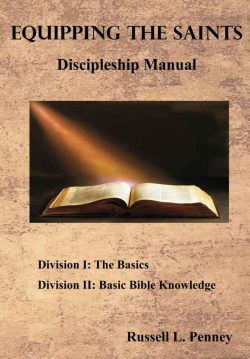
Equipping the Saints – Discipleship Manual
Description
Russell (“Rusty”) L. Penney B.A., M.A„ Th.D. serves as Senior Pastor at Prairie Valley Baptist Church in Whitney, Texas, He is husband of Joann Squires Penney and father of Joseph, Hannah and Micah. Rusty and Joann have served the Lord as missionaries in Sophia, Bulgaria and Santa Cruz. Bolivia. In Santa Cruz, Rusty served as professor of theology, head of postgraduate studies, and later as President for 7 years at Hebron Theological Seminary. Rusty is the general editor of Overcoming the World Missions Crisis (Kregel, 2001), and contributor to six other books including the silver medallion award winner Dictionary of Premillennial Theology (Kregel, 1996).
“There is no greater need in the church in the United States today than the maturing of believers or, what the Bible calls, ‘making disciples’ (Matt. 28:18-20). Like a newborn babe, true spiritual growth is accompanied by a longing for spiritual food. This volume was written with that great need in mind. Equipping the Saints is ‘food for the soul’. If we lead someone to Christ, it is imperative to help them grow. The Christian life is properly seen as the process of God conforming us to the moral image of Christ (Rom. 8:28-30), and bringing us to ‘share in His holiness’ (Heb. 12:10). This volume gives the believer a foundational understanding of the Christian life. It is time for the church to abandon its unbiblical and debilitating church growth, strategies and return to what God called the church to do; making disciples by equipping the saints (Eph. 4:11-12).”
theWord Features:
- Verse popups
- Fully searchable text
- Footnotes
- Questions and Answers as .pdf files
- Easy navigation of topics via topics tree display.
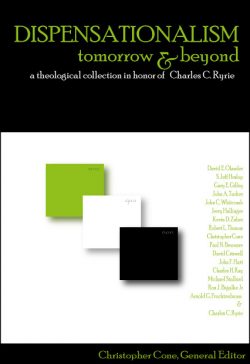
Dispensationalism Tomorrow and Beyond
Description
“This book in honor of Dr. Charles Ryrie was written by scholars who hold to the same basic view of Dispensationalism for which he is noted. In their chapters they address subjects related directly or indirectly to that system of theology. They exhibit a confirmed commitment to the authority, power, sufficiency, original languages, and correct interpretation of the Scriptures. Their work reflects careful exegesis of pertinent Biblical passages and significant interaction with writings of scholars who disagree with the Dispensational view of the Bible. Readers will be introduced to subjects not normally addressed by Dispensational authors….”
-Renald Showers
theWord Features:
- Verse popups
- Fully searchable text
- Footnotes
- Easy navigation of topics via topics tree display.
Table of Contents
1) The Necessity of Dispensationalism; Charles C. Ryrie
2) Four Pillars of Dispensationalism; Christopher Cone
3) Priorities in Presenting the Faith; John C. Whitcomb
4) Basic Distinctives of Dispensational Systematic Theology; Charles H. Ray
5) The Importance of Biblical Languages; David E. Olander
6) The Principle of Single Meaning; Robert L. Thomas
7) The Role of Israel in Dispensational Theology; Arnold G. Fruchtenbaum
8) Dispensational Definition & Division Revisited; Christopher Cone
9) The New Testament Use of the Old Testament; Robert L. Thomas
10) Do We Really Hold Scripture to be Sufficient?; John A. Tucker
11) Content, Object & Message of Saving Faith; S. Jeff Heslop
12) The Times of the Gentiles; David Criswell
13) The Pre-Day of the Lord Rapture; David E. Olander
14) Daniel 9:24-27 Considered, Part I; Charles H. Ray
15) Daniel 9:24-27 Considered, Part II; Charles H. Ray
16) Metaphor & the Rapture; Kevin D. Zuber
17) The Two Witnesses; John C. Whitcomb
18) The Realization of Ezekiel’s Temple; Jerry Hullinger
19) Released From the Law for Sanctification; John F. Hart
20) The Kingdom of Emergent Theology; Gary E. Gilley
21) The Church & Social Responsibility; Ron J. Bigalke, Jr.
22) Is Dispensationalism Hurting American Political Policies in the Middle East?; Michael Stallard
23) Biblical Prophecy: An Essential Element in Living a Genuine & Useful Christian Life; Paul N. Benware
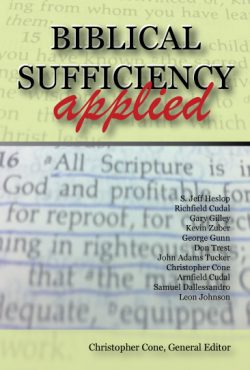
Biblical Sufficiency Applied
Description
God-breathed. Profitable. These two words Paul conveys in 2 Timothy 3:16 to describe the word of God. That the Text is God-breathed attests to its authority, and that it is profitable attests to its sufficiency. The authority of Scripture has no limit for the believer – in its pages God demands complete submission of His children. Likewise the sufficiency of Scripture reaches to the farthest corners of the believer’s position and practice.
Paul describes the purpose of Scripture’s inspiration: “that the man of God may be adequate, equipped for every good work” (2 Tim 3:17). God’s word is sufficient for the equipping of His people for the works He has planned for them (Eph 2:10). The divine prescriptions explain the believer’s course of action, oftentimes revealing the rationale for the action, and always pointing to the enablement needed and provided. In short, the true knowledge of Him provides everything pertaining to life and godliness (2 Pet 1:3).
As such, we can rely on Scripture in every area of life. We will find no topic out of bounds, and no subject so controversial as to be avoided or lacking illumination in the pages of the Bible. Biblical Sufficiency Applied is an effort on the part of its several contributors to consider certain areas of contemporary controversy in the light of Scripture. We hope and pray that God uses this work both to challenge and encourage the reader to seek the answers in Scripture, and to be confident in the Biblical record as sufficient for every aspect of the believer’s life.
theWord Features:
- Verse popups
- Fully searchable text
- Footnotes
- Easy navigation of topics via topics tree display.
Nothing but the truth
Description
Nothing but the Truth was first published in 1978 and, after many reprints and two revised editions. It was finally reprinted in 2012. Further revision and expansion led to the publication of six small volumes in 2017 under the title All you need to know about the Bible. This edition in one 768 page hardback volume lightly revised version of All you need to know.
It aims to answer in an accessible and accurate way, the many questions that are asked about the main theme of the Bible, how it came to be written, how trustworthy it is, how the individual books were gathered together, and much more. Full references allow the reader to pursue each subject in more depth. In 2020 we are pleased to be able to release a digital version, compatible with theWord Bible software.
Overview of the book and reading plan inside theWord:
theWord Features:
- Verse popups
- Fully searchable text
- Footnotes
- Pages links <p676] indicates the page is above this point.
- Easy navigation of topics via topics tree display.
- Reading Plan for the whole Bible included as a separate resource. (developed from the reading plan in Book 6 Chapter 7)
The reading plan can be used as a basis to make custom plans to allow you to schedule readings to your requirements.
People in the Bible: Jonah
Description
We are often told that good things come in small packages, and this is the case when it comes to the book of Jonah. Through just four chapters we discover many layers to the life of this prophet and to the character of the God who does not give up—whether on this prophet, or on the barbaric city he called this prophet to reach.
We follow Jonah on the run, on the beach, in the city and eventually in the great dock of God. As we uncover this dramatic story, we see that God has not only the will to reach a violent city, but also the grace to reach the heart of a stubborn prophet
theWord Features:
⦁ Verse popups
⦁ Verse synchronization
⦁ Fully searchable text
⦁ Footnotes
⦁ Commentary link popup can be set in Bible view.
⦁ Easy navigation of topics via topics tree display.
Note: Does not display commentary under Bible text.
The Text of the Old Testament, An Introduction to the Biblia Hebraica, THIRD EDITION
DESCRIPTION
Major revision of a landmark work in Old Testament scholarship
Ernst Würthwein’s introduction to the Biblia Hebraica has long served as a textbook for generations of students interested in the history of the Old Testament text and the problems of textual criticism. From its first appearance in 1952 to the fifth German edition in 1988, the book was faithfully updated by Würthwein himself in light of new research. But now a new edition of “Würthwein” is due.
While staying true to the original structure and character of Würthwein’s classic work, Alexander Fischer has rewritten the text completely to bring it up to date with the new Quinta edition of Biblia Hebraica. Besides updating information throughout, this edition includes a new chapter on the texts from the Qumran. This third edition of The Text of the Old Testament will be an indispensable resource for serious students of the Biblia Hebraica and Old Testament exegesis.
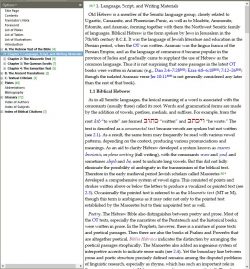
theWord Features:
- Verse popups
- Abbreviation popups
- Fully searchable text
- Easy navigation of topics via topics tree display.
- Images
- Special Text Colors
- Normal: Text
- Hyperlink: BHS | Deut 34:10-12BHS
- Page Number: pg 21
- Latin: supra
- Transliteration: qādēs̆: ṭāhēr
- Greek: σωμάτων
- Hebrew: מִשְׁפָּט
- Aramaic: כְּתִיב

People in the Bible: Saul and sons
Description
Israel’s first king began with great promise and ended in tragedy. The author traces Saul’s head start into the monarchy and the accelerating spiral into possibly the most lamentable biography in the Bible. Along the way there is much to learn from a king whose story is told in Scripture so that we might learn the ways of a man who fell out with God and fell in with the powers of darkness. And there are surprises along the way, not least in the story of his son who, but for the purposes of God, would surely have made an excellent king.
However, on the blood-spattered walls of Beth Shan, the story does not quite end. There is another member of Saul’s line who shines with bright hope and reflects the character of his godly father in contrast to that of his tragic grandfather.
An accessible book for every reader which, as well as bringing the three characters of Saul, Jonathan and Mephibosheth to life and clarifying difficulties in the text, concludes every chapter with questions for thoughtful discussion suitable for group or personal study.
theWord Features:
- Verse popups
- Fully searchable text
- Footnotes
- Easy navigation of topics via topics tree display.

People in the Bible: Jesus
Description
We can be glad for Mel Gibson’s film, The Passion of the Christ, in at least one respect: it has familiarized many with the term ‘Passion’. People now know it refers to the suffering of Jesus Christ. How did his suffering come to be called the ‘passion’? The answer is our word ‘passion’ comes from the Latin word ‘passio’, which means ‘suffering’.
The Passion of Christ is an inexhaustible subject. In these warm and challenging devotional studies, Roger Ellsworth takes a look at the Passion through the eyes of the people most closely associated with it. By reminding us again of the wonder of what Christ did on the cross for ordinary people, he encourages us to become more passionate about the Passion and how we serve our Saviour.
theWord Features:
- Verse popups
- Fully searchable text
- Footnotes
- Easy navigation of topics via topics tree display.

People in the Bible: Samson
Description
The story of Samson is one of the most exciting and intriguing in the whole of Scripture. As the sub-title suggests, it is a simultaneous insight into his incredible strength and persistent weakness. We marvel at the thrilling accounts of unorthodox battles and awe inspiring demonstrations of physical power. Sadly, we also wonder at his apparent inability to learn from his own mistakes as he follows his passions to their inevitable end.
This rollercoaster of a story sweeps us from the rich promises accompanying his birth, though the tragedies and triumphs of his life. The story almost ends with the pitiable sight of him as the blind captive of his life-long enemies the Philistines. Yet, there is still one surprising twist to this epic tale ‘victory through death. Throughout we trace the contrasts with the great Judge of Israel’ Christ.
theWord Features:
- Verse popups
- Fully searchable text
- Footnotes
- Easy navigation of topics via topics tree display.

People in the Bible: Philip
Description
Evangelism.
What immediately springs to mind when you read that word? Whatever reaction you may have, evangelism is becoming increasingly dangerous in an apparently post-secular Western world, yet the church has a continuing mandate to be a witness and to share the great message of the gospel.
This book looks at the gospel adventures of Philip the Evangelist and draws lessons that will encourage, enliven and challenge you. It will ultimately also inspire you to lift up the sword of the Spirit boldly and, for the sake of lost souls, enter into the evangelistic fray.
theWord Features:
- Verse popups
- Fully searchable text
- Footnotes
- Easy navigation of topics via topics tree display.
People in the Bible: Judah
Description
A book about Judah? Maybe you don’t even remember the man himself. Or, if you do, you may feel that his story is a very unpleasant one, one you’d rather not dwell on. But perhaps you also remember him pleading for the life of his half-brother Benjamin. Can you read that part of his story without being deeply moved—perhaps even to tears? And the tribe of Judah: why did that become so important in the Bible? And who is it who is ‘the Lion of the tribe of Judah’? In this book, Paul E. Brown discovers many surprising and helpful truths as he reviews the frequently ignored life and legacy of Judah.
theWord Features:
- Verse popups
- Fully searchable text
- Footnotes
- Map
- Easy navigation of topics via topics tree display.
DIVINE FOREKNOWLEDGE, PROVIDENCE, PREDESTINATION & HUMAN FREEDOM
Description
Have you ever wrestled with God’s sovereignty and our human free-will? Brother John Cook takes us on a journey through this deep subject. His use of the Word of God and various historical and modern resources on this topic should help us grow in our understanding of this deep subject. So please setup your favorite Bible in theWord Bible Software and join him in his book.

theWord Features:
- Verse popups
- Fully searchable text
- Footnotes
- Easy navigation of topics via topics tree display
People in the Bible: Elisha
Description
While the life of Elijah is familiar to most Christians, the mission and ministry of his successor, Elisha, is not so well known—probably because of the great drama that surrounded Elijah’s service for the Lord. The majority of Elijah’s miracles were performed in the context of death and destruction, whereas the miracles of Elisha were mainly to do with healing and restoration.
It could therefore be argued that Elijah was primarily a prophet of judgement, whereas his successor was more a prophet of grace. If this is so, the story of Elisha’s life is very relevant to the times in which we live. Elisha prophesied in Israel during the ninth century BC as a shining light amid the darkness of idolatry and unbelief which prevailed at the time. We would therefore do well to follow his noble example as we seek to be witnesses for the Lord in our generation.
theWord Features:
- Verse popups
- Fully searchable text
- Footnotes
- Easy navigation of topics via topics tree display.
People in the Bible: Elijah
Description
When Elijah lived in Israel in 900 BC, truth was being compromised and the people had departed from the worship of the one true God. It was a multi-faith society. There was immorality at the highest level. Toleration trumped truth. True prophets were being persecuted. It was much like Western society today. What can Christians do in such a spiritual and moral climate? Elijah is our great example and inspiration as we dare to contend for the truth, even taking on the religious establishment if necessary. What could be more timely or relevant for the Christian church at the present time?
theWord Features:
- Verse popups
- Fully searchable text
- Footnotes
- Easy navigation of topics via topics tree display.
People in the Bible: Caleb
Description
Caleb is one of the forgotten heroes of the Bible. One of the twelve spies sent out by Moses into Canaan, he was commended by God for his faithfulness. While others were fearful, he believed they could conquer the land. He remained faithful throughout forty years in the wilderness, until he and Joshua alone entered the land, as God had promised, with the younger generation. His story thus takes us all the way from Egypt to Canaan. Even in old age, he proved himself a courageous warrior, famously demanding, ‘Give me this mountain’, and a generous father, giving freely to his daughter. He is an inspiration to us all.
theWord Features:
- Verse popups
- Fully searchable text
- Footnotes
- Easy navigation of topics via topics tree display.
People in the Bible: Barnabas
Description
If Christians were to vote for their favourite Bible character, Barnabas would surely be in the top ten. Most of us feel drawn to this warm-hearted disciple, who so wonderfully lives up to his name, ‘Son of Encouragement’. In these character studies based on passages in Acts, Robert Dale helps us to appreciate and encourages us to imitate this wonderful man, who himself is a reflection of a still greater Man, our Lord Jesus Christ, the greatest Encourager of all.
theWord Features:
- Verse popups
- Fully searchable text
- Footnotes
- Easy navigation of topics via topics tree display.
Hebrews a verse by verse commentary by John Cook
Description
John Cook was a true son of Texas. Born here in 1954, John grew up in a Christian family and was riding bulls in rodeos while still in high school. After graduation, John honorably served in the Army, in both South Korea and Germany. Following his enlistment in the Army, John returned to Texas, got married and moved to Oklahoma to work in the oil fields while raising a family.
John Cook was also a true, born again, child of God. He and his wife Pam raised their children in the church and it was during this period of his life that John started questioning some of the teachings coming from the pulpit in his church.
However, he did not feel qualified to debate these teachings with the pastor. This was when he decided it was time to go to Bible college.
John arrived at Tyndale Theological Seminary and Biblical Institute about six months after I did. As students, sharing many of the same classes, and as members of Seminary Bible Fellowship Church (later renamed Tyndale Bible Church), we quickly became friends. Little did we know that, together, we would pursue bachelors, masters, and doctoral degrees.
Throughout our course of studies, John took particular interest in the biblical languages and Latin. Tyndale has always emphasized the study of the original biblical languages: Hebrew, Aramaic and Greek, but John pursued additional studies past those required by his program, eventually taking, I believe, every language course offered, including those from guest lecturers.
His greatest love was biblical Greek, and during his course of studies, John started working at Tyndale as the school Registrar. After graduation he began teaching Greek and Theology to undergraduate, graduate, and seminary level students.
John rose to become Vice President of Tyndale Theological Seminary and, to help our educational efforts, moved with his wife, Pam, to Louisiana, where he established and oversaw a branch campus of Tyndale for a few years before he retired. He came back to Texas, but our Lord saw fit to take our brother to his heavenly home at the young age of 58.
It was during his years at Tyndale that John wrote this commentary on the book of Hebrews. Even to an excellent Greek exegete like John, the book of Hebrews presents its challenges, not the least of which is deciding on who the author was and to whom it was written: unsaved Jews, saved Jews, or a combination of both.
These were the types of challenges that John liked the most, and in this volume you will find an excellent commentary, worthy of your time, written by my friend and colleague, whom I look forward to seeing again!
Patrick E. Belvill
Hurst, Texas
“Now the God of peace, that brought again from the dead our Lord Jesus, that great shepherd of the sheep, through the blood of the everlasting covenant,
Make you perfect in every good work to do his will, working in you that which is wellpleasing in his sight, through Jesus Christ; to whom be glory for ever and ever. Amen.” Heb. 13:20-21
John Cook (1954-2012) was Vice President of Tyndale Theological Seminary and Biblical Institute and a Professor of Greek and Theology. He received his Bachelors (Dip.Th.S.), from Tyndale Biblical Institute and his Masters (M.T.S.), and Doctor of Theology (Th.D.), degrees from Louisiana Baptist Theological Seminary.
theWord Features:
Note: Does not display commentary under Bible text.