
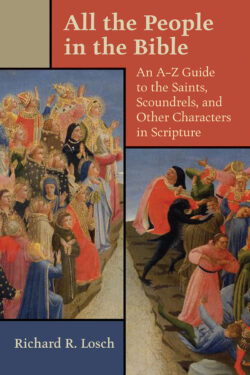
All the People in the Bible
DESCRIPTION
“More than any other book, the Bible offers an amazing collection of fascinating characters ranging from the holiest of the holy to some of the most depraved scoundrels imaginable. Many are mentioned only in passing, yet history and archaeology can often fill in the blanks and flesh them out as exciting human beings. For this reason we have in many cases been able to tell much more about them than the Bible alone reveals.”
— Richard R. Losch (from the preface)
A comprehensive gathering of persons found in the Bible, including the Apocrypha, All the People in the Bible really delivers on its title: literally all of the Bible’s characters appear in this fascinating reference work. From the first article on Aaron to the final entry on Zophar, Richard Losch details each person in a lively narrative style.
The bulk of the book consists of Losch’s A–Z articles covering the familiar and the not-so-familiar figures in Scripture. Names of people who are found only in genealogies or who had no significant effect on history are included solely in the alphabetical listing starting on page 452. That listing, “All the People in the Bible and Apocrypha,” includes pronunciations, brief identifications, and biblical references. Persons covered in greater detail in the main part of the book are identified in bold print.
Losch’s intriguing look at all the people in the Bible is anything but a dry reference work. This is a book to dip into and enjoy over and over.
theWord Features:
- Dictionary lookup and A-Z topic-tree navigation
- Fully searchable biographical entries
- Aliases and internal cross-references
- Bible-reference links and verse popups
- Footnotes with exact single-note popups
- Greek, Hebrew, and transliterated name forms
- Images and tables
- Print-page markers and bookmarks
- Pgs: 586
- Special Text Colors
- Normal: Text
-
Dictionary link: Peter
- Greek: Πέτρος
- Hebrew: שמעון
- Transliteration: Kephah
-
Page Number: [p1>


theWord-App Advanced Subscription (Beta)
theWord-App Advanced Features
Includes every feature available in theWord-App Basic, plus:
- Bible Search
- Create and manage custom cross-reference sets and files
- Reading plans, daily readings, and devotionals
- Saved layouts and multi-view workspace layouts
- Create new user modules
- Create, organize, format, edit, and save user-module topics
- Paste Bible selections directly into the editor
- Copy Verses dialog with advanced copying and printing
- Bible View List and Compare modes
- Create, save, manage, copy, and print verse lists
- Display commentaries inline within Bible View
- Bible text-formatting toolbar, advanced colors, and link styling
- Advanced Strong’s, morphology, and lemma colors, fonts, substitutions, and display styling
- Book View background images with placement controls
- Fuzzy topic matching, diacritic reorientation, and matching highlights
- Advanced startup, update, and view preferences
30 Day Trial below so you can try before you buy https://app.theword.net (or download it first from a link below).
Android, iPhone, iPad, macOS, Linux, Windows
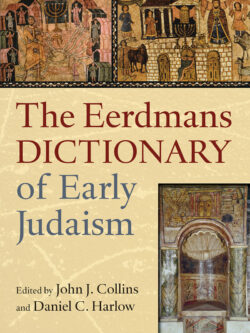
The Eerdmans Dictionary of Early Judaism
DESCRIPTION
The Dictionary of Early Judaism is the first reference work devoted exclusively to Second Temple Judaism (fourth century b.c.e. through second century c.e.).
The first section of this substantive and incredible work contains thirteen major essays that attempt to synthesize major aspects of Judaism in the period between Alexander and Hadrian. The second — and significantly longer — section offers 520 entries arranged alphabetically. Many of these entries have cross-references and all have select bibliographies. Equal attention is given to literary and nonliterary (i.e. archaeological and epigraphic) evidence and New Testament writings are included as evidence for Judaism in the first century c.e. Several entries also give pertinent information on the Hebrew Bible.
The Dictionary of Early Judaism is intended to not only meet the needs of scholars and students — at which it succeeds admirably — but also to provide accessible information for the general reader. It is ecumenical and international in character, bringing together nearly 270 authors from as many as twenty countries and including Jews, Christians, and scholars of no religious affiliation.
theWord Features:
- Dictionary lookup and A-Z topic-tree navigation
- Fully searchable articles, bibliographies, and author lines
- Scripture-reference popups and Bible links
- Internal cross-references
- Pgs: 1406
- Maps, illustrations, and tables
- Special Text Colors
- Normal: Text
-
Dictionary link: Apocalypticism
-
Scripture: Genesis 3
-
Page Number: [p1>
-
Hebrew transliteration: halakah
-
Greek transliteration: apokalypsis
The New International Greek Testament Commentary: The Book of Revelation
DESCRIPTION
This volume on Revelation is accessible and comprehensive. It provides an in-depth look at the parallels between images in the Apocalypse and their Old Testament and Jewish antecedents G.K. Beale’s painstaking anaylsis will help you better understand the obscure metaphors in Revelation and the purpose of the book itself.
Author:
G. K. Beale is J. Gresham Machen Chair of New Testament and professor of New Testament and biblical theology at Westminster Theological Seminary.
G. K. Beale is J. Gresham Machen Chair of New Testament and professor of New Testament and biblical theology at Westminster Theological Seminary.
theWord Features:
- Verse popups
- Verse (span) synchronization
- Fully searchable text
- Footnotes
- Pages links
- Easy navigation of topics via topics tree display.
- Special Text Colors
- Normal: Text
- Hyperlink: Gen 3:15
- Page Number: [pg 21>
- Greek: σκανδάλων
- Hebrew: לבנות
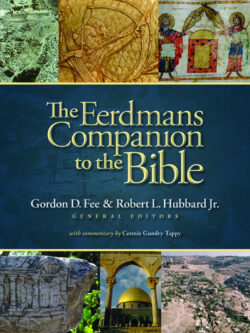
The Eerdmans Companion to the Bible
DESCRIPTION
A quality guidebook that opens up new vistas and insights into the whole Bible
Marked by a broad evangelical perspective, up-to-date research, and contributions from respected biblical scholars, The Eerdmans Companion to the Bible offers a reliable and illuminating guide to the entire Bible. Whether readers find the Bible familiar or foreign, they will appreciate the Companion’s informative articles and its commentary by Connie Gundry Tappy on all of the Old and New Testament books. This comprehensive reference work promises to make the Word of God come alive as never before.
- Compiled by some of the foremost biblical scholars in the world today
- New articles by sixty expert authors on many pertinent biblical topics
- Well-written background information and commentary on every book of the Bible
- Illustrated with maps, photos, and charts throughout
theWord Features:
-
Fully searchable text
-
Chapter, section, and indexed-entry navigation via the topic tree
-
Internal cross-references
-
Pgs: 834
-
Maps, illustrations, and tables
- Special Text Colors
- Normal: Text
- Internal link: Lands of the Bible
- Hebrew: א
- Transliteration: aleph
- Latin: testamentum
- Page Number: [p210>

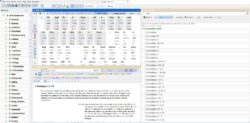
theWord-App Premium Subscription (Beta)
theWord-App Premium Features
Includes every feature available in theWord-App Basic and Advanced, plus:
- Book Search
- Create, edit, order, import, and export Book View module sets
- Bible View Interlinear mode
- Original-word and gloss sections
- Ancient Biblical language databases
- Bible and Book Word Study
- Power Word Study
- Word-popup statistics with original-word, transliteration, and gloss information
- Bible View background images with placement controls
- Custom Bible tab flags and icons
- Go directly to a topic by ID and export topics
- Change abbreviations or original-module identity for non-user modules
- Bible Search indexing preferences
- Book Search indexing and maintenance preferences
- Clipboard Monitor and Clipboard Viewer
- Proofing and spell-checking tools
Please note: Full Bible Search Helper and Inline Bible
Search Helper are optional add-ons. Premium access is required, but these
add-ons must be purchased and unlocked separately.
30 Day Trial below so you can try before you buy https://app.theword.net (or download it first from a link below).
Android, iPhone, iPad, macOS, Linux, Windows
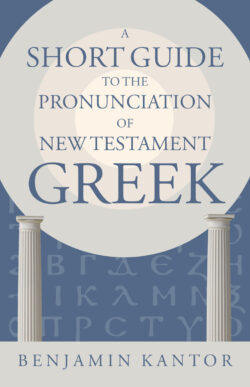
A Short Guide to the Pronunciation of New Testament Greek
DESCRIPTION
What did the apostles’ Greek sound like?
How should New Testament Greek be pronounced in our classrooms? Often students are taught Erasmian pronunciation, which does not even reproduce Erasmus’s own pronunciation faithfully, let alone that of the New Testament authors. But if we want to process the language of the New Testament the same way its original authors and readers did, we should use their pronunciation. In his new book, Benjamin Kantor breaks a path toward an authentic pronunciation of Koine Greek at the time of the New Testament, seeking to improve students’ reading proficiency.
A Short Guide to the Pronunciation of New Testament Greek distills Kantor’s new monograph, The Pronunciation of New Testament Greek, with an eye toward practical instruction. The first comprehensive phonological and orthographic study of Judeo-Palestinian Koine Greek, The Pronunciation of New Testament Greek surveys thousands of inscriptions and papyri to determine historical pronunciation. A Short Guide gives students an overview of the basics of phonology before explaining the pronunciation of each Greek letter and phoneme individually. Perfect for classroom use, this guide explains Kantor’s cutting-edge research accessibly and includes sample texts for reading practice.
theWord Features:
- Chapter and named-section topic navigation
- Searchable chapter text
- Greek, transliteration, IPA, and pronunciation tables
- Greek and Hebrew language examples
- Exact single-footnote popups
- Internal cross-references
- Native tables and images
- Special Text Colors
- Normal: Text
- Internal link: The International Phonetic Alphabet
- Greek: λόγχη
- Transliteration: lonχi(-yoθ)
- IPA: [x] / [χ]
- Hebrew comparison: לוֹנְכִֿייוֹתֿ

Reading Jesus’s Bible – How the New Testament Helps Us Understand the Old Testament
DESCRIPTION
For Jesus and his contemporaries, what we now know as the Old Testament was simply the Scriptures—and it was the fundamental basis of how people understood their relationship with God. In this book John Goldingay uncovers five major ways in which the New Testament uses the Old Testament. His discussion paves the way for contemporary readers to understand and appreciate the Old Testament more fully.
Along with an overview of how Jesus and the first Christian writers read the Old Testament, illustrated with passages from Matthew, Romans, 1 Corinthians, and Hebrews, Goldingay offers a straightforward introduction to the Old Testament in its own right. Reading Jesus’s Bible will shed fresh Old Testament light on Jesus, God, and the church for readers today.
theWord Features:
- Chapter and named-section topic navigation
- Direct subject topics and testament/book Scripture indexes
- Fully searchable text
- Verse popups and Bible links
- Internal cross-references
- Exact single-footnote popups
- Native tables and images
- Special Text Colors
- Normal: Text
- Scripture reference: Matthew 5:17
- Page Number: [p21>
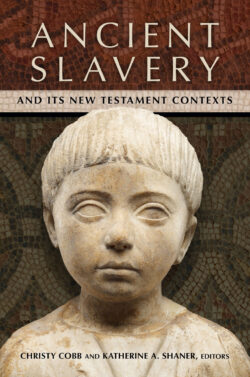
Ancient Slavery and Its New Testament Contexts
DESCRIPTION
An essential resource for understanding slavery in the New Testament and early Christianity
Slavery permeated society in the ancient world. The realities of slavery and its shadows pervade the New Testament and other early Christian texts. Yet enslavement remains an under-taught aspect of the context of the New Testament and early Christianity. Because of this, readers are left with numerous questions about ancient slavery. How did people become enslaved? What kinds of work did enslaved people do? Who enslaved people? How did ancient slavery compare with more contemporary enslavement eras? Did anyone in the ancient world criticize slavery? Was ancient slavery racialized? Did Christians have a different understanding of slavery than others? These are just some of the questions students ask in higher education and in Bible study classrooms alike.
This volume takes on these questions, introducing students to the textures, complexities, and material realities of slavery in the Greco-Roman world. Ancient Slavery and Its New Testament Contexts draws on the expertise of scholars around the world with a focus on introductory information, accessibility, and readability. It does not attempt to dismiss or downplay the role of New Testament texts in the perpetuation of either ancient slavery or slavery in the North American context. Rather, the volume helps students and teachers alike wrestle with the ongoing historical, theological, and ethical legacies of slavery in their own faith formation and engagement with the biblical text.
theWord Features:
- Fully searchable text
- Chapter and glossary-entry navigation via the topic tree
- Internal cross-references
- Bible-reference links and verse popups
- Footnotes with exact single-note popups
- Tables and illustrations
- Special Text Colors
- Normal: Text
- Internal link: Ethics of Interpretation
- Bible reference: Acts 16:16–40
- Greek: βασιλεία τοῦ θεοῦ
- Greek transliteration: paidiskē
- Latin: operae
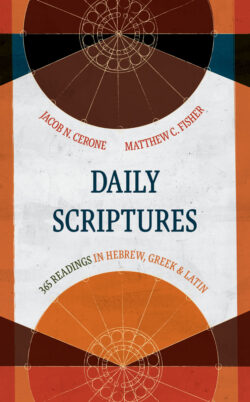
Daily Scriptures – 365 Readings in Hebrew, Greek, and Latin
DESCRIPTION
Pastors, students, and scholars not in the midst of language coursework often find it difficult to maintain their knowledge of biblical languages like Hebrew, Greek, and Latin. For those looking to do so in a meaningful but manageable way, this devotional offers 365 short daily readings, pairing an Old Testament passage in Hebrew and Greek with a corresponding New Testament passage in Greek and Latin. Lexical notes in English are included as a way of facilitating a comfortable reading experience that will build one’s confidence and ability in reading the Hebrew Bible, the Septuagint, the Greek New Testament, and the Latin Vulgate.
“Our goal and our purpose for this volume is to keep you in the languages, keep you fed in the Word, and hopefully spark a desire to explore more deeply how the New Testament at its core relies upon the Old Testament Scriptures.”
— from the introduction
theWord Features:
-
Devotional 365-day synchronization
-
Date and topic-tree navigation
-
Verse popups and Bible links
-
Fully searchable reading and note text
-
Exact single-footnote popups
-
Hebrew, Greek, and Latin source text
-
Native tables and images
-
Special Text Colors
-
Normal: Text
-
Bible link: Psalm 110:1
-
Greek: Εἶπεν ὁ κύριος τῷ κυρίῳ μου
-
Hebrew: נְאֻם יְהוָה לַאדֹנִי
-
Latin: qui cum sit splendor gloriae
-
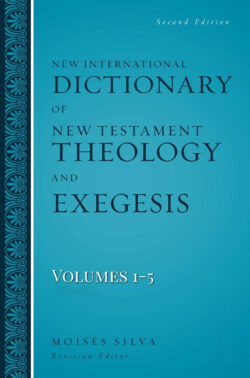
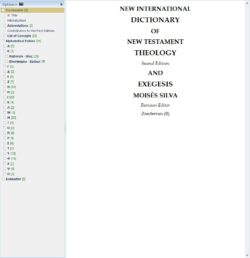
New International Dictionary of New Testament Theology and Exegesis Set
DESCRIPTION
A standard and widely-used reference work for nearly 40 years, the New International Dictionary of New Testament Theology and Exegesis has been thoroughly revised and updated to aid today’s pastors, students, scholars, and teachers in their study of the New Testament.
Offering a wealth of background and information on the meaning of Greek words in the New Testament—as well as related usage in classical Greek sources, the Septuagint, Jewish literature, and more—this important tool offers the following features:
• Alphabetical arrangement according to Greek words instead of previous order according to English topics; this ensures that individual Greek words are not discussed in isolation from one another and are easy to access
• Expanded to include additional Greek words and concepts not covered in the original work, NIDNTTE includes nearly 800 entries covering over 3,000 Greek words
• Discussions have been revised to be in line with modern scholarship and bibliographies are updated
• Corrections have been made to inconsistencies and omissions in earlier versions
• Updated and added consistency to include—for every entry—all necessary background information from classical Greek, the LXX, and Jewish literature.
• A helpful semantic domain index now directs the reader to all of the Greek words that have something to do with a particular English word. For example, under the English word “Anger, Wrath,” there is a list of thirteen Greek words that are related to that topic.
• Significant changes have been made in the presentation and discussion of linguistic details
• and much more!
theWord Features:
- Verse popups
- Fully searchable text
- Footnotes
- Easy navigation of topics via topics tree display.
- Cross-links to NIDOTTE, TDOT and TDNT.
- Special Text Colors
- Normal: Text
- Hyperlink: Glossary | Gen. 9:8
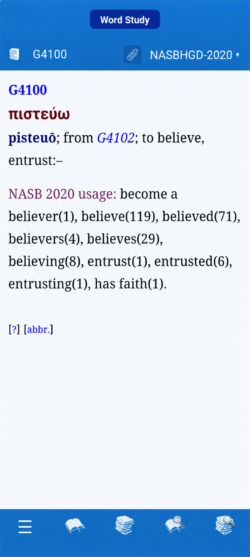
- G/K Numbering G325
Note: The codes H## and G## used in this module refer to the Goodrick–Kohlenberger (G/K) numbering system, not to Strong’s Concordance numbers. This follows the publisher’s data. Strong to Goodrick-Kohlenberger Number Conversion Chart at the end of the resource. - Greek: πατήρ
- Greek Transliteration: pater
- Hebrew: אֱלֹהִים
- Hebrew Transliteration: ʾelōhîm



theWord-App Basic (Beta)
theWord-App Basic Features
- Bible reading, navigation, history, and bookmarks
- Book View reading, navigation, history, and bookmarks
- Dictionary modules with linked word lookup
- Commentary modules with verse-linked lookup
- General Book and hybrid verse-synchronized modules
- Strong’s number support and dictionary lookup
- Morphology and lemma data lookup
- Module downloads, installation, updates, and removal
- Standard selection, lookup, copying, and study-navigation tools
- Bible and Book display options
- Interface support for 32 language packs
- Application skins and theme selection
- Custom Book View background colors
- Works offline after setup
- One-time purchase per major version (Version 8 for example) with no recurring subscription fee
30 Day Trial below so you can try before you buy https://app.theword.net (or download it first from a link below).
Android, iPhone, iPad, macOS, Linux, Windows
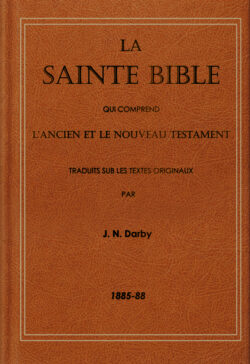
La Sainte Bible (French Darby Bible)
Traduction française de J.N. Darby
Traducteur : John Nelson Darby (1800-1882), bibliste britannique et figure influente du mouvement des Frères de Plymouth.
Méthode de traduction : Traduction littérale (« mot à mot ») de l’hébreu et du grec, visant à restituer la structure exacte des langues originales.
Historique de publication : Le Nouveau Testament a été publié par étapes (1859, 1872, 1875, 1878) et la Bible complète, avec un Ancien Testament complété par ses étudiants, a été publiée en 1885.
French J.N.Darby translation
Translator: John Nelson Darby (1800–1882), a British Bible scholar and influential figure in the Plymouth Brethren movement.
Translation Method: Literal (“word-for-word”) translation from Hebrew and Greek, aiming to convey the exact structure of the original languages.
Publication History: The New Testament was released in stages (1859, 1872, 1875, 1878) and the complete Bible, with an Old Testament completed by his students, was published in 1885.

theWord-Fonctions:
• Text intégral consultable
• Ancien et Nouveau Testaments
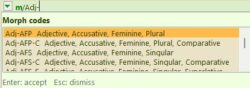
Premium Feature: Inline Bible Search Helper
Description:
This is still a work in progress feature and subject to change.
(Note: Premium Features are not needed to use theWord it still maintains existing functionality this just adds special extended features.)
- Bible Background Indexer
- Indexes the Bibles to provide much internal data (Original Word, Strong, Lemma, Morphology). This is required for the use of the Inline Helper, Bible Search Helper.
- .morph files (May be included with their Bibles or this Premium feature (to decide)
- Used for Definitions of the Morphology code and Morphology Builder
- Bible View – Top translation words: for Bibles with Strong’s #/Lemma
- Bible Search – inline helper (as you type it gives you a list of available terms.)
- Auto complete for Original Words (English, Hebrew, Greek, Main Text of the Bible)
- Auto complete for Strongs (H#, G#)
- Auto complete for Lemma (Hebrew/Greek)
- Auto complete for Morphology with expanded definition (RMAC for NA28, BYZa, SBLGNT; WHMC for WHM 4.22; BHSMorphoogy for BHS5/ETCBC; BSB Morphology for BSBHebInt, BSBGrkInt, BSBRevInt; PMAC for lxx;
- Preferences
- Settings for Inline Bible Search Helper
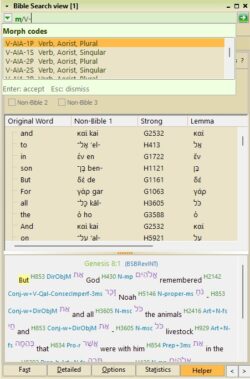
Premium Feature: Full Bible Search Helper
Description:
This is still a work in progress feature and subject to change.
(Note: Premium Features are not needed to use theWord it still maintains existing functionality this just adds special extended features.)
- Bible Background Indexer
- Indexes the Bibles to provide much internal data (Original Word, Strong, Lemma, Morphology). This is required for the use of the Inline Helper, Bible Search Helper.
- .morph files (May be included with their Bibles or this Premium feature (to decide)
- Used for Definitions of the Morphology code and Morphology Builder
- Bible View – Top translation words: for Bibles with Strong’s #/Lemma
- Bible Search – inline helper (as you type it gives you a list of available terms.)
- Auto complete for Original Words (English, Hebrew, Greek, Main Text of the Bible)
- Auto complete for Strongs (H#, G#)
- Auto complete for Lemma (Hebrew/Greek)
- Auto complete for Morphology with expanded definition (RMAC for NA28, BYZa, SBLGNT; WHMC for WHM 4.22; BHSMorphoogy for BHS5/ETCBC; BSB Morphology for BSBHebInt, BSBGrkInt, BSBRevInt; PMAC for lxx;
- Bible Search Helper (accessible via Helper tab in Bible Search)
- Tabs: (Dependent on what is supported in a Bible)
- Combined
- Filter for sorting with advanced sorting
- Column Toggles: Original Word, Strong, Lemma, Morphology, Switch Text 1..3, Non-Bible 1..3, Count
- Column Sorting
- Verse Preview
- highlight of hovered word
- Right Click to go to Verse
- Original Word
- Filter for sorting
- Columns: Key, Original Forms (OT, NT), Count
- Column Sorting
- Dictionary shown on Hover if activated.
- Word preview pane
- Double click to send to Bible search
- Strong’s #
- Filter for sorting
- Columns: Key, Top Words, Count
- Column Sorting
- Dictionary shown on Hover if activated.
- Word preview pane
- Double click to send to Bible search
- Morphology
- Filter for sorting
- Columns: Key, Top Words, Count
- Column Sorting
- Dictionary shown on Hover if activated.
- Word preview pane
- Double click to send to Bible search
- Morphology Builder
- Uses the .morph file to help with building morphology
- Part of speech check boxes for easy building of Morphology.
- Matching codes with definitions.
- Lemma
- Filter for sorting
- Columns: Key, Representative Forms, Count
- Column Sorting.
- Send to Lemma Family
- Dictionary shown on Hover if activated.
- Word preview pane
- Double click to send to Bible search
- Lemma Family
- Enter Lemma Root, Include all forms (substring match): Find Family
- Dictionary shown on Hover if activated.
- Double click to send to Bible search
- Syntax Validator
- Used for help you build good Bible Search syntax (may not stay in release)
- Headings
- Filter forsorting
- Columns: Key, Testament, Count
- Double Click to go to first verse occurence
- Right Click to go to a specific verse
- Footnotes
- Filter, Key, Testament, Count
- Double Click to go to first verse occurence
- Right Click to go to a specific verse
- Switch Text 1…3
- Filter for sorting
- Columns: Key, Testament, Count
- Word preview pane
- Non-Bible 1…3
- Filter for sorting
- Columns: Key, Testament, Count
- Word preview pane
- Preferences
- Settings for Bible Search Helper
Revelation: A Shorter Commentary
DESCRIPTION
G. K. Beale’s monumental New International Greek Testament Commentary volume on Revelation has been highly praised since its publication in 1999. This shorter commentary distills the superb grammatical analysis and exegesis from that tome (over 1,300 pages) into a book more accessible and pertinent to preachers, students, and general Christian readers.
As in the original commentary, Beale views Revelation as an integrated whole, as a conscious continuation of the Old Testament prophetic books, and shows that recognizing Revelation’s nearly constant use of Old Testament allusions is key to unlocking its meaning. Interspersed throughout the volume are more than sixty sets of “Suggestions for Reflection” to help readers better grasp the relevance of Revelation to their lives and our world today.
theWord Features: