

THGNT
-
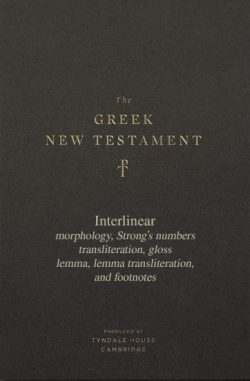
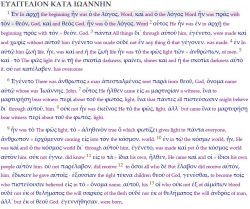
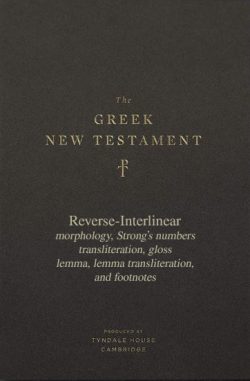
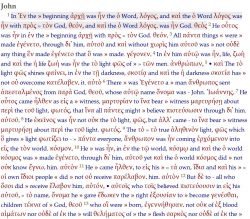
Crossway ESVified edition of The Greek New Testament Produced at Tyndale House Cambridge
The Greek New Testament is priceless in its value as it is how God has given us his revelation of the gospel and of Jesus Christ. While a few trusted Greek texts are in print, significant advances have been made in Greek translation studies of the New Testament since a standard text was adopted by academics in 1975. The Greek New Testament, Produced at Tyndale House, Cambridge has been created under the oversight of editors Dr. Dirk Jongkind (St. Edmund’s College, University of Cambridge) and Dr. Peter Williams (Tyndale House, Cambridge). Together with their team, they have taken a rigorously philological approach to reevaluating the standard text—reexamining spelling and paragraph decisions as well as allowing more recent discoveries related to scribal habits to inform editorial decisions. Ideal for students, scholars, and pastors alike, and published to coincide with the 500th anniversary of the Reformation, The Greek New Testament, Produced at Tyndale House, Cambridge is a groundbreaking contribution to biblical scholarship.

The New International Greek Testament Commentary: The Epistles to the Thessalonians
Series: The New International Greek Testament Commentary (NIGTC)
The letters of Paul to the newly founded Christian community at Thessalonica hold a special place within the Christian tradition as possibly the earliest extant Christian writings. They are also of special interest not only for their theological value but for their sociological context. Among the communities established by Paul, the church at Thessalonica appears to have been the only one to have suffered serious external oppression. These two important epistles, then, speak uniquely to contemporary Christians living in a society often ideologically, if not politically, opposed to Christian faith.
In this innovative commentary Charles A. Wanamaker incorporates what may be called a social science approach to the study of 1 and 2 Thessalonians, taking into full account the social context that gave rise to Paul’s correspondence. While Wanamaker in no way ignores traditional historical-critical, linguistic, literary, and theological approaches to writing a commentary — in fact, at several points he makes a significant contribution to the questions raised by traditional exegesis — at the same time he goes beyond previous commentaries on the Thessalonian correspondence by taking seriously the social dimensions both of Christianity at Thessalonica and of the texts of 1 and 2 Thessalonians themselves. In blending traditional exegetical methods with this newer approach, Wanamaker seeks to understand Pauline Christianity at Thessalonica as a socio-religious movement in the first-century Greco-Roman world and attempts to grasp the social character and functions of Paul’s letters within this context.
Author:
Charles A. Wanamaker, Associate professor in the department of religious studies and director of postgraduate studies at the University of Cape Town in South Africa. He received his doctorate in New Testament studies at the University of Durham under C. K. Barrett.
theWord Features: