
Strong’s Number Package
DESCRIPTION
Intermediate Hebrew Package
DESCRIPTION
Basic Hebrew Package
DESCRIPTION
Advanced Greek Package
DESCRIPTION
Intermediate Greek Package
DESCRIPTION
Basic Greek Package
DESCRIPTION
New Heart English Bible
While there are many Bible translations available, few are in the public domain in modern English, and even fewer in the public domain are based on the latest textual criticism using all available manuscripts. The goal of the New Heart English Bible (NHEB) project is to meet these requirements. The NHEB began with the public domain World English Bible, and was updated with consideration of all the available manuscripts.

theWord Features:
- Old and New Testament
- Fully searchable text
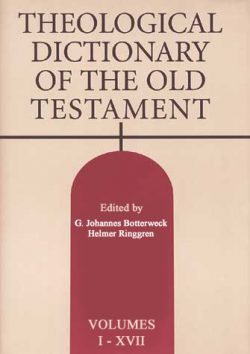
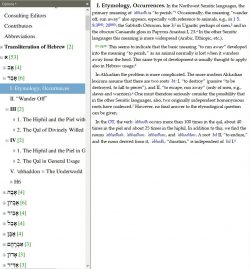
Theological Dictionary of the Old Testament, Volumes 1 – 17
DESCRIPTION
Series Editors: G. Johannes Botterweck, Helmer Ringgren, Heinz-Josef Fabry
This multivolume work is still proving to be as fundamental to Old Testament studies as its companion set, the Kittel-Friedrich Theological Dictionary of the New Testament, has been to New Testament studies.
Beginning with ‘ābh (‘āb), “father,” and continuing through the alphabet, the TDOT volumes present in-depth discussions of the key Hebrew and Aramaic words in the Old Testament. Leading scholars of various religious traditions (including Roman Catholic, Lutheran, Reformed, Anglican, Greek Orthodox, and Jewish) and from many parts of the world (Denmark, France, Germany, Great Britain, Greece, Israel, Italy, the Netherlands, Norway, Sweden, Switzerland, and the United States) have been carefully selected for each article by editors Botterweck, Ringgren, and Fabry and their consultants, George W. Anderson, Henri Cazelles, David Noel Freedman, Shemaryahu Talmon, and Gerhard Wallis.
The intention of the writers is to concentrate on meaning, starting from the more general, everyday senses and building to an understanding of theologically significant concepts. To avoid artificially restricting the focus of the articles, TDOT considers under each keyword the larger groups of words that are related linguistically or semantically. The lexical work includes detailed surveys of a word’s occurrences, not only in biblical material but also in other ancient Near Eastern writings. Sumerian, Akkadian, Egyptian, Ethiopic, Ugaritic, and Northwest Semitic sources are surveyed, among others, as well as the Qumran texts and the Septuagint; and in cultures where no cognate word exists, the authors often consider cognate ideas.
TDOT’s emphasis, though, is on Hebrew terminology and on biblical usage. The contributors employ philology as well as form-critical and traditio-historical methods, with the aim of understanding the religious statements in the Old Testament. Extensive bibliographical information adds to the value of this reference work.
This English edition attempts to serve the needs of Old Testament students without the linguistic background of more advanced scholars; it does so, however, without sacrificing the needs of the latter. Ancient scripts (Hebrew, Greek, etc.) are regularly transliterated in a readable way, and meanings of foreign words are given in many cases where the meanings might be obvious to advanced scholars. Where the Hebrew text versification differs from that of English Bibles, the English verse appears in parentheses. Such features will help all earnest students of the Bible to avail themselves of the manifold theological insights contained in this monumental work.
Note: Print edition is 17 volumes.
Print pages/price per volume on 12/11/2021 from Eerdmans.com
Volume I: 501pgs, $66.50
Volume II: 508pgs, $75.00
Volume III: 483pgs, $66.50
Volume IV: 513pgs, $75.00
Volume V: 543pgs, $76.50
Volume VI: 513pgs, $76.50
Volume VII: 578pgs, $66.50
Volume VIII: 584pgs, $76.50
Volume IX: 589pgs, $76.50
Volume X: 616pgs, $76.50
Volume XI: 639pgs, $66.50
Volume XII: 636pgs, $67.50
Volume XIII: 677pgs, $79.50
Volume XIV: 726pgs, $84.50
Volume XV: 821pgs, $68.50
Volume XVI: 932pgs, $75.00
Volume XVII: 845pgs, $75.00
Total print pages: 10,704
Total print price: $1,248.50
theWord Features
- Verse popups
- Fully searchable text
- Footnotes
- Easy navigation of topics via topics tree display.
- Hebrew Lemmas: אָב
- Aramaic Lemmas: שׂגי
- Strong’s Numbers: H1
- Special Text Colors
- Normal: Text
- Hyperlink: lit | Luke 20:21
- Page Number: [v1 pg21>
- Latin: septuaginta
- Transliteration: môrāʾ
- Hebrew: אָב
- Aramaic: שׂגי
- Greek: σαμβύκη
Handbook of Biblical Hebrew
DESCRIPTION
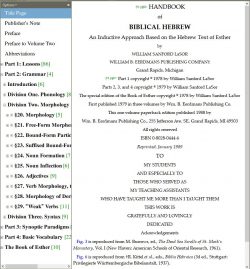
The Handbook, designed as a complete tool for the student of Biblical Hebrew, is the result of over twenty- five years of teaching the language. While it is primarily intended for use in Hebrew courses, it is also an excellent tool for a refresher course or useful as a basic grammatical reference work to aid the exegete. Similar in format to the author’s Handbook of New Testament Greek, it combines reading lessons (vol. 1) with grammar, paradigms, and basic vocabulary (vol. 2). William LaSor uses the inductive method, studying directly from the text, rather than the conventional method of language study in which beginning students learn the rules of grammar and syntax and memorize vocabulary, often without reading the actual text. Instead of memorizing numerous forms that will never be encountered in actual reading, the student learns only what he or she encounters.
The lessons are based on the Hebrew text of Esther, chosen because it presents little difficulty in theological or textual matters and has an excellent vocabulary. LaSor has included readings from other portions of the Bible, such as several chapters from Genesis, to introduce the student to Hebrew other than that found in Esther.
The diligent student of this method will learn not only the elements of Hebrew but also how to inductively study the language and how to learn by induction what the Hebrew text says.
theWord Features
- Verse popups
- Fully searchable text
- FootNotes
- Easy navigation of topics via topics tree display.
- Hebrew Lemmas: אָב
- Special Text Colors
- Normal: Text
- Hyperlink: §11.325| Esther 1:2BHS
- Page Number: [v2 pg1>
- Latin: plene
- Transliteration: bay-yā-mîym
- Hebrew: בַּיָּמִ֖ים

Wuest Word Studies in the Greek New Testament Vols 1-3
DESCRIPTION
These studies and translations of the Greek New Testament are simplified commentaries on the Greek text for the Bible student who is not conversant with the Greek language. The three-volume set includes commentaries on Mark, Romans, Galatians, Ephesians Colossians, Philippians, Hebrews, 1 Timothy, 2 Timothy, Titus, 1 Peter, 2 Peter, 1 John, 2 John, 3 John and Jude; graphic elucidations of selected passages, words, and phrases; and devotional studies on the teachings of Jesus and the apostles.
theWord Features
- Verse popups
- Fully searchable text
- Footnotes
- Easy navigation of topics via topics tree display.
- Special Text Colors
- Normal: Text
- Hyperlink: Luke 20:21
- Page Number: [pg 21>
- Greek: χρησις
- Hebrew: מֶ֫לֶךְ
- Transliterated Greek & Hebrew: euaggelion
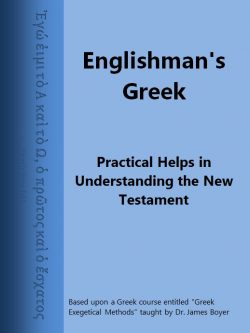
Englishman’s Greek
Practical Helps in Understanding the New Testament
Based upon a Greek course entitled “Greek Exegetical Methods” taught by Dr. James Boyer
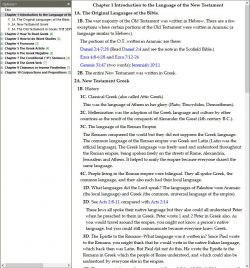
“This excellent study helps a beginner to Greek dive into the Greek New Testament. It is also a helpful review of Greek. This book will bringing you along in your exegetical study of the New Testament by reading Greek, word studies, and more.” – Jonathan Koehn
theWord Features:
- Verse popups
- Fully searchable text
- Easy navigation of topics via topics tree display.
- Special Text Colors
- Normal: Text
- Hyperlink: LXX | Luke 20:21
- Greek: ἑαυτούς
- Chiasmus: A Repent
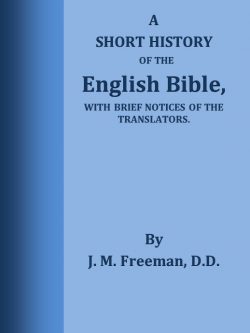
A Short History of the English Bible
WITH BRIEF NOTICES OF THE TRANSLATORS.
BY J. M. FREEMAN, D.D.
“Believers should ascertain for themselves the matters of their faith by having the Scriptures in a language which they fully understand.”—Wycliffe.
“If God spare my life, ere many years I will cause a boy that driveth the plow to know more of the Scriptures than the priests do.”—Tyndale.
theWord Features:
- Verse popups
- Fully searchable text
- Footnotes
- Pages links
- Easy navigation of topics via topics tree display.
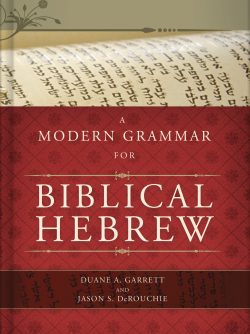
A Modern Grammar for Biblical Hebrew
DESCRIPTION
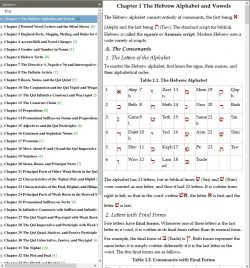
A Modern Grammar for Biblical Hebrew and its accompanying materials are designed for a two-semester course of study. The textbook’s structure, however, is intentionally set up to allow maximal use in both traditional and non-traditional academic settings. The format of the material gives instructors numerous options for customizing their syllabi.
theWord Features
- Verse popups
- Fully searchable text
- Footnotes
- Easy navigation of topics via topics tree display.
- Special Text Colors
- Normal: Text
- Hyperlink: LXX| Luke 20:21
- Page Number: [pg 21>
- Hebrew: מֶ֫לֶךְ
Beginning with New Testament Greek
DESCRIPTION
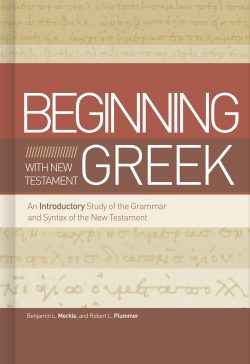
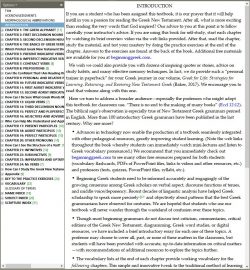
If you are a student who has been assigned this textbook, it is our prayer that it will help instill in you a passion for reading the Greek New Testament. After all, what is more exciting than reading the very words that God inspired? Our advice to you at this point is to follow carefully your instructor’s advice. If you are using this book for self-study, start each chapter by watching its brief overview video via the web links provided. After that, read the chapter, study the material, and test your mastery by doing the practice exercises at the end of the chapter. Answers to the exercises are found at the back of the book. Additional free materials are available for you at beginninggreek.com.
We wish we could also provide you with dozens of inspiring quotes or stories, advice on study habits, and many effective memory techniques. In fact, we do provide such a “personal trainer in paperback” for your Greek journey in our volume, Greek for Life: Strategies for Learning, Retaining, and Reviving New Testament Greek (Baker, 2017). We encourage you to read that volume along with this one.
Here we turn to address a broader audience—especially the professors who might adopt this textbook for classroom use. “There is no end to the making of many books” (Eccl 12:12). The biblical sage’s observation is especially true of New Testament Greek grammars penned in English. More than 100 introductory Greek grammars have been published in the last century. Why one more?
- Advances in technology now enable the production of a textbook seamlessly integrated with other pedagogical resources, greatly improving student learning. (Note the web links throughout the book whereby students can immediately watch mini-lectures and listen to Greek vocabulary pronounced.) We recommend that you immediately check out beginninggreek.comto see many other free resources prepared for both students (vocabulary flashcards, PDFs of PowerPoint files, links to videos and other resources, etc.) and professors (tests, quizzes, PowerPoint files, syllabi, etc.).
- Beginning Greek students need to be informed accurately and engagingly of the growing consensus among Greek scholars on verbal aspect, discourse functions of tenses, and middle voice/deponency. Recent decades of linguistic analysis have helped Greek scholarship to speak more precisely and objectively about patterns that the best Greek grammarians have observed for centuries. We are hopeful that students who use our textbook will never wander through the wasteland of confusion over these topics.
- Though most beginning grammars do not discuss text criticism, commentaries, critical editions of the Greek New Testament, diagramming, Greek word studies, or digital resources, we have included a brief introductory essay for each one of these topics. A professor may choose to cover all, part, or none of these matters in the classroom, but students will have been provided with accurate, up-to-date information on critical matters—with recommendations of additional resources to explore the topics further.
- The vocabulary lists at the end of each chapter provide working vocabulary for the followingchapters. This simple and innovative tweak to the traditional method of learning Greek vocabulary enables students to focus on new grammatical concepts without the distraction of learning many new words at the same time.
- Without sacrificing accuracy or essential detail, this textbook streamlines and consolidates essential Greek grammar into 24 chapters—giving professors maximum flexibility in choosing to cover the material in one or two semesters.
Though not original to our grammar, we also think the following features help increase its pedagogical effectiveness:
- Each chapter begins with a “significance” section—looking at specific text from the Greek New Testament that illustrates the meaning payoff of the new grammatical category that is being introduced.
- Chapters contain multiple practice exercises that isolate specific new skills before applying them to translation sentences.
- All translation sentences come directly from the Greek New Testament—a great encouragement to students who are learning Greek in order to read the Bible more faithfully. If you find the exercises at the end of the chapter are taking your students too long, feel free to assign only a percentage of them.
- An answer key is provided in the back of the book, allowing students to check their work immediately.
We love seeing students ablaze with a passion to read, understand, believe, obey, enjoy, and teach the Greek New Testament. It is our prayer and hope that this textbook aids in igniting that fire in many hearts.
theWord Features
- Verse popups
- Fully searchable text
- Footnotes
- Pages links
- Easy navigation of topics via topics tree display.
- Glossary of terms
- Name Index
- Subject Index
- Scripture Index
- Special Text Colors
- Normal: Text
- Hyperlink: LXX| Luke 20:21
- Page Number: [p21>
- Greek: Καλλίμαχος
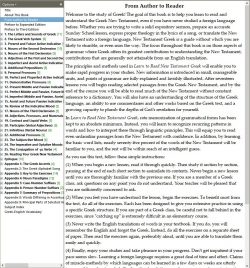
Learn to Read New Testament Greek
DESCRIPTION
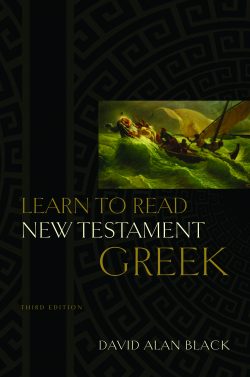
Welcome to the study of Greek! The goal of this book is to help you learn to read and understand the Greek New Testament, even if you have never studied a foreign language before. Whether you are trying to write a solid expository sermon, prepare an accurate Sunday School lesson, express proper theology in the lyrics of a song, or translate the New Testament into a foreign language, New Testament Greek is a guide without which you are likely to stumble, or even miss the way. The focus throughout this book is on those aspects of grammar where Greek offers its greatest contributions to understanding the New Testament, contributions that are generally not attainable from an English translation.
The principles and methods used in Learn to Read New Testament Greek will enable you to make rapid progress in your studies. New information is introduced in small, manageable units, and points of grammar are fully explained and lavishly illustrated. After seventeen lessons you will begin reading selected passages from the Greek New Testament, and by the end of the course you will be able to read much of the New Testament without constant reference to a dictionary. You will also have an understanding of the structure of the Greek language, an ability to use commentaries and other works based on the Greek text, and a growing capacity to plumb the depths of God’s revelation for yourself.
In Learn to Read New Testament Greek, rote memorization of grammatical forms has been kept to an absolute minimum. Instead, you will learn to recognize recurring patterns in words and how to interpret these through linguistic principles. This will equip you to read even unfamiliar passages from the New Testament with confidence. In addition, by learning the basic word lists, nearly seventy-five percent of the words of the New Testament will be familiar to you, and the rest will be within reach of an intelligent guess.
As you use this text, follow these simple instructions:
(1) When you begin a new lesson, read it through quickly. Then study it section by section, pausing at the end of each short section to assimilate its contents. Never begin a new lesson until you are thoroughly familiar with the previous one. If you are a member of a Greek class, ask questions on any point you do not understand. Your teacher will be pleased that you are sufficiently concerned to ask.
(2) When you feel you have understood the lesson, begin the exercises. To benefit most from the text, do all of the exercises. Each has been designed to give you extensive practice in using a specific Greek structure. If you are part of a Greek class, be careful not to fall behind in the exercises, since “catching up” is extremely difficult in an elementary course.
(3) Never write the English translations of words in your textbook. If you do, you will remember the English and forget the Greek. Instead, do all the exercises on a separate sheet of paper. Then read the exercises again, preferably aloud, until you are able to translate them easily and quickly.
(4) Finally, enjoy your studies and take pleasure in your progress. Don’t get impatient if your pace seems slow. Learning a foreign language requires a great deal of time and effort. Claims of miracle-methods by which languages can be learned in a few days or weeks are utterly irresponsible and unfounded. On the other hand, if you make proper use of your instruction, you will be surprised how rapidly you progress. By the end of the course, you will actually be reading your New Testament in the original Greek!
theWord Features
- Verse popups
- Fully searchable text
- Footnotes
- Section links
- Easy navigation of topics via topics tree display.
- Special Text Colors
- Normal: Text
- Hyperlink: §15| Luke 20:21
- Greek: Καλλίμαχος
Kingcomments (Deutsch)
Einleitung
Das Ziel der Kommentare besteht darin, das Lesen der Bibel anzuregen. Die ursprüngliche Webadresse der Kommentare ist www.kingcomments.com. Die Kommentare, die vorhanden sind, sind aus dem Niederländischen ins Deutsche übersetzt worden. Es ist vorgesehen, dass, so Gott will, im Laufe der Zeit die fehlenden Kommentare übersetzt und verfügbar gemacht werden. Die Kommentare sollen das persönlich Bibelstudium unterstützen. Die Bibelzitate, die in den Kommentaren vollständig wiedergegeben sind, sind der Elberfelder Übersetzung 2009 (Edition CSV Hückeswagen) entnommen.
Die Kommentare zu den Büchern Hiob, Psalmen und Jesaja habe ich gemeinsam mit Tony Jonathan geschrieben. Der Kommentar zu Hesekiel ist in enger Zusammenarbeit mit Ron Vellekoop entstanden.
Die Bibel ist das unfehlbare, ewige Wort Gottes. In der Bibel geht es um den Sohn Gottes, der Mensch wurde, um am Kreuz für sündige Menschen zu sterben. Gott hat Ihn von den Toten auferweckt und Er ist jetzt im Himmel. Jeder, der seine Sünden bekennt und an den Sohn und sein Versöhnungswerk am Kreuz glaubt, wird nicht verlorengehen, sondern ewiges Leben empfangen. So jemand ist ein Kind Gottes. Gott unterweist seine Kinder in seinem Wort, wie sie zu seiner Ehre leben können und was sie durch ihre Verbindung mit seinem Sohn geschenkt bekommen haben.
Hier de vertaling:
Dies sind Quellen, die aus Public-Domain-Materialien oder Materialien, für die eine Genehmigung erteilt wurde, konvertiert wurden. Die Wertschätzung gilt uns als WordBooks-Team dafür, dass wir die Zeit, das Geld für die Programmierung der Quellen und mehr investiert haben, um diese Quellen in das Format der Bibel-Software theWord zu konvertieren. Die Quellen sind mit allen verfügbaren Funktionen qualitativ hochwertig und konsistent formatiert und korrekt implementiert, damit sie sich wunderschön in theWord integrieren lassen. Sie können wählen, wie viel Wertschätzung Sie zeigen möchten, bevor Sie diese Quelle zum Einkaufswagen hinzufügen. Beispiel: $0 Keine Wertschätzung, $2, $10, bis zum vollen Betrag von $24.
theWord-Funktionen:
- Vers-Popups
- An Biblische referenzen gebunden
- Vollständig durchsuchbarer Text
- Einfache Navigation von Themen über die Themenbaumanzeige.
Kingcomments (Nederlands)
Inleiding
Het doel van dit commentaar is mensen aan te moedigen de Bijbel te lezen. Het commentaar is oorspronkelijk gepubliceerd op de website www.kingcomments.com. Van alle Bijbelboeken is een commentaar beschikbaar. De commentaren zijn bedoeld om te helpen de Bijbel persoonlijk te bestuderen. De Bijbelcitaten die in de commentaren voluit geschreven zijn, komen uit de Herziene Statenvertaling als het een citaat uit het Oude Testament betreft en uit de TELOS-vertaling als het een citaat uit het Nieuwe Testament betreft.
De commentaren over Job, Psalmen en Jesaja zijn samen met Tony Jonathan geschreven. Het commentaar over Ezechiël is geschreven in nauwe samenwerking met Ron Vellekoop.
De Bijbel is het onfeilbare, eeuwige Woord van God. De Bijbel gaat over de Zoon van God, Die Mens werd om aan het kruis te sterven voor zondige mensen. God heeft Hem opgewekt uit de dood en Hij is nu in de hemel. Ieder die zijn zonden belijdt en gelooft in de Zoon en Zijn verzoeningswerk op het kruis, zal niet verloren gaan, maar ontvangt het eeuwige leven. Zo iemand is een kind van God. God vertelt Zijn kinderen in Zijn Woord hoe zij tot Zijn eer kunnen leven en alles wat Hij van plan is hun te geven, vanwege hun verbinding met Zijn Zoon.
Waardering Bron:
Deze module is omgezet vanuit het publieke domein of er is toestemming gegeven om dit materiaal te gebruiken. De waardering is voor ons als theWordBooks Team voor het besteden van tijd, geld voor het programmeren en meer activiteiten om de module om te zetten naar het theword Bible software formaat. De module voldoet aan de vereisten voor kwaliteit en consistentie waarbij alle functies op een correcte wijze zijn geïmplementeerd zodat ze op een mooie wijze geïntegreerd zijn in theWord. U kunt kiezen hoeveel waardering u wilt geven voordat u de module in de winkelkar plaatst. Bijv. $0 voor geen waardering, $2, $10, tot het volledige bedrag van $24.
theWord Functies:
- Vers pop-ups
- Gebonden aan Bijbelse verwijzingen
- Volledig doorzoekbare tekst
- Gemakkelijke navigatie van onderwerpen via de weergave van de onderwerpenboom.
The New Testament An Expanded Translation by Kenneth Wuest (Commentary Style)
theWord Features: