
Martyr’s Mirror
Description:
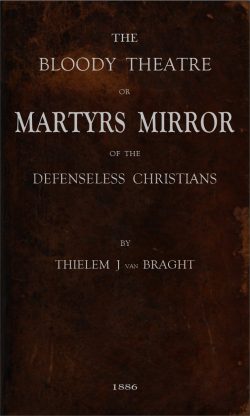
THE
BLOODY THEATRE,
OR
MARTYRS MIRROR
OF THE
DEFENSELESS CHRISTIANS,
who baptized only upon Confession of Faith, and who suffered and died for the testimony of Jesus, their Savior, from the time of Christ to the year A. D. 1660.
COMPILED FROM VARIOUS AUTHENTIC CHRONICLES, MEMORIALS, AND TESTIMONIES, BY
THIELEM J. van BRAGHT.
Translated from the original Dutch or Holland language from the Edition of 1660,
BY JOSEPH F. SOHM.
As the English language, year by year, becomes more prevalent among our Mennonite people, the necessity of presenting to them in that language the doctrines, teachings and practices, as well as the story of the sufferings, the faithful endurance and the final triumphant deaths, of those of like faith with us who lived in the earlier ages of Christianity, becomes apparent to every reflecting mind.
These doctrines, teachings and practices together with the examples of faithful devotion to Christ and his word, and the unfaltering endurance under the severest persecution, are powerful incentives to Christians to-day, to inspire many sincere souls to live a more consecrated life, to practice greater self-denial, to live more separated from the world, and show a greater zeal in the work of the Lord and the salvation of souls; and they are especially precious to us, as Mennonites, because through these people it pleased God to hand down to us the living exemplification of the peculiar tenets and doctrines which we hold and practice at the present day.
The reading of books of this kind will also help us to appreciate more highly the privileges with which God has blessed us above our forefathers. While they oftentimes were not permitted to have permanent places of abode, and were driven about and hunted down like wild beasts, compelled to dwell in caves and mountains, and other secluded places, hold their meetings in secret, and suffer every imaginable form of injustice and persecution, because to be a true follower of Christ in those days was considered the very worst of crimes, we enjoy all the privileges of citizenship and are protected in the fullest enjoyment of our religion and forms of worship.
It is the duty of the Church to maintain and teach the pure gospel of Jesus Christ and to transmit the same to coming generations, and as we contemplate these facts, what a glorious treasure of pure Christian devotion shines forth in these pages of the Story of the Martyrs, and how much this grand record of their sufferings has done, and may yet do to perpetuate the pure doctrines of the gospel, eternity alone will reveal.
For these reasons and many others that might be referred to, the publishers of this edition, have, in the fear of God, for the promotion of his glory, undertaken the publication of “The Bloody Theatre or Martyrs Mirror” and herewith give it to the public, in the hope that it may be the means of promoting the glory of God and of doing much good among the children of men.
Note.—The translation of this work was made from the Dutch Edition of 1660, and where questions of doubt occurred, the edition of 1685 as well as the German editions were consulted.

theWord Features:
- Verse popups
- Fully searchable text
- Easy navigation of topics via topics tree display.
- Footnotes
- Pages links
- Special Text Colors
- Normal: Text
- Hyperlink: Gen. 9:8
- Page Number: [pg 21>
Handbook of Biblical Hebrew
DESCRIPTION
The Handbook, designed as a complete tool for the student of Biblical Hebrew, is the result of over twenty- five years of teaching the language. While it is primarily intended for use in Hebrew courses, it is also an excellent tool for a refresher course or useful as a basic grammatical reference work to aid the exegete. Similar in format to the author’s Handbook of New Testament Greek, it combines reading lessons (vol. 1) with grammar, paradigms, and basic vocabulary (vol. 2). William LaSor uses the inductive method, studying directly from the text, rather than the conventional method of language study in which beginning students learn the rules of grammar and syntax and memorize vocabulary, often without reading the actual text. Instead of memorizing numerous forms that will never be encountered in actual reading, the student learns only what he or she encounters.
The lessons are based on the Hebrew text of Esther, chosen because it presents little difficulty in theological or textual matters and has an excellent vocabulary. LaSor has included readings from other portions of the Bible, such as several chapters from Genesis, to introduce the student to Hebrew other than that found in Esther.
The diligent student of this method will learn not only the elements of Hebrew but also how to inductively study the language and how to learn by induction what the Hebrew text says.
theWord Features
- Verse popups
- Fully searchable text
- FootNotes
- Easy navigation of topics via topics tree display.
- Hebrew Lemmas: אָב
- Special Text Colors
- Normal: Text
- Hyperlink: §11.325| Esther 1:2BHS
- Page Number: [v2 pg1>
- Latin: plene
- Transliteration: bay-yā-mîym
- Hebrew: בַּיָּמִ֖ים
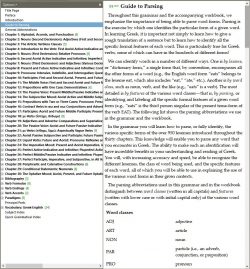
Fundamentals of New Testament Greek
DESCRIPTION
Request instructor resources
Get the workbook
“We know that this book works and will take students to a level not often achieved through other beginning textbooks.” So say Stanley Porter and his coauthors in the preface to their Fundamentals of New Testament Greek — an ambitious, comprehensive introduction to the grammar and vocabulary of the Greek New Testament.
This first-year Greek textbook discusses all the forms and basic syntax of Koine Greek, complete with extensive paradigms, examples, and explanations. Porter, Reed, and O’Donnell’s Fundamentals of New Testament Greek features pedagogically sound and linguistically informed techniques of language instruction. The volume introduces the individual words and grammatical details of Greek, sensitive to their frequency of use in the New Testament, reinforcing for students the elements that they will most often encounter. Grammatical forms, including the less common ones, are analyzed and explained in detail, often with illustrative examples from the Greek New Testament. The authors include complete paradigms and give numerous examples; the vocabulary list includes nearly one thousand words, which are introduced throughout the book’s thirty chapters.
Students who complete this text will be able to move directly into Greek exegesis courses and more advanced Greek-language courses. Fundamentals of New Testament Greek will prove invaluable for gaining a thorough foundational understanding of New Testament Greek, including full exposure to the formation, accenting, and semantics of its complex verbal system.
Read more about the book in a blog post by its editor, Craig Noll, on EerdWord.
theWord Features
- Verse popups
- Footnote popups
- Terms explained popups
- Fully searchable text
- Easy navigation via topics tree display.
- Lemmas (which can be used with Bibles that have Lemmas)
- Special Text Colors
- Normal: Text
- Hyperlink: Nom | Rev. 7:12
- Page Number: [pg 21>
- Latin: exempli gratia
- Transliteration: ang-gelos
- Greek: σωμάτων
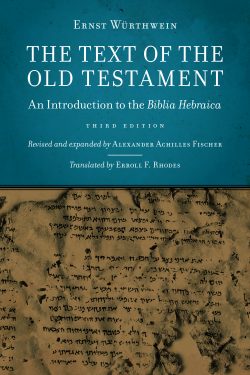
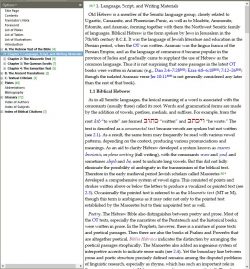
The Text of the Old Testament, An Introduction to the Biblia Hebraica, THIRD EDITION
DESCRIPTION
Major revision of a landmark work in Old Testament scholarship
Ernst Würthwein’s introduction to the Biblia Hebraica has long served as a textbook for generations of students interested in the history of the Old Testament text and the problems of textual criticism. From its first appearance in 1952 to the fifth German edition in 1988, the book was faithfully updated by Würthwein himself in light of new research. But now a new edition of “Würthwein” is due.
While staying true to the original structure and character of Würthwein’s classic work, Alexander Fischer has rewritten the text completely to bring it up to date with the new Quinta edition of Biblia Hebraica. Besides updating information throughout, this edition includes a new chapter on the texts from the Qumran. This third edition of The Text of the Old Testament will be an indispensable resource for serious students of the Biblia Hebraica and Old Testament exegesis.
theWord Features:
- Verse popups
- Abbreviation popups
- Fully searchable text
- Easy navigation of topics via topics tree display.
- Images
- Special Text Colors
- Normal: Text
- Hyperlink: BHS | Deut 34:10-12BHS
- Page Number: pg 21
- Latin: supra
- Transliteration: qādēs̆: ṭāhēr
- Greek: σωμάτων
- Hebrew: מִשְׁפָּט
- Aramaic: כְּתִיב
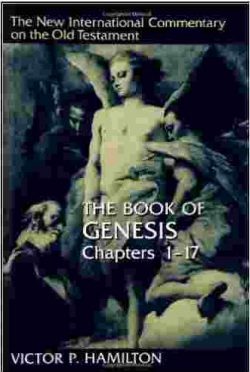
New International Commentary: The Book of Genesis, Chapters 1–17
PRODUCT HIGHLIGHTS:
- Verse-by-verse commentary
- In-depth discussion of textual and critical matters
- Introductions to each book’s authorship, date, purpose, structure, and theology
- Detailed bibliography
DESCRIPTION
The first of Victor P. Hamilton’s two-volume study of Genesis in the NICOT series, this commentary contributes a solid, thorough explication of the wealth and depth of material embedded in Scripture’s foundational book.
Hamilton’s substantive introduction—which serves both this volume and the one covering chapters 18–50—discusses the structure of Genesis and its composition, its theology, the problems involved in its interpretation, its canonicity, and the Hebrew text itself. The commentary proper, based on Hamilton’s own translation, evidences his extensive knowledge of the ancient Near East and of contemporary scholarship, including literary, form, and text criticism. Siding with the arguments in favor of the literary and theological unity of the Genesis text, Hamilton stresses the main theme running throughout the book—God’s gracious promise of blessing and reconciliation in the face of evil and sin.
A unique feature of this book is Hamilton’s emphasis on the reading of Genesis by the New Testament community. Following his commentary on each section of Genesis, he discusses where and how the New Testament appropriated material from that section and incorporated it into the message of the New Covenant.
….
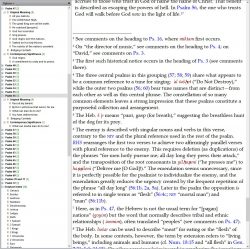
NIV Application Commentary: Haggai & Zechariah
DESCRIPTION
The books of Haggai and Zechariah are rarely recognized for the formative role they play in Israel’s history and the NT understanding of Christ.
In Haggai, Zechariah [NIVAC] Mark Boda shows us that the books tell of a golden period in Old Testament history, but that these prophets also speak powerfully to the church today. They call us to a community of faith, to the priority of God’s house, and inspire us with glimpses of its future glory.
Book Summary
The NIV Application Commentary helps readers with the vital task of bringing the ancient message of the Bible into a contemporary context. It gives preachers and teachers the tools, ideas, and insights they need to communicate God’s Word with the same powerful impact it had when it was first written.
About the Book
The NIV Application Commentary helps you communicate and apply biblical text effectively in today’s context.
To bring the ancient messages of the Bible into today’s context, each passage is treated in three sections:
- Original Meaning. Concise exegesis to help readers understand the original meaning of the biblical text in its historical, literary, and cultural context.
- Bridging Contexts. A bridge between the world of the Bible and the world of today, built by discerning what is timeless in the timely pages of the Bible.
- Contemporary Significance. This section identifies comparable situations to those faced in the Bible and explores relevant application of the biblical messages. The author alerts the readers of problems they may encounter when seeking to apply the passage and helps them think through the issues involved.
This unique, award-winning commentary is the ideal resource for today’s preachers, teachers, and serious students of the Bible, giving them the tools, ideas, and insights they need to communicate God’s Word with the same powerful impact it had when it was first written.
theWord Features:
- Verse popups
- Verse (span) synchronization
- Fully searchable text
- Footnotes
- Pages links
- Easy navigation of topics via topics tree display.
- Scripture Index
- Subject Index
- Author Index
- Special Text Colors
- Normal: Text
- Hyperlink: Glossary | Gen. 9:8
- Page Number: [pg 21>
- Greek Transliteration: archon
- Greek: εὐδόκησα
- Hebrew Transliteration: weʿattah
- Hebrew: יָרֵךְ
Note: Does not display commentary under Bible text.
NIV Application Commentary: Revelation
DESCRIPTION
The Book of Revelation has been the subject of endless speculation, study, and debate both responsible and irresponsible. Indeed, discussion about the book is so overwhelming one often feels like simply leaving it be. Yet, as we all recognize, this difficult and troubling book is part of God’s word for our lives. But who to trust?
Revelation [NIVAC] written by a top evangelical NT scholar and a researcher who is second to none, Craig S. Keener, is one of the most trustworthy commentators active today. With an affinity for exhaustive work, Keener, in this instance masterfully distills a wealth of research into a compact volume that should meet the needs of all those interested in Revelation. Clearly written, with minimal technical jargon, and thoughtful analysis and application of the book, Keener’s work is a monumental achievement.
Book Summary
The NIV Application Commentary helps readers with the vital task of bringing the ancient message of the Bible into a contemporary context. It gives preachers and teachers the tools, ideas, and insights they need to communicate God’s Word with the same powerful impact it had when it was first written.
About the Book
The NIV Application Commentary helps you communicate and apply biblical text effectively in today’s context.
To bring the ancient messages of the Bible into today’s context, each passage is treated in three sections:
- Original Meaning. Concise exegesis to help readers understand the original meaning of the biblical text in its historical, literary, and cultural context.
- Bridging Contexts. A bridge between the world of the Bible and the world of today, built by discerning what is timeless in the timely pages of the Bible.
- Contemporary Significance. This section identifies comparable situations to those faced in the Bible and explores relevant application of the biblical messages. The author alerts the readers of problems they may encounter when seeking to apply the passage and helps them think through the issues involved.
This unique, award-winning commentary is the ideal resource for today’s preachers, teachers, and serious students of the Bible, giving them the tools, ideas, and insights they need to communicate God’s Word with the same powerful impact it had when it was first written.
theWord Features:
- Verse popups
- Verse (span) synchronization
- Fully searchable text
- Footnotes
- Pages links
- Easy navigation of topics via topics tree display.
- Scripture Index
- Other Ancient Sources
- Subject Index
- Author Index
- Special Text Colors
- Normal: Text
- Hyperlink: Glossary | Gen. 9:8
- Page Number: [pg 21>
- Greek Transliteration: archon
- Greek: εὐδόκησα
Note: Does not display commentary under Bible text.
NIV Application Commentary: Ezekiel
DESCRIPTION
When you are attempting to understand a book as enigmatic and as flatly strange as Ezekiel, you want a skill experienced guide who maintains a firm doctrinal grounding. Ian Duguid, author of this commentary Ezekiel [NIVAC] was a perfect selection for this job by editors of the NIVAC series as he has written extensively on the prophets and understand the critical task of translating their seemingly other worldly message into the lives of Christians today.
With a rarely-matched mastery of the entire prophetic corpus, Iain Duguid reminds us the message is as relevant today as in Ezekiel’s day. This world is not our home, but we can learn to live as exiles, with endurance and hope.
Book Summary
The NIV Application Commentary helps readers with the vital task of bringing the ancient message of the Bible into a contemporary context. It gives preachers and teachers the tools, ideas, and insights they need to communicate God’s Word with the same powerful impact it had when it was first written.
About the Book
The NIV Application Commentary helps you communicate and apply biblical text effectively in today’s context.
To bring the ancient messages of the Bible into today’s context, each passage is treated in three sections:
- Original Meaning. Concise exegesis to help readers understand the original meaning of the biblical text in its historical, literary, and cultural context.
- Bridging Contexts. A bridge between the world of the Bible and the world of today, built by discerning what is timeless in the timely pages of the Bible.
- Contemporary Significance. This section identifies comparable situations to those faced in the Bible and explores relevant application of the biblical messages. The author alerts the readers of problems they may encounter when seeking to apply the passage and helps them think through the issues involved.
This unique, award-winning commentary is the ideal resource for today’s preachers, teachers, and serious students of the Bible, giving them the tools, ideas, and insights they need to communicate God’s Word with the same powerful impact it had when it was first written.
theWord Features:
- Verse popups
- Verse (span) synchronization
- Fully searchable text
- Footnotes
- Pages links
- Easy navigation of topics via topics tree display.
- Scripture Index
- Subject Index
- Author Index
- Special Text Colors
- Normal: Text
- Hyperlink: Glossary | Gen. 9:8
- Page Number: [pg 21>
- Greek Transliteration: archon
- Greek: εὐδόκησα
- Hebrew Transliteration: mašmîm
Note: Does not display commentary under Bible text.
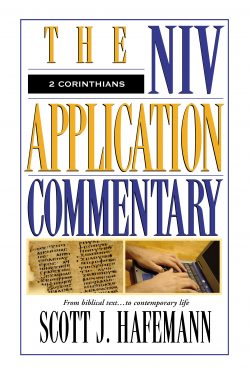
NIV Application Commentary: 2 Corinthians
DESCRIPTION
The second letter Paul addressed to the eminently troubled church in Corinth is the most ministerially difficult and personally complex of all Paul’s letters. It brims with passionate self-defense, intense concern for the eternal destiny of the Corinthians, and even anger.
In 2 Corinthians [NIVAC] Scott J. Hafeman reconciles three key themes to one another that are critical to rightly understanding Paul’s second Corinthian letter: weakness, sufficiency, and the Holy Spirit. The weakness is Paul’s personally ability to succeed, the sufficiency is the fact that Paul does succeed, in spite of his weakness and the Holy Spirit is the power that enables this sufficiency in spite of weakness to occur. And in as much as these realities are true for Paul in his own life, he desperately wishes the Corinthians to accept them as well.
Book Summary
The NIV Application Commentary helps readers with the vital task of bringing the ancient message of the Bible into a contemporary context. It gives preachers and teachers the tools, ideas, and insights they need to communicate God’s Word with the same powerful impact it had when it was first written.
About the Book
The NIV Application Commentary helps you communicate and apply biblical text effectively in today’s context.
To bring the ancient messages of the Bible into today’s context, each passage is treated in three sections:
- Original Meaning. Concise exegesis to help readers understand the original meaning of the biblical text in its historical, literary, and cultural context.
- Bridging Contexts. A bridge between the world of the Bible and the world of today, built by discerning what is timeless in the timely pages of the Bible.
- Contemporary Significance. This section identifies comparable situations to those faced in the Bible and explores relevant application of the biblical messages. The author alerts the readers of problems they may encounter when seeking to apply the passage and helps them think through the issues involved.
This unique, award-winning commentary is the ideal resource for today’s preachers, teachers, and serious students of the Bible, giving them the tools, ideas, and insights they need to communicate God’s Word with the same powerful impact it had when it was first written.
theWord Features:
- Verse popups
- Verse (span) synchronization
- Fully searchable text
- Footnotes
- Pages links
- Easy navigation of topics via topics tree display.
- Scripture Index
- Subject Index
- Special Text Colors
- Normal: Text
- Hyperlink: Glossary | Gen. 9:8
- Page Number: [pg 21>
- Greek Transliteration: archon
- Greek: εὐδόκησα
Note: Does not display commentary under Bible text.
Theological Dictionary of the NT: Abridged in One Volume (TDNTa)
This dictionary is a landmark Greek dictionary which has come to us through a lot of people and years of scholarship dedicated to making this scholarly work available. One of the neat features about this work is that it has Strongs numbers, so those who are not proficient in the Greek language can still use the work, working off of the Strong’s Greek Numbers.
Note that there is a foundational work back to Gerhard Kittel, and thus that work is called “Big Kittels” or just “Kittel”, and there is the present work we are offering which is abridged, and called “Little Kittels”. The unabridged Kittel is very large, and has very long and detailed studies on each word, including a lot of linguistics, Greek, German, Latin, Hebrew, etc. It is a very scholarly work, and understood best “by scholars” (very educated scholars at that). Little Kittel though has been edited so as to delete most of that, and leave a simple work that most laymen could understand (and most Bible students with normal Greek abilities, or no Greek abilities at all, in the style of Strong’s Lexicon perhaps).
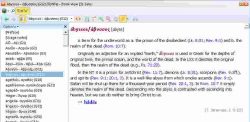
For actual samples of articles in the dictionary, click on the image at left (a popup viewer should open) and then use the left-right arrow keys on the keyboard, or click on the far left or far right arrows on the image itself.
The samples are:
ábyssos/άβυσσος [abyss]
agathós/αγαθός [good],
ángelos/άγγελος [messenger, angel],
kýrios/κύριος [Lord, lord], -searching dictionary for a word
kýrios/κύριος [Lord, lord], – searching using Strongs Number
mágos/μάγος [magician, Magus],
méli/μέλι [honey]
New International Commentary: The Gospel of Luke
PRODUCT HIGHLIGHTS:
- Verse-by-verse commentary
- In-depth discussion of textual and critical matters
- Introductions to each book’s authorship, date, purpose, structure, and theology
- Detailed bibliography
DESCRIPTION
This highly original commentary on the Gospel of Luke is unique for the way it combines concerns with first-century culture in the Roman world with understanding the text of Luke as a wholistic, historical narrative. Focusing primarily on how each episode functions within Luke’s narrative development, Joel B. Green provides countless fresh perspectives on and new insights into the Third Gospel. His extended examination of Luke’s literary art and Luke’s narrative theology allows the Evangelist to address clearly and convincingly both ancient and contemporary readers.
Insisting on the narrative unity of Luke–Acts, Green highlights in this volume the centrality of God’s purpose to bring salvation to all people. Against the backdrop of the conflicted first-century world of the Mediterranean, Green proposes that the purpose of Luke–Acts would have been to strengthen the early Christians in the face of opposition by assuring them in their interpretation and experience of the redemptive purpose and faithfulness of God and by calling them to continued faithfulness and witness in God’s salvific project.
….
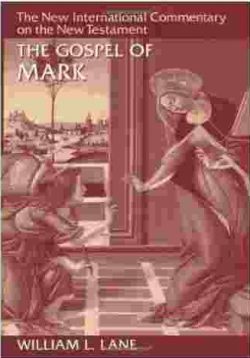
New International Commentary: The Gospel of Mark
PRODUCT HIGHLIGHTS:
- Verse-by-verse commentary
- In-depth discussion of textual and critical matters
- Introductions to each book’s authorship, date, purpose, structure, and theology
- Detailed bibliography
DESCRIPTION
The Gospel of Mark is significant in many ways. Not only was it the first Gospel to be written and an important literary source for Matthew and Luke, but it is also best characterized as a witness document, a proclamation of salvation through Jesus Christ, which received its creative impulse from the early apostolic preaching. Mark bears witness to the word of revelation that Jesus is the Messiah, the Son of God.
In this widely praised commentary by William L. Lane, Mark is revealed as a theologian whose primary intention was the strengthening of the people of God in a time of fiery persecution by Nero. Using redaction criticism as a hermeneutical approach for understanding the text and the intention of the evangelist, Lane considers the Gospel of Mark as a total literary work and describes Mark’s creative role in shaping the Gospel tradition and in exercising a conscious theological purpose. By taking care to indicate how the text was heard by Mark’s contemporaries while also placing the study of Mark within the frame of reference offered by modern Gospel research, Lane has constructed a thorough going work that is at once useful to scholars and highly intelligible to nonspecialists.
….

Revelation: A Shorter Commentary
DESCRIPTION
G. K. Beale’s monumental New International Greek Testament Commentary volume on Revelation has been highly praised since its publication in 1999. This shorter commentary distills the superb grammatical analysis and exegesis from that tome (over 1,300 pages) into a book more accessible and pertinent to preachers, students, and general Christian readers.
As in the original commentary, Beale views Revelation as an integrated whole, as a conscious continuation of the Old Testament prophetic books, and shows that recognizing Revelation’s nearly constant use of Old Testament allusions is key to unlocking its meaning. Interspersed throughout the volume are more than sixty sets of “Suggestions for Reflection” to help readers better grasp the relevance of Revelation to their lives and our world today.
theWord Features:
- Revelation verse-range synchronization
- Verse popups and Bible links
- Chapter, section, and index topic navigation
- Fully searchable commentary text
- Internal cross-references
- Native commentary tables
- Native cover image
- Print-page markers and navigation
- Pgs: 576
- Special Text Colors
- Normal: Text
-
Scripture: Revelation 1:1
- Greek Transliteration: sēmainō
- Page Number: [p1>
- Latin: ex nihilo
NIV Application Commentary: Ecclesiastes & Song of Solomon
DESCRIPTION
The Books of Ecclesiastes/Song of Songs present unique difficulties to readers—the challenge of reading the texts in themselves and seeing them as intrinsic parts of Scripture. In this newest volume in The NIV Application Commentary, Iain Provan wrestles honestly with the grammar and syntax issues of Ecclesiastes and the interpretation options of the Song of Songs, portraying both books as deeply relevant to the contemporary church and culture. 432 pages, hardcover, Zondervan.
Book Summary
The NIV Application Commentary helps readers with the vital task of bringing the ancient message of the Bible into a contemporary context. It gives preachers and teachers the tools, ideas, and insights they need to communicate God’s Word with the same powerful impact it had when it was first written.
About the Book
The NIV Application Commentary helps you communicate and apply biblical text effectively in today’s context.
To bring the ancient messages of the Bible into today’s context, each passage is treated in three sections:
- Original Meaning. Concise exegesis to help readers understand the original meaning of the biblical text in its historical, literary, and cultural context.
- Bridging Contexts. A bridge between the world of the Bible and the world of today, built by discerning what is timeless in the timely pages of the Bible.
- Contemporary Significance. This section identifies comparable situations to those faced in the Bible and explores relevant application of the biblical messages. The author alerts the readers of problems they may encounter when seeking to apply the passage and helps them think through the issues involved.
This unique, award-winning commentary is the ideal resource for today’s preachers, teachers, and serious students of the Bible, giving them the tools, ideas, and insights they need to communicate God’s Word with the same powerful impact it had when it was first written.
theWord Features:
- Verse popups
- Verse (span) synchronization
- Fully searchable text
- Footnotes
- Pages links
- Easy navigation of topics via topics tree display.
- Scripture Index
- Subject Index
- Special Text Colors
- Normal: Text
- Hyperlink: Glossary | Gen. 9:8
- Page Number: [pg 21>
- Greek Transliteration: adelphen gynaika
Hebrew Transliteration: raqqa
Note: Does not display commentary under Bible text.
NIV Application Commentary: Jeremiah & Lamentations
DESCRIPTION
Jeremiah & Lamentations [NIVAC] treats readers to the excellant compositional skills and exceptional scholarly acumen and judgment of J. Andrew Dearman. Dearman holds that the prophetic books, unlike many modern scholars, are in fact prophetic and reflect their own culture while pointing towards the fulfillment of the covenant in Jesus Christ. Covenant, and its renewal takes center stage in Jeremiah’s writings and Dearman masterfully expounds the text and draws application in this direction.
Book Summary
The NIV Application Commentary helps readers with the vital task of bringing the ancient message of the Bible into a contemporary context. It gives preachers and teachers the tools, ideas, and insights they need to communicate God’s Word with the same powerful impact it had when it was first written.
About the Book
The NIV Application Commentary helps you communicate and apply biblical text effectively in today’s context.
To bring the ancient messages of the Bible into today’s context, each passage is treated in three sections:
- Original Meaning. Concise exegesis to help readers understand the original meaning of the biblical text in its historical, literary, and cultural context.
- Bridging Contexts. A bridge between the world of the Bible and the world of today, built by discerning what is timeless in the timely pages of the Bible.
- Contemporary Significance. This section identifies comparable situations to those faced in the Bible and explores relevant application of the biblical messages. The author alerts the readers of problems they may encounter when seeking to apply the passage and helps them think through the issues involved.
This unique, award-winning commentary is the ideal resource for today’s preachers, teachers, and serious students of the Bible, giving them the tools, ideas, and insights they need to communicate God’s Word with the same powerful impact it had when it was first written.
theWord Features:
- Verse popups
- Verse (span) synchronization
- Fully searchable text
- Footnotes
- Pages links
- Easy navigation of topics via topics tree display.
- Scripture Index
- Subject Index
- Special Text Colors
- Normal: Text
- Hyperlink: Glossary | Gen. 9:8
- Page Number: [pg 21>
- Greek Transliteration: archon
- Greek: εὐδόκησα
- Hebrew Transliteration: bat ṣiyyon
- Hebrew: בַת צִיֹּון
Note: Does not display commentary under Bible text.
NIV Application Commentary: Hebrews
DESCRIPTION
The Bringing the Bible to Life provides an introduction to the biblical book, six to twelve sessions with discussion questions, and a closing section that assists the reader in responding to God’s Word in a group or individually.
8 Sessions on Hebrews Include:
-Pay Attention: Jesus is Great!
-Hang On: Jesus Is One of Us!
-Be Careful to Learn from the Past
-Draw Near Because We Have a Better Priest
-Encourage One Another, for God Is Faithful
-Keep Going: It Really Matters!
-Run the Race: The Torch Is Now Yours!
-Be Holy: God Will Be Pleased
Book Summary
The NIV Application Commentary helps readers with the vital task of bringing the ancient message of the Bible into a contemporary context. It gives preachers and teachers the tools, ideas, and insights they need to communicate God’s Word with the same powerful impact it had when it was first written.
About the Book
The NIV Application Commentary helps you communicate and apply biblical text effectively in today’s context.
To bring the ancient messages of the Bible into today’s context, each passage is treated in three sections:
- Original Meaning. Concise exegesis to help readers understand the original meaning of the biblical text in its historical, literary, and cultural context.
- Bridging Contexts. A bridge between the world of the Bible and the world of today, built by discerning what is timeless in the timely pages of the Bible.
- Contemporary Significance. This section identifies comparable situations to those faced in the Bible and explores relevant application of the biblical messages. The author alerts the readers of problems they may encounter when seeking to apply the passage and helps them think through the issues involved.
This unique, award-winning commentary is the ideal resource for today’s preachers, teachers, and serious students of the Bible, giving them the tools, ideas, and insights they need to communicate God’s Word with the same powerful impact it had when it was first written.
theWord Features:
- Verse popups
- Verse (span) synchronization
- Fully searchable text
- Footnotes
- Pages links
- Easy navigation of topics via topics tree display.
- Scripture Index
- Subject Index
- Special Text Colors
- Normal: Text
- Hyperlink: Glossary | Gen. 9:8
- Page Number: [pg 21>
- Greek Transliteration: archon
- Greek: εὐδόκησα
Note: Does not display commentary under Bible text.
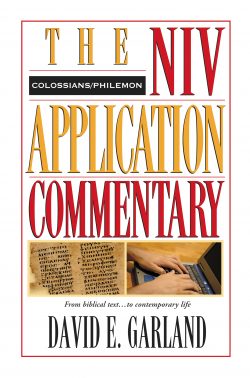
NIV Application Commentary: Colossians & Philemon
DESCRIPTION
From the Back Cover
Most Bible commentaries take us on a one-way trip from the twentieth century to the first century. But they leave us there, assuming that we can somehow make the return journey on our own. In other words, they focus on the original meaning of the passage but don’t discuss its contemporary application. The information they offer is valuable — but the job is only half done!
The NIV Application Commentary Series helps us with both halves of the interpretive task. This new and unique series shows readers how to bring an ancient message into a modern context. It explains not only what the Bible meant but also how it can speak powerfully today.
–This text refers to the hardcover edition.
Book Summary
The NIV Application Commentary helps readers with the vital task of bringing the ancient message of the Bible into a contemporary context. It gives preachers and teachers the tools, ideas, and insights they need to communicate God’s Word with the same powerful impact it had when it was first written.
About the Book
The NIV Application Commentary helps you communicate and apply biblical text effectively in today’s context.
To bring the ancient messages of the Bible into today’s context, each passage is treated in three sections:
- Original Meaning. Concise exegesis to help readers understand the original meaning of the biblical text in its historical, literary, and cultural context.
- Bridging Contexts. A bridge between the world of the Bible and the world of today, built by discerning what is timeless in the timely pages of the Bible.
- Contemporary Significance. This section identifies comparable situations to those faced in the Bible and explores relevant application of the biblical messages. The author alerts the readers of problems they may encounter when seeking to apply the passage and helps them think through the issues involved.
This unique, award-winning commentary is the ideal resource for today’s preachers, teachers, and serious students of the Bible, giving them the tools, ideas, and insights they need to communicate God’s Word with the same powerful impact it had when it was first written.
theWord Features:
- Verse popups
- Verse (span) synchronization
- Fully searchable text
- Footnotes
- Pages links
- Easy navigation of topics via topics tree display.
- Scripture Index
- Subject Index
- Special Text Colors
- Normal: Text
- Hyperlink: Glossary | Gen. 9:8
- Page Number: [pg 21>
- Greek Transliteration: archon
- Greek׃ θλίβω
- Hebrew: א
Note: Does not display commentary under Bible text.
The New International Greek Testament Commentary: The Epistle of James
(These are resources that are being developed. There is no release date. Pricing is subject to change.)
Series: The New International Greek Testament Commentary (NIGTC)
Peter David’s study on the Epistle of James is a contribution to The New International Greek Testament Commentary, a series based on the UBS Greek New Testament, which attempts to provide thorough exegesis of the text that is sensitive to theological themes as well as to the details of the historical, linguistic, and textual context.
Author:
Peter H. Davids is professor of biblical theology at St.Stephen’s University, St. Stephen, New Brunswick. He is also the coeditor of Dictionary of the Later NewTestament and Its Developments.
theWord Features: