
Introductory Study Package
DESCRIPTION
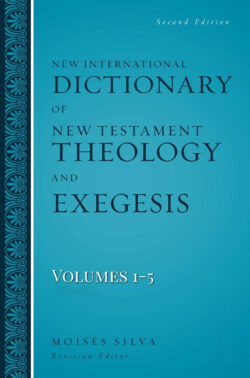
New International Dictionary of New Testament Theology and Exegesis Set
DESCRIPTION
A standard and widely-used reference work for nearly 40 years, the New International Dictionary of New Testament Theology and Exegesis has been thoroughly revised and updated to aid today’s pastors, students, scholars, and teachers in their study of the New Testament.
Offering a wealth of background and information on the meaning of Greek words in the New Testament—as well as related usage in classical Greek sources, the Septuagint, Jewish literature, and more—this important tool offers the following features:
• Alphabetical arrangement according to Greek words instead of previous order according to English topics; this ensures that individual Greek words are not discussed in isolation from one another and are easy to access
• Expanded to include additional Greek words and concepts not covered in the original work, NIDNTTE includes nearly 800 entries covering over 3,000 Greek words
• Discussions have been revised to be in line with modern scholarship and bibliographies are updated
• Corrections have been made to inconsistencies and omissions in earlier versions
• Updated and added consistency to include—for every entry—all necessary background information from classical Greek, the LXX, and Jewish literature.
• A helpful semantic domain index now directs the reader to all of the Greek words that have something to do with a particular English word. For example, under the English word “Anger, Wrath,” there is a list of thirteen Greek words that are related to that topic.
• Significant changes have been made in the presentation and discussion of linguistic details
• and much more!
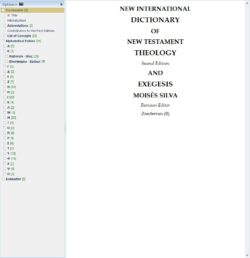
theWord Features:
- Verse popups
- Fully searchable text
- Footnotes
- Easy navigation of topics via topics tree display.
- Cross-links to NIDOTTE, TDOT and TDNT.
- Special Text Colors
- Normal: Text
- Hyperlink: Glossary | Gen. 9:8
- G/K Numbering G325
Note: The codes H## and G## used in this module refer to the Goodrick–Kohlenberger (G/K) numbering system, not to Strong’s Concordance numbers. This follows the publisher’s data. Strong to Goodrick-Kohlenberger Number Conversion Chart at the end of the resource. - Greek: πατήρ
- Greek Transliteration: pater
- Hebrew: אֱלֹהִים
- Hebrew Transliteration: ʾelōhîm
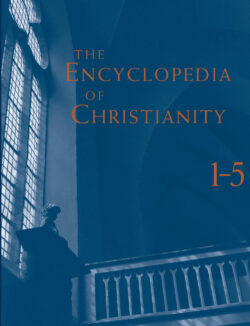
The Encyclopedia of Christianity, Volumes 1–5
DESCRIPTION
Volume 1 (A-D) contains 465 articles featuring (Retail $109.99)
- articles on all but the smallest countries of the world, including the former communist nations that have gained independence since 1989;
- the latest statistical information from David B. Barrett on the religious affiliation and ecclesiastical breakdown of each country and continent;
- articles on doctrines, denominations, and social and ethical issues in relation to the churches;
- biographical articles on prominent figures through church history.
Volume 2 of the award-winning reference work on Christianity. (Retail: $99.99)
The multiple award-winning Encyclopedia of Christianity (EC), copublished by Eerdmans and Brill, is a monumental five-volume work presenting the history and current state of the Christian faith in its rich spiritual and theological diversity around the world. The much-anticipated second volume of the EC contains more than 300 articles for alphabetical entries EûI. Written by leading scholars from around the world, the articles in Volume 2 range from discussions of early church history, ethics, and evil to entries on Holy Week, icons, and Christianity in Ireland.
Volume 3 of the EC (Retail: $109.99)
contains 342 articles constituting the alphabetical entries J–O — articles on significant topics ranging from Jesus, the kingdom of God, liberation theology, and Martin Luther to medical ethics, the Middle Ages, North American theology, and the Orthodox Church. Like each volume in the complete EC, this book incorporates many enhancements of and additions to the third revised edition of the German Evangelisches Kirchenlexikon: Internationale theologische EnzyklopSdie, on which the EC is based. Among the new features of this English work are the following:
- articles on all but the smallest countries of the world, including former communist states that have gained their independence since 1989;
- the latest, best statistical information, compiled by David B. Barrett, on the religious affiliation and ecclesiastical breakdown of each country and continent;
- the addition of over seventy biographical articles on prominent figures throughout church history;
- many expanded or entirely new articles that address topics of particular interest to English-speaking readers.
Unparalleled in scholarship and breadth of content, the Encyclopedia of Christianity will long serve as the standard reference work for the study of Christianity in the past and the present — and its trajectory into the twenty-first century.
Volume 4 of the EC (Retail: $109.99)
contains 299 articles constituting the alphabetical entries PûSh — articles on significant topics ranging from Paul, process theology, and the Qur’an to religious liberty, salvation history, and Scholasticism. Like each volume in the complete EC, this book incorporates many enhancements of and additions to the third revised edition of the German Evangelisches Kirchenlexikon: Internationale theologische Enzyklopädie, on which the EC is based. Among the features of this English work are the following:
- articles on all but the smallest countries of the world, including former communist states that have gained their independence since 1989;
- the latest, best statistical information, compiled by David B. Barrett, on the religious affiliation and ecclesiastical breakdown of each country and continent;
- the addition of over seventy biographical articles on prominent figures throughout church history;
- many expanded or entirely new articles that address topics of particular interest to English-speaking readers.
Unparalleled in scholarship and breadth of content, the Encyclopedia of Christianity will long serve as the standard reference work for the study of Christianity in the past and the present — and its trajectory into the twenty-first century.
Volume 5 of the EC (Retail: $99.99)
contains 295 articles constituting the alphabetical entries Si–Z — articles on significant topics ranging from sin, spiritual direction, Sufism, and terrorism to Vatican I and II, Vineyard Christian Fellowship, World Alliance of Reformed Churches, and Zionism. Like each volume in the complete EC, this book incorporates many enhancements of and additions to the third revised edition of the German Evangelisches Kirchenlexikon: Internationale theologische Enzyklopädie, on which the EC is based. Among the features of this English work are the following:
- articles on all but the smallest countries of the world, including former communist states that have gained their independence since 1989;
- the latest, best statistical information, compiled by David B. Barrett, on the religious affiliation and ecclesiastical breakdown of each country and continent;
- the addition of over seventy biographical articles on prominent figures throughout church history;
- many expanded or entirely new articles that address topics of particular interest to English-speaking readers.Unparalleled in scholarship and breadth of content, the Encyclopedia of Christianity will long serve as the standard reference work for the study of Christianity in the past and the present — and its trajectory into the future.
theWord Features:
-
Dictionary lookup and A-Z topic-tree navigation
-
Fully searchable five-volume text
-
Internal cross-references
-
Verse popups
-
Abbreviation and table-note popups
-
Tables and restored publisher illustrations
-
Volume-qualified print-page markers and bookmarks
-
Vol. 1 Pgs: 933
-
Vol. 2 Pgs: 819
-
Vol. 3 Pgs: 916
-
Vol. 4 Pgs: 984
-
Vol. 5 Pgs: 896
-
Total Pgs: 4548
- Special Text Colors
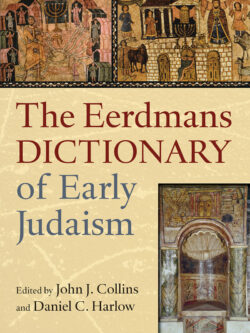
The Eerdmans Dictionary of Early Judaism
DESCRIPTION
The Dictionary of Early Judaism is the first reference work devoted exclusively to Second Temple Judaism (fourth century b.c.e. through second century c.e.).
The first section of this substantive and incredible work contains thirteen major essays that attempt to synthesize major aspects of Judaism in the period between Alexander and Hadrian. The second — and significantly longer — section offers 520 entries arranged alphabetically. Many of these entries have cross-references and all have select bibliographies. Equal attention is given to literary and nonliterary (i.e. archaeological and epigraphic) evidence and New Testament writings are included as evidence for Judaism in the first century c.e. Several entries also give pertinent information on the Hebrew Bible.
The Dictionary of Early Judaism is intended to not only meet the needs of scholars and students — at which it succeeds admirably — but also to provide accessible information for the general reader. It is ecumenical and international in character, bringing together nearly 270 authors from as many as twenty countries and including Jews, Christians, and scholars of no religious affiliation.
theWord Features:
- Dictionary lookup and A-Z topic-tree navigation
- Fully searchable articles, bibliographies, and author lines
- Scripture-reference popups and Bible links
- Internal cross-references
- Pgs: 1406
- Maps, illustrations, and tables
- Special Text Colors
- Normal: Text
-
Dictionary link: Apocalypticism
-
Scripture: Genesis 3
-
Page Number: [p1>
-
Hebrew transliteration: halakah
-
Greek transliteration: apokalypsis
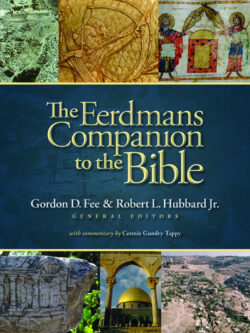
The Eerdmans Companion to the Bible
DESCRIPTION
A quality guidebook that opens up new vistas and insights into the whole Bible
Marked by a broad evangelical perspective, up-to-date research, and contributions from respected biblical scholars, The Eerdmans Companion to the Bible offers a reliable and illuminating guide to the entire Bible. Whether readers find the Bible familiar or foreign, they will appreciate the Companion’s informative articles and its commentary by Connie Gundry Tappy on all of the Old and New Testament books. This comprehensive reference work promises to make the Word of God come alive as never before.
- Compiled by some of the foremost biblical scholars in the world today
- New articles by sixty expert authors on many pertinent biblical topics
- Well-written background information and commentary on every book of the Bible
- Illustrated with maps, photos, and charts throughout
theWord Features:
-
Fully searchable text
-
Chapter, section, and indexed-entry navigation via the topic tree
-
Internal cross-references
-
Pgs: 834
-
Maps, illustrations, and tables
- Special Text Colors
- Normal: Text
- Internal link: Lands of the Bible
- Hebrew: א
- Transliteration: aleph
- Latin: testamentum
- Page Number: [p210>



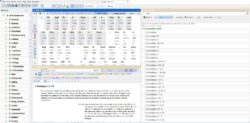
theWord-App Premium Subscription (Beta)
theWord-App Premium Features
Includes every feature available in theWord-App Basic and Advanced, plus:
- Book Search
- Create, edit, order, import, and export Book View module sets
- Bible View Interlinear mode
- Original-word and gloss sections
- Ancient Biblical language databases
- Bible and Book Word Study
- Power Word Study
- Word-popup statistics with original-word, transliteration, and gloss information
- Bible View background images with placement controls
- Custom Bible tab flags and icons
- Go directly to a topic by ID and export topics
- Change abbreviations or original-module identity for non-user modules
- Bible Search indexing preferences
- Book Search indexing and maintenance preferences
- Clipboard Monitor and Clipboard Viewer
- Proofing and spell-checking tools
Please note: Full Bible Search Helper and Inline Bible
Search Helper are optional add-ons. Premium access is required, but these
add-ons must be purchased and unlocked separately.
30 Day Trial below so you can try before you buy https://app.theword.net (or download it first from a link below).
Android, iPhone, iPad, macOS, Linux, Windows
Premium Feature: Inline Bible Search Helper
Description:
This is still a work in progress feature and subject to change.
(Note: Premium Features are not needed to use theWord it still maintains existing functionality this just adds special extended features.)
- Bible Background Indexer
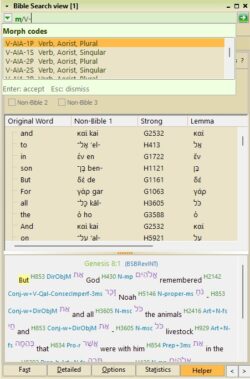
- Indexes the Bibles to provide much internal data (Original Word, Strong, Lemma, Morphology). This is required for the use of the Inline Helper, Bible Search Helper.
- .morph files (May be included with their Bibles or this Premium feature (to decide)
- Used for Definitions of the Morphology code and Morphology Builder
- Bible View – Top translation words: for Bibles with Strong’s #/Lemma
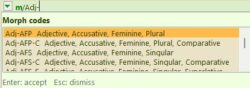
- Bible Search – inline helper (as you type it gives you a list of available terms.)
- Auto complete for Original Words (English, Hebrew, Greek, Main Text of the Bible)
- Auto complete for Strongs (H#, G#)
- Auto complete for Lemma (Hebrew/Greek)
- Auto complete for Morphology with expanded definition (RMAC for NA28, BYZa, SBLGNT; WHMC for WHM 4.22; BHSMorphoogy for BHS5/ETCBC; BSB Morphology for BSBHebInt, BSBGrkInt, BSBRevInt; PMAC for lxx;
- Preferences
- Settings for Inline Bible Search Helper
Premium Feature: Full Bible Search Helper
Description:
This is still a work in progress feature and subject to change.
(Note: Premium Features are not needed to use theWord it still maintains existing functionality this just adds special extended features.)
- Bible Background Indexer
- Indexes the Bibles to provide much internal data (Original Word, Strong, Lemma, Morphology). This is required for the use of the Inline Helper, Bible Search Helper.
- .morph files (May be included with their Bibles or this Premium feature (to decide)
- Used for Definitions of the Morphology code and Morphology Builder
- Bible View – Top translation words: for Bibles with Strong’s #/Lemma
- Bible Search – inline helper (as you type it gives you a list of available terms.)
- Auto complete for Original Words (English, Hebrew, Greek, Main Text of the Bible)
- Auto complete for Strongs (H#, G#)
- Auto complete for Lemma (Hebrew/Greek)
- Auto complete for Morphology with expanded definition (RMAC for NA28, BYZa, SBLGNT; WHMC for WHM 4.22; BHSMorphoogy for BHS5/ETCBC; BSB Morphology for BSBHebInt, BSBGrkInt, BSBRevInt; PMAC for lxx;
- Bible Search Helper (accessible via Helper tab in Bible Search)
- Tabs: (Dependent on what is supported in a Bible)
- Combined
- Filter for sorting with advanced sorting
- Column Toggles: Original Word, Strong, Lemma, Morphology, Switch Text 1..3, Non-Bible 1..3, Count
- Column Sorting
- Verse Preview
- highlight of hovered word
- Right Click to go to Verse
- Original Word
- Filter for sorting
- Columns: Key, Original Forms (OT, NT), Count
- Column Sorting
- Dictionary shown on Hover if activated.
- Word preview pane
- Double click to send to Bible search
- Strong’s #
- Filter for sorting
- Columns: Key, Top Words, Count
- Column Sorting
- Dictionary shown on Hover if activated.
- Word preview pane
- Double click to send to Bible search
- Morphology
- Filter for sorting
- Columns: Key, Top Words, Count
- Column Sorting
- Dictionary shown on Hover if activated.
- Word preview pane
- Double click to send to Bible search
- Morphology Builder
- Uses the .morph file to help with building morphology
- Part of speech check boxes for easy building of Morphology.
- Matching codes with definitions.
- Lemma
- Filter for sorting
- Columns: Key, Representative Forms, Count
- Column Sorting.
- Send to Lemma Family
- Dictionary shown on Hover if activated.
- Word preview pane
- Double click to send to Bible search
- Lemma Family
- Enter Lemma Root, Include all forms (substring match): Find Family
- Dictionary shown on Hover if activated.
- Double click to send to Bible search
- Syntax Validator
- Used for help you build good Bible Search syntax (may not stay in release)
- Headings
- Filter forsorting
- Columns: Key, Testament, Count
- Double Click to go to first verse occurence
- Right Click to go to a specific verse
- Footnotes
- Filter, Key, Testament, Count
- Double Click to go to first verse occurence
- Right Click to go to a specific verse
- Switch Text 1…3
- Filter for sorting
- Columns: Key, Testament, Count
- Word preview pane
- Non-Bible 1…3
- Filter for sorting
- Columns: Key, Testament, Count
- Word preview pane
- Preferences
- Settings for Bible Search Helper

Intermediate-Advance Package
DESCRIPTION
New International Dictionary of New Testament Theology: Abridged Edition
DESCRIPTION
This abridgment of Colin Brown’s original four volume work is arranged with its entries in Greek alphabet order, which makes it easy to find the discussion of a particular word. All Greek words are transliterated into English and linked with their Goodrick/Kohlenberger numbers. This book was formerly titled The NIV Theological Dictionary of New Testament Words.
theWord Features:
-
Greek-headword dictionary lookup and Greek-alphabetical topic-tree navigation
-
Strong G and Goodrick-Kohlenberger GKG identifier lookup
-
Fully searchable dictionary text
-
Pgs: 734
-
Verse popups and Bible links for canonical Scripture references
-
Internal cross-references and source aliases
-
Subject Index and Scripture Index
-
Greek GKG/Strong and supplemental Hebrew GKH/Strong conversion charts
-
Native tables for conversion charts and transliteration guides
-
Source-mapped transliterations followed by original-language equivalents in square brackets
-
Native images and diagrams retained from the resource
-
Print-page markers and page navigation
- Special Text Colors
- Normal: Text
- Scripture: John 3:16
- Page Number: [p1>
- Greek
- Transliteration: agapaō
- Original Script: ἀγαπάω
- Hebrew
- Transliteration: ʾāhēb
- Original Script: אָהֵב
- Aramaic
- Transliteration: ʾabbāʾ
- Original Script: אַבָּא
The New International Greek Testament Commentary: The Gospel of Luke
“WORK IN PROGRESS!”
(These are resources that are being developed. There is no release date. Pricing is subject to change.)
(These are resources that are being developed. There is no release date. Pricing is subject to change.)
DESCRIPTION
The Gospel of Luke was written, says its author, as an historical account of the ministry of Jesus. Not only would it serve as the basis for a sound faith on the part of professing Christians, but it would also claim a place for Christianity in history. Christ’s ministry, as Luke shows, is realized prophecy; it is that time during which God’s promise of salvation was fulfilled. His teachings, healing, and acts of compassion are all part of the good news. In Luke’s Gospel, Christ’s message of salvation is directed to the weak, poor, and needy, with an emphasis on the importance of self-denial and of whole-hearted discipleship. Thus, while Luke is the most conscious historian of the Gospel writers, his history is a vehicle of theological interpretation in which the significance of Jesus is expressed.
In this commentary I. Howard Marshall calls attention to the theological message of Luke the Evangelist. His primary purpose is to exegete the text as it was written by Luke, so that the distinctiveness of Luke’s Gospel may be seen.
Basing his commentary on the third edition of The Greek New Testament, Dr. Marshall also refers to many variant readings which are significant in this study. He provides fairly full information on the meanings of the Greek words used by Luke and shows which words and constructions occur frequently and are therefore characteristic of his style. It is by this meticulous analysis of the Greek that Luke’s theological intentions can be objectively determined.
Author:
I. Howard Marshall (1934–2015) was professor emeritus of New Testament exegesis and honorary research professor at the University of Aberdeen, Scotland. His many books include New Testament Theology: Many Witnesses, One Gospel and Beyond the Bible: Moving from Scripture to Theology.
theWord Features:
- Verse popups
- Verse (span) synchronization
- Fully searchable text
- Footnotes
- Pages links
- Easy navigation of topics via topics tree display.
- Special Text Colors
- Normal: Text
- Hyperlink: Gen 3:15
- Page Number: [pg 21>
- Greek: σκανδάλων
- Hebrew: לבנות
The New International Greek Testament Commentary: The Gospel of Matthew
“WORK IN PROGRESS!”
(These are resources that are being developed. There is no release date. Pricing is subject to change.)
(These are resources that are being developed. There is no release date. Pricing is subject to change.)
DESCRIPTION
Having devoted the past ten years of his life to research for this major new work, John Nolland gives us a commentary on the Gospel of Matthew that engages with a notable range of Matthean scholarship and offers fresh interpretations of the dominant Gospel in the history of the church.
Without neglecting the Gospel’s sources or historical background, Nolland places his central focus on the content and method of Matthew’s story. His work explores Matthew’s narrative technique and the inner logic of the unfolding text, giving full weight to the Jewish character of the book and its differences from Mark’s presentation of parallel material. While finding it unlikely that the apostle Matthew himself composed the book, Nolland does argue that Matthew’s Gospel reflects the historical ministry of Jesus with considerable accuracy, and he brings to the table new evidence for an early date of composition.
Including accurate translations based on the latest Greek text, detailed verse-by-verse comments, thorough bibliographies for each section, and an array of insightful critical approaches, Nolland’s Gospel of Matthew will stimulate students, preachers, and scholars seeking to understand more fully Matthew’s presentation of the gospel narrative.
Author:
John Nolland is academic dean and lecturer in New Testament studies at Trinity College, Bristol, England. An ordained minister of the Church of England, he is also the author of the three-volume Word Biblical Commentary on the Gospel of Luke.
theWord Features:
- Verse popups
- Verse (span) synchronization
- Fully searchable text
- Footnotes
- Pages links
- Easy navigation of topics via topics tree display.
- Special Text Colors
- Normal: Text
- Hyperlink: Gen 3:15
- Page Number: [pg 21>
- Greek: σκανδάλων
- Hebrew: לבנות
The New International Greek Testament Commentary: The Epistle to the Hebrews
“WORK IN PROGRESS!”
(These are resources that are being developed. There is no release date. Pricing is subject to change.)
(These are resources that are being developed. There is no release date. Pricing is subject to change.)
DESCRIPTION
Series: The New International Greek Testament Commentary (NIGTC)
This superb work is sure to win a name for itself as one of the major commentaries on the Epistle to the Hebrews. The principal purpose of this substantial volume is to clarify the meaning of Hebrews, long considered a complicated and obscure book. Paul Ellingworth’s fine-tooth-comb coverage of Hebrews looks at the text up close and in a broad light, enabling the reader to see the forest as well as the trees.
In his determined quest to understand Hebrews, Ellingworth begins with a detailed study of the Greek text, working outward to consider the wider context, linguistic questions, and the relation of Hebrews to other early Christian writings and to the Old Testament. Nonbiblical writings such as Philo and the Dead Sea Scrolls, though less directly related to Hebrews, are considered where appropriate.
Unveiling the discourse structure of this carefully written letter, Ellingworth’s commentary helps make coherent sense of the complexities of Hebrews. As a result of his exhaustive study, Ellingworth finds Hebrews to be primarily a pastoral, not a polemical, writing. Showing how Hebrews beautifully emphasizes the supremacy of Christ, Ellingworth concludes that the essential purpose of the epistle – which maintains the continuity of God’s people before and after Christ – is to encourage readers to base their lives on nothing other and nothing less than Jesus.
A substantive bibliography and a comprehensive introduction precede Ellingworth’s commentary, and three indexes – of subjects, authors, and Greek words discussed – conclude the volume.
Author:
Paul Ellingworth (1931–2018) was a British biblical scholar who taught at the University of Aberdeen and served as a translation consultant for the United Bible Societies.
theWord Features:
- Verse popups
- Verse (span) synchronization
- Fully searchable text
- Footnotes
- Pages links
- Easy navigation of topics via topics tree display.
- Special Text Colors
- Normal: Text
- Hyperlink: Gen 3:15
- Page Number: [pg 21>
- Greek: σκανδάλων
- Hebrew: לבנות
The New International Greek Testament Commentary: The Epistles to the Thessalonians
“WORK IN PROGRESS!”
(These are resources that are being developed. There is no release date. Pricing is subject to change.)
(These are resources that are being developed. There is no release date. Pricing is subject to change.)
DESCRIPTION
The letters of Paul to the newly founded Christian community at Thessalonica hold a special place within the Christian tradition as possibly the earliest extant Christian writings. They are also of special interest not only for their theological value but for their sociological context. Among the communities established by Paul, the church at Thessalonica appears to have been the only one to have suffered serious external oppression. These two important epistles, then, speak uniquely to contemporary Christians living in a society often ideologically, if not politically, opposed to Christian faith.
In this innovative commentary Charles A. Wanamaker incorporates what may be called a social science approach to the study of 1 and 2 Thessalonians, taking into full account the social context that gave rise to Paul’s correspondence. While Wanamaker in no way ignores traditional historical-critical, linguistic, literary, and theological approaches to writing a commentary — in fact, at several points he makes a significant contribution to the questions raised by traditional exegesis — at the same time he goes beyond previous commentaries on the Thessalonian correspondence by taking seriously the social dimensions both of Christianity at Thessalonica and of the texts of 1 and 2 Thessalonians themselves. In blending traditional exegetical methods with this newer approach, Wanamaker seeks to understand Pauline Christianity at Thessalonica as a socio-religious movement in the first-century Greco-Roman world and attempts to grasp the social character and functions of Paul’s letters within this context.
Author:
Charles A. Wanamaker, Associate professor in the department of religious studies and director of postgraduate studies at the University of Cape Town in South Africa. He received his doctorate in New Testament studies at the University of Durham under C. K. Barrett.
theWord Features:
- Verse popups
- Verse (span) synchronization
- Fully searchable text
- Footnotes
- Pages links
- Easy navigation of topics via topics tree display.
- Special Text Colors
- Normal: Text
- Hyperlink: Gen 3:15
- Page Number: [pg 21>
- Greek: σκανδάλων
- Hebrew: לבנות
The New International Greek Testament Commentary: The Book of Revelation
DESCRIPTION
This volume on Revelation is accessible and comprehensive. It provides an in-depth look at the parallels between images in the Apocalypse and their Old Testament and Jewish antecedents G.K. Beale’s painstaking anaylsis will help you better understand the obscure metaphors in Revelation and the purpose of the book itself.
Author:
G. K. Beale is J. Gresham Machen Chair of New Testament and professor of New Testament and biblical theology at Westminster Theological Seminary.
G. K. Beale is J. Gresham Machen Chair of New Testament and professor of New Testament and biblical theology at Westminster Theological Seminary.
theWord Features:
- Verse popups
- Verse (span) synchronization
- Fully searchable text
- Footnotes
- Pages links
- Easy navigation of topics via topics tree display.
- Special Text Colors
- Normal: Text
- Hyperlink: Gen 3:15
- Page Number: [pg 21>
- Greek: σκανδάλων
- Hebrew: לבנות
Package: NIV Application Commentary: New Testament
Description
The NIV Application Commentary helps you communicate and apply biblical text effectively in today’s context.
To bring the ancient messages of the Bible into today’s world, each passage is treated in three sections:
This unique, award-winning commentary is the ideal resource for today’s preachers, teachers, and serious students of the Bible, giving them the tools, ideas, and insights they need to communicate God’s Word with the same powerful impact it had when it was first written.
Volumes and authors in The NIV Application Commentary, New Testament Set: Matthew – Revelation, 20-Volume Collection include:
$688.80Original price was: $688.80.$495.94Current price is: $495.94. Add to cart