
Concise New International Dictionary of New Testament Theology and Exegesis
DESCRIPTION
The Exegesis Quick-Reference Tool Every Pastor, Teacher, Student, and Scholar Needs
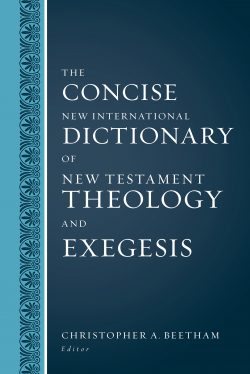
The Concise New International Dictionary of New Testament Theology and Exegesis (CNIDNTTE) by Christopher A. Beetham is a significant resource for those looking for a quick-reference guide to aid in exegesis and interpretation. It retains all the essentials of the monumental and magisterial New International Dictionary of New Testament Theology and Exegesis edited by Moises Silva, bringing together its most important elements into one accessible volume. This reference includes the most vital, relevant information needed to delve deep into the study of the Greek words used in Scripture for study of the New Testament–its texts and theology.
This volume offers a wealth of background and information on the meaning of Greek words in the New Testament, as well as related usage in classical Greek sources, the Greek Old Testament (Septuagint), and extrabiblical Second Temple Jewish literature. This significant tool offers the following features:
- All the nearly 800 entries covering over 3,000 Greek words found in the full edition are included and presented in the same order and arrangement
- Retains approximately 60 percent of the original edition, with the emphasis now on synchronic word study and usage in the Greek Old Testament, extrabiblical Second Temple literature, and especially the New Testament
- The unique arrangement according to Greek words and use of English concepts is retained from the full edition and allows all users to access Greek terms regardless of their level of competence in Greek.
- This edition retains the significant semantic-domain tool that directs the reader to all the Greek words that have something to do with a particular English word or concept. For example, under the English words “Resurrection,” there is a list of four Greek words that are related to that topic.
- Discussions reflect the latest in modern scholarship
- Bibliographies retain essential references to other standard lexicons and theological dictionaries
The Concise New International Dictionary of New Testament Theology and Exegesis is the ideal tool for pastors, Bible teachers, students, and scholars engaging in exegesis. It is packed with the essential information needed to study the New Testament.
There is a comparison below of this Concise version and the Full version here.
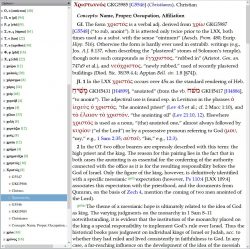
theWord Features:
- Dictionary topics
- Greek: εὐδόκησα
- Greek Transliteration: archon
- Strong’s Numbers: G25
- Concept(s): Love
- Verse popups
- Fully searchable text
- Footnotes
- Easy navigation of topics via topics tree display.
- Linked to Bible view via Lemma, Word, and Strong’s Numbers
- Special Text Colors
- Normal: Text
- Hyperlink: Glossary | Gen. 9:8
- Page numbers: [piix> | [p9>
- Strong’s Numbers: G25
- Greek Transliteration: archon
- Greek: εὐδόκησα
- Hebrew: יָרֵךְ
Package: Wuest Word Studies & New Testament Expanded Translation
Kenneth Wuest was a long time Greek teacher at Moody Bible Institute back in 1920’s, ‘30’s, 40’s, and 50’s. (Yeah – he taught almost 30 years). At that time, Moody was one of the leaders in both dispensationalism and fundamentalism.
When he started writing, it was his intent to bring the nuance of the Greek language out for the non-Greek speaking English reader. This reviewer thinks that he hits that mark pretty well.
His first book was entitled Treasures from the Greek New Testament for the English Reader. This was a collection of twelve essays (which became twelve chapters – imagine that!) that are topical. His second book was a commentary on 1Peter entitled First Peter in the Greek New Testament for the English Reader (do you see a common theme?). It is pleasantly verse by verse.
Over the course of his writing career, he wrote commentaries on Mark, Romans, Galatians, Ephesians, Philippians, Colossians, 1Timothy, 2Timothy, Hebrews, 1Peter, 2Peter, 1John, 2John, 3John, & Jude. [If you’re keeping score at home, that means he missed Matthew, Luke, John, Acts, 1Corinthians, 2Corinthians, 1Thessalonians, 2Thessalonians, Titus, Philemon, James, and Revelation.]
In addition to his commentaries, he also wrote six topical books – all revolving around word studies in the Greek New Testament.
 Theological Bias
I’ve already noted that Wuest is both dispensational and evangelical in his doctrinal outlook. I also mentioned that in the era he wrote, Moody was considered a fundamentalist institution. That’s good.
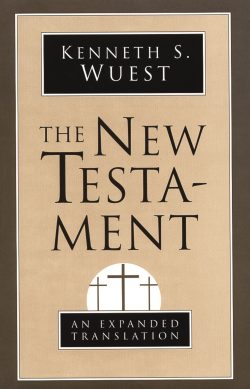
I would like to point out that Wuest was not a KJV lover. He served on the translation team that produced the NASB. He actually published an entire expanded translation of the New Testament. But as you might think with his NASB background, his own translation is based on the Nestle Greek text, and not the Textus Receptus (which is the text behind the KJV). Personal kudos for rejecting the ASV; but he was one of the early proponents within the fundamentalist movement to depart from the KJV. He makes no apologies for correcting “error” in the KJV. For this reason alone, I don’t recommend this resource to anyone not grounded in bibliology.
Entry Length
Again, please note that his NT commentary covers only 15 books of the NT (of 27 total books); but because he left off four of the five longest books in the NT, his commentary actually covers far less than 50% of it. However, where he does have comments, they are more than sufficient. For me, they are right in the sweet spot between “sufficient” and “verbose” (I guess I like ‘em a little longer than sufficient…).
I like to provide an example from Rom 3:24 in these reviews. So here is Wuest on Rom 3:24 –
QUOTATION BEGINS – “Freely” is dōrean [δωρεαν], “freely, for naught, gratis, gratuitously, without just cause.” “Grace” is Charis [Χαρις] which signified in classical authors a favor done out of the spontaneous generosity of the heart without any expectation of return. Of course, this favor was always done to one’s friend, never to an enemy. But when Charis [Χαρις] comes into the New Testament, it takes an infinite leap forward, for the favor God did at Calvary was for those who hated Him. It was a favor clone out of the spontaneous generosity of God’s heart of love with no expectation of return. There are no strings attached to grace. It is given dōrean [δωρεαν], gratuitously. Of course, grace in the form of salvation is so adjusted that the one who receives it, turns from sin to serve the living God and live a holy life, for grace includes not only the bestowal of a righteousness, but the inward transformation consisting of the power of indwelling sin broken and the divine nature implanted, which liberates the believer from the compelling power of sin and makes him hate sin, love holiness, and gives him the power to obey the Word of God.
This grace shown the believing sinner is made possible, Paul says through the redemption which is in Christ Jesus. “Redemption” is apolutrōseōs [ἀπολυτρωσεως], the verbal form of which is apolutroō [ἀπολυτροω], “to redeem by paying the lutron [λυτρον] price.” There are three words translated “redeem,” agorazō [ἀγοραζω], “to buy in the slave market” (1 Cor. 6:20; 7:23, 2 Pet. 2:1), Christ bought us in this slave market of sin by His own blood; believers are His bondslaves; exagorazō [ἐξαγοραζω], “to buy out of the slave market” (Gal. 3:13; 4:5), the redeemed are never to be put up for sale in any slave market again; and litroō [λιτροω], “to set free by paying a price” (Tit. 2:14, 1 Pet. 1:18): the believer is set free from sin and free to live a life pleasing to God in the power of the Holy Spirit. The redemption price, the precious blood of Jesus, makes it possible for a righteous God to justify a believing sinner on the basis of justice satisfied. This Paul proceeds to explain in the next two verses. – QUOTATION ENDS
This might be a little longer than his typical comment, but you get the flavor here of how he writes.
Language Skills Needed
Did you remember the ending phrase in his titles? “…for the English Reader.” While a little bit of Greek is helpful (he does use words like “aorist,” “imperfect,” “middle voice,” and even “pluperfect,”), he actually does a pretty good job of explaining the importance of each of those words in his exposition. So Greek is helpful, yes, but not essential in profiting from this work. HOWEVER: keep reading for more info on the necessity of language skills.
Academic Target
Wuest and I are going to disagree on this. His work; my review. Wuest would tell you that his target was the Bible disciple who wanted to know more about his English Bible by expanding all of the nuances of the Greek into English. Fair enough. I would tell you that Wuest does not like the KJV, believes there to be translation errors in it, and those errors are due to the KJV coming from a corrupt Greek text. Hmmm. I have a problem with that.
Some of his comments are based on the Nestle text, which differs regularly from the TR. A knowledge of Greek will be very helpful – especially to those expositors who, like me, use the KJV/TR. When he makes an argument based on the Nestle text, it will be very helpful to know what the TR instead says. So due to his theological bias, I don’t recommend this resource to anyone who is not clear in his stance on bibliology. I have it tagged above as “Pastoral” for this reason.
And Then There’s All This Topical Content
Let’s not forget that he wrote six topical books, totaling almost another 100 chapters. From a personal perspective, this will be a harder tool to use (how are you going to find his interesting comments on “crowns” in a topical presentation?). But the writing is just as good, even though it may be hard to find.
Contents Conclusion
I like Wuest very much, as a matter of fact. It is too bad he did not finish all of the NT Books. I wish he had. And with the above mentioned foibles in mind, I recommend the use of his writing to you. This is a DDT approved Good Resource.
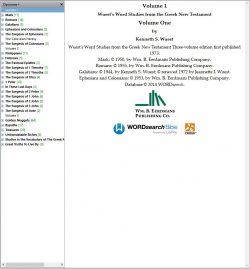
Wuest Word Studies in the Greek New Testament Vols 1-3
DESCRIPTION
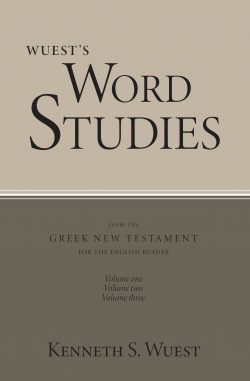
These studies and translations of the Greek New Testament are simplified commentaries on the Greek text for the Bible student who is not conversant with the Greek language. The three-volume set includes commentaries on Mark, Romans, Galatians, Ephesians Colossians, Philippians, Hebrews, 1 Timothy, 2 Timothy, Titus, 1 Peter, 2 Peter, 1 John, 2 John, 3 John and Jude; graphic elucidations of selected passages, words, and phrases; and devotional studies on the teachings of Jesus and the apostles.
theWord Features
- Verse popups
- Fully searchable text
- Footnotes
- Easy navigation of topics via topics tree display.
- Special Text Colors
- Normal: Text
- Hyperlink: Luke 20:21
- Page Number: [pg 21>
- Greek: χρησις
- Hebrew: מֶ֫לֶךְ
- Transliterated Greek & Hebrew: euaggelion
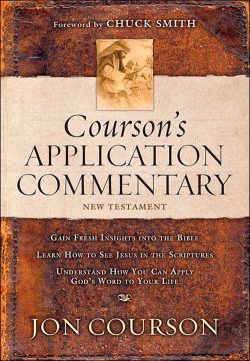
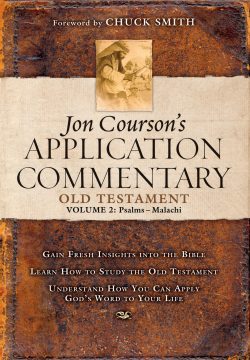
Package: Jon Courson’s Application NT & OT Commentaries
In a unique blend of pertinent information and inspiration, Jon Courson sheds light in a fresh way on the timeless truths of God’s Word. He has amassed a wealth of interesting topics in a very readable and comfortable expositional style. He combines thorough and comprehensive teaching of every paragraph of Scripture in the New Testament along with practical in-depth topical studies.
He has a unique ability to articulate the Bible’s truths with insight, focusing on valid life applications. This commentary is very useful for laymen as well as ministers of the gospel.
About the Author:
Jon Courson is one of the most exhilarating ministers today. In his unique style, Pastor Jon has written an Old Testament commentary that is a scholarly work, but is easy to read and makes practical applications for us in our daily walk with Jesus. This volume begins Jon Courson’s verse-by-verse commentary on the Old Testament. It is your opportunity to study the Bible with one of the great Bible teachers of our time.
See the excellent review below by DoctorDaveT
Basic Greek Package
DESCRIPTION
Intermediate Hebrew Package
DESCRIPTION
Introductory Study Package
DESCRIPTION
Strong’s Number Package
DESCRIPTION
New International Dictionary of New Testament Theology and Exegesis Set
DESCRIPTION
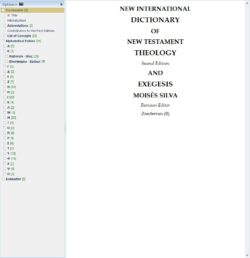
A standard and widely-used reference work for nearly 40 years, the New International Dictionary of New Testament Theology and Exegesis has been thoroughly revised and updated to aid today’s pastors, students, scholars, and teachers in their study of the New Testament.
Offering a wealth of background and information on the meaning of Greek words in the New Testament—as well as related usage in classical Greek sources, the Septuagint, Jewish literature, and more—this important tool offers the following features:
• Alphabetical arrangement according to Greek words instead of previous order according to English topics; this ensures that individual Greek words are not discussed in isolation from one another and are easy to access
• Expanded to include additional Greek words and concepts not covered in the original work, NIDNTTE includes nearly 800 entries covering over 3,000 Greek words
• Discussions have been revised to be in line with modern scholarship and bibliographies are updated
• Corrections have been made to inconsistencies and omissions in earlier versions
• Updated and added consistency to include—for every entry—all necessary background information from classical Greek, the LXX, and Jewish literature.
• A helpful semantic domain index now directs the reader to all of the Greek words that have something to do with a particular English word. For example, under the English word “Anger, Wrath,” there is a list of thirteen Greek words that are related to that topic.
• Significant changes have been made in the presentation and discussion of linguistic details
• and much more!
theWord Features:
- Verse popups
- Fully searchable text
- Footnotes
- Easy navigation of topics via topics tree display.
- Cross-links to NIDOTTE, TDOT and TDNT.
- Special Text Colors
- Normal: Text
- Hyperlink: Glossary | Gen. 9:8
- G/K Numbering G325
Note: The codes H## and G## used in this module refer to the Goodrick–Kohlenberger (G/K) numbering system, not to Strong’s Concordance numbers. This follows the publisher’s data. Strong to Goodrick-Kohlenberger Number Conversion Chart at the end of the resource. - Greek: πατήρ
- Greek Transliteration: pater
- Hebrew: אֱלֹהִים
- Hebrew Transliteration: ʾelōhîm

New International Dictionary of Old Testament Theology and Exegesis
DESCRIPTION
Only one hermeneutical text published prior to the New International Dictionary of Old Testament Theology & Exegesis can be held up reasonably to its measure of quality and the exhaustive nature of the research that produced this immense work. That singular collection worthy of comparison is its counterpart, the New International Dictionary of New Testament Theology, edited by Colin Brown.
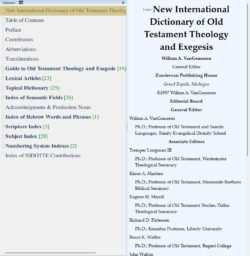
This 5 volume addition to that acclaimed work, though intimidating in the achievement it embodies, is intended for serious Old Testament and exegetical study by men and women of all walks of life — both academics and pastors, students and laypersons. Volume one contains a Guide to Old Testament Theology and Exegesis in which ten essays have been compiled to thoroughly explain proper hermeneutics and interpretation, as well as guidelines for using this source material.
Volumes one through four contain the Lexicon of the Old Testament, all words found in the text ordered by Hebrew alphabetization for easy reference, and coupled with a Goodrick / Kohlenberger cross-referencing number to be used in conjunction with Strong’s numbering system. The relationship of each word in different contexts and languages is also explained, including alternative words, and the particulars of their semantic domain. All this information is, of course, complete with bibliography. Volume four also begins the Topical Dictionary. Therein can be found articles on the theology of each Old Testament book individually, as well as discussion of biblical concepts, people, places, events, and literary pieces, all information that is cross-referenced to the preceding Hebraic Lexicon.
Finally, volume five contains a series of indexes: Hebrew Index, Scripture Index, Subject Index, and an index of Semantic Fields. Taken as a whole, the New International Dictionary of Old Testament Theology & Exegesis is an unparalleled accomplishment in the field of biblical hermeneutics.
theWord Features:
- Verse popups
- Fully searchable text
- Footnotes
- Easy navigation of topics via topics tree display.
- Special Text Colors
- Normal: Text
- Hyperlink: Glossary | Gen. 9:8
- Hebrew: אֱלֹהִים
- Hebrew Transliteration: ʾelōhîm
- Page numbers: v1p104>
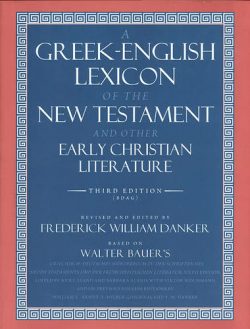
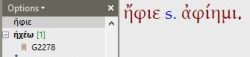
Bible Dictionary of Ancient Greek (BDAG) A Greek-English Lexicon of the New Testament
22% off Lowest price possible is $175. (Publisher requirement)
Now includes Strong’s numbers in topic tree! It will now work with your Strong’s number resources NASB, NET2, etc.
Described as an “invaluable reference work” (Classical Philology) and “a tool indispensable for the study of early Christian literature” (Religious Studies Review) in its previous edition, this new updated edition takes Walter Bauer’s Wörterbuch zu den Schriften des Neuen Testaments even further. This work includes Greek definitions for works of all periods of Greek, and has more than 25,000 additional references to classical, intertestamental, Early Christian, and modern literature.
In this edition, Frederick W. Danker’s broad knowledge of Greco-Roman literature, as well as papyri and epigraphs, provides a more panoramic view of the world of Jesus and the New Testament. Danker has also introduced a more consistent mode of reference citation, and has provided a composite list of abbreviations to facilitate easy access to this wealth of information.
Perhaps the single most important lexical innovation of Danker’s edition is its inclusion of extended definitions for Greek terms. For instance, a key meaning of “episkopos” was defined in the second American edition as overseer; Danker defines it as “one who has the responsibility of safeguarding or seeing to it that something is done in the correct way, guardian.” Such extended definitions give a fuller sense of the word in question, which will help avoid both anachronisms and confusion among users of the lexicon who may not be native speakers of English.
Danker’s edition of Bauer’s Wörterbuch is an indispensable tool for New Testament exegete.
theWord Features:
- Verse popups
- Abbreviation popups
- Fully searchable text
- Easy navigation of topics via topics tree display.
- Greek Lemmas
- Strong’s Numbers in topic tree
- Special Text Colors
- Normal: Text
- Hyperlink: New Docs | Hb 9:4
- Greek: σωμάτων
- Hebrew: מִשְׁפָּט
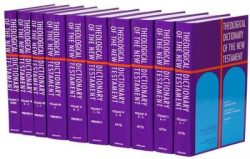
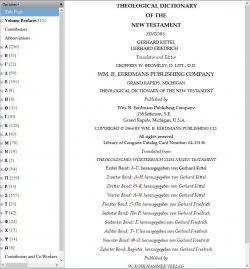
Theological Dictionary of the New Testament TDNT (10 vols.)
25% off on this product lowest price possible is $150. (Publisher requirement)
Please see the excellent software & book review by DoctorDaveT below.
This monumental reference work, complete in ten volumes, is the authorized and unabridged translation of the famous Theologisches Wörterbuch zum Neuen Testament, known commonly as “Kittel” and considered by many scholars to be the best New Testament Dictionary ever compiled. Mediating between ordinary lexicography and the specific task of exposition, TDNT treats more than 2,300 theologically significant New Testament words, including the more important prepositions and numbers as well as many proper names from the Old Testament. Presenting the words in the order of the Greek alphabet, TDNT typically discusses the following for each word: its secular Greek background, its role in the Old Testament, its use in extra biblical Jewish literature, and its varied uses in the New Testament. Substantial bibliographies and footnotes supplement the articles. It is designed for the intermediate and advanced Greek student. Each significant Greek word of the New Testament is comprehensively presented and takes account of its:
- Greek background
- role in the Old Testament (in the Hebrew and the Septuagint)
- use by Philo, Josephus, and in the rabbinical literature
- uses in the New Testament and its various genres
- appearances (where appropriate) in the Apostolic Fathers
More than 100 distinguished scholars contributed to the work, including specialists in Old Testament, Septuagint, Hellenistic, Semitic and Rabbinic studies. Extensive bibliographies and detailed footnoting supplement the articles.
Overview of the resource inside theWord
theWord Features:
- Verse popups
- Abbreviation popups
- Fully searchable text
- Easy navigation of topics via topics tree display.
- Greek Lemmas
- Strong’s Numbers in topic tree
- Special Text Colors
- Normal: Text
- Hyperlink: Grundmann | 2 Tm. 3:1 ff. | 1 | †
- Volume & Page Number: v1 p162
- Latin: supra
- Transliteration: qādēs̆: ṭāhēr
- Greek: σωμάτων
- Hebrew: מִשְׁפָּט
Note: This is the unabridged version which is 10 volumes in print.
About the Author
(1888-1948) Former Professor of New Testament both atGreifswald and Tübingen. He undertook the editorial direction of Theologisches Wörterbuch zum NeuenTestament in 1928.
The editor of the Theologisches Wörterbuch zumNeuen Testament, he has been Professor of New Testamentat the University of Erlangen since 1954.
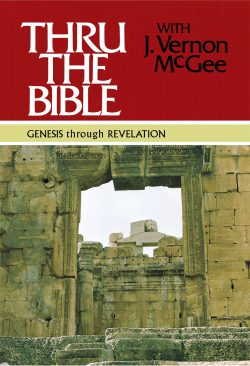
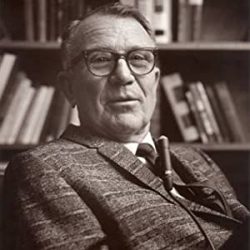
Thru the Bible with J. Vernon McGee
Simple Teaching of the Whole Bible
Full 5-volume set of Dr. McGee’s radio messages from the popular “Thru the Bible” program were recorded, transcribed, and published, giving us this well-known commentary series. The series is meant to be a “simple teaching of the whole Bible for the masses of the world.”
Augmented with Dr. McGee’s own observations and experiences, these commentaries are engaging, fun, and written specifically to meet the needs of lay readers as well as pastors and teachers.
Features include:
- Introductory sections
- Detailed outlines
- Paragraph-by-paragraph discussion
- Dr. McGee’s personal observations and experiences
- Vol. 1 Genesis – Deuteronomy (Original size 640 pgs)
- Vol. 2 Joshua – Psalms (Original size 896 pgs)
- Vol. 3 Proverbs – Malachi (Original size 1040 pgs)
- Vol. 4 Matthew – Romans (Original size 768 pgs)
- Vol. 5 1Corinthians – Revelation (Original size 1080 pgs)
- Total 4424 pgs
Specifically writing to meet the needs of lay Bible readers as well as clergy, Dr. McGee deliberately avoids ‘the straitjacket of printed prose and lofty verbiage.’ His plain writing and lively approach make biblical truth understandable and Bible study more enjoyable. An introductory section and a detailed outline preface the discussion of each book. Each chapter is examined through a careful, paragraph-by-paragraph discussion of all significant verses.
Radio messages from J. Vernon McGee delighted and enthralled listeners for years with simple, straightforward language and clear understanding of the Scripture. Now enjoy his personable, yet scholarly, style in this 60-volume set of commentaries that takes you from Genesis to Revelation with new understanding and insight. Each volume includes introductory sections, detailed outlines and a thorough, paragraph-by-paragraph discussion of the text. A great choice for pastors – and even better choice for the average Bible reader and student!
Intermediate Greek Package
DESCRIPTION
Advanced Greek Package
DESCRIPTION
Pastor/Elder/Minister Package
DESCRIPTION
The New International Greek Testament Commentary: The Epistle to the Romans
Series: The New International Greek Testament Commentary (NIGTC)
This highly anticipated commentary on the Greek text of Romans by veteran New Testament scholar Richard Longenecker provides solid scholarship and innovative solutions to long-standing interpretive problems. Critical, exegetical, and constructive, yet pastoral in its application, Longenecker’s monumental work on Romans sets a course for the future that will promote a better understanding of this most famous of Paul’s letters and a more relevant contextualization of its message.
Author:
Richard N. Longenecker (1930–2021) was a distinguished New Testament scholar who taught for many years at Wycliffe College, University of Toronto. He was the author of numerous books, including Paul, Apostle of Liberty; The Christology of Early Jewish Christianity; New Testament Social Ethics for Today; Introducing Romans: Critical Issues in Paul’s Most Famous Letter, and the New International Greek Testament Commentary volume on Romans.
theWord Features: