
Basic Greek Package
DESCRIPTION


Exploring the Bible: Esther
Description
The study of the providence of God is both exciting and profitable: it thrills our hearts as we see the wisdom and power of our Heavenly Father; it strengthens our resolve as we marvel at the sufficiency of his grace; and it brings comfort when we do not understand what is happening to us or around us. Esther is all about that marvellous providence. Studying it can deepen our trust, enrich our worship, and intensify our love for our great God. It will reassure us that though we may not always see him, he never looses sight of us. The history of Esther is one of the clearest examples of Paul’s great assertion in Romans 8:28: ‘We know that in all things God works for the good of those who love him.’
theWord Features:
- Verse popups
- Verse synchronization
- Fully searchable text
- Commentary link popup can be set in Bible view.
- Footnotes
- Easy navigation of topics via topics tree display.
Note: Does not display commentary under Bible text.
New International Commentary: The Book of Ezekiel, Chapters 25–48
PRODUCT HIGHLIGHTS:
- Verse-by-verse commentary
- In-depth discussion of textual and critical matters
- Introductions to each book’s authorship, date, purpose, structure, and theology
- Detailed bibliography
DESCRIPTION
To many modern readers the prophecies of Ezekiel are a mystery. This commentary by Daniel Block—which completes his two-volume study of the whole book of Ezekiel—seeks to answer the questions that contemporary readers bring to the text by examining the language, the message, and the methods of this obscure and often misunderstood Hebrew prophet. The result of twelve years of study, this volume, like the one on chapters 1–24, provides an excellent discussion of the background of Ezekiel and offers a verse-by-verse exposition of each literary/prophetic unit in Ezekiel 25–48 that not only makes clear the prophet’s message to his original readers but also shows that Ezekiel’s ancient wisdom and vision are still very much needed by the church in the twenty-first century.
….
New International Commentary: The Book of Isaiah, Chapters 40–66
PRODUCT HIGHLIGHTS:
- Verse-by-verse commentary
- In-depth discussion of textual and critical matters
- Introductions to each book’s authorship, date, purpose, structure, and theology
- Detailed bibliography
DESCRIPTION
The second of John N. Oswalt’s two-part study of the book of Isaiah for the NICOT series, this commentary provides exegetical and theological exposition on the latter twenty-seven chapters of Isaiah for scholars, pastors, and students who seek to know the perennial meaning of the text in contemporary terms.
Though Oswalt’s main introduction to Isaiah is found in his commentary on chapters 1–39, this second volume opens with an important discussion of scholarly debate over the unity/diversity of Isaiah. In this work Oswalt makes stronger his case for reading the entire book of Isaiah as written by a single author—a position not common in other recent commentaries. Oswalt’s work stands alone, then, as an attempt to take seriously Israel’s historical situation at the time chapters 40–66 were composed while also seeking to understand how these chapters function as a part of Isaiah’s total vision written in the late 700s or early 600s b.c.
Assuming the single authorship of Isaiah, the verse-by-verse commentary aims to interpret chapters 40–66 in light of the book as a whole. While not neglecting issues of historical criticism or form criticism, the commentary focuses mainly on the theological meaning of the text as indicated especially by the literary structure. Building on his earlier argument that the central theme of Isaiah is servanthood, Oswalt keeps readers focused on the character of Israel’s sovereign Redeemer God, on the blind servant Israel, and on the ultimate work of the Suffering Servant in whom the world can find its Savior.
….
A Short Guide to the Pronunciation of New Testament Greek
DESCRIPTION
What did the apostles’ Greek sound like?
How should New Testament Greek be pronounced in our classrooms? Often students are taught Erasmian pronunciation, which does not even reproduce Erasmus’s own pronunciation faithfully, let alone that of the New Testament authors. But if we want to process the language of the New Testament the same way its original authors and readers did, we should use their pronunciation. In his new book, Benjamin Kantor breaks a path toward an authentic pronunciation of Koine Greek at the time of the New Testament, seeking to improve students’ reading proficiency.
A Short Guide to the Pronunciation of New Testament Greek distills Kantor’s new monograph, The Pronunciation of New Testament Greek, with an eye toward practical instruction. The first comprehensive phonological and orthographic study of Judeo-Palestinian Koine Greek, The Pronunciation of New Testament Greek surveys thousands of inscriptions and papyri to determine historical pronunciation. A Short Guide gives students an overview of the basics of phonology before explaining the pronunciation of each Greek letter and phoneme individually. Perfect for classroom use, this guide explains Kantor’s cutting-edge research accessibly and includes sample texts for reading practice.
theWord Features:
- Chapter and named-section topic navigation
- Searchable chapter text
- Greek, transliteration, IPA, and pronunciation tables
- Greek and Hebrew language examples
- Exact single-footnote popups
- Internal cross-references
- Native tables and images
- Special Text Colors
- Normal: Text
- Internal link: The International Phonetic Alphabet
- Greek: λόγχη
- Transliteration: lonχi(-yoθ)
- IPA: [x] / [χ]
- Hebrew comparison: לוֹנְכִֿייוֹתֿ

Reading Jesus’s Bible – How the New Testament Helps Us Understand the Old Testament
DESCRIPTION
For Jesus and his contemporaries, what we now know as the Old Testament was simply the Scriptures—and it was the fundamental basis of how people understood their relationship with God. In this book John Goldingay uncovers five major ways in which the New Testament uses the Old Testament. His discussion paves the way for contemporary readers to understand and appreciate the Old Testament more fully.
Along with an overview of how Jesus and the first Christian writers read the Old Testament, illustrated with passages from Matthew, Romans, 1 Corinthians, and Hebrews, Goldingay offers a straightforward introduction to the Old Testament in its own right. Reading Jesus’s Bible will shed fresh Old Testament light on Jesus, God, and the church for readers today.
theWord Features:
- Chapter and named-section topic navigation
- Direct subject topics and testament/book Scripture indexes
- Fully searchable text
- Verse popups and Bible links
- Internal cross-references
- Exact single-footnote popups
- Native tables and images
- Special Text Colors
- Normal: Text
- Scripture reference: Matthew 5:17
- Page Number: [p21>
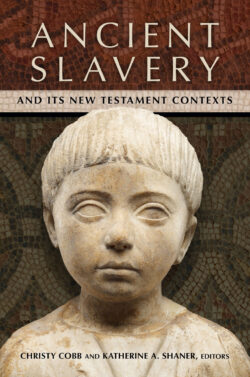
Ancient Slavery and Its New Testament Contexts
DESCRIPTION
An essential resource for understanding slavery in the New Testament and early Christianity
Slavery permeated society in the ancient world. The realities of slavery and its shadows pervade the New Testament and other early Christian texts. Yet enslavement remains an under-taught aspect of the context of the New Testament and early Christianity. Because of this, readers are left with numerous questions about ancient slavery. How did people become enslaved? What kinds of work did enslaved people do? Who enslaved people? How did ancient slavery compare with more contemporary enslavement eras? Did anyone in the ancient world criticize slavery? Was ancient slavery racialized? Did Christians have a different understanding of slavery than others? These are just some of the questions students ask in higher education and in Bible study classrooms alike.
This volume takes on these questions, introducing students to the textures, complexities, and material realities of slavery in the Greco-Roman world. Ancient Slavery and Its New Testament Contexts draws on the expertise of scholars around the world with a focus on introductory information, accessibility, and readability. It does not attempt to dismiss or downplay the role of New Testament texts in the perpetuation of either ancient slavery or slavery in the North American context. Rather, the volume helps students and teachers alike wrestle with the ongoing historical, theological, and ethical legacies of slavery in their own faith formation and engagement with the biblical text.
theWord Features:
- Fully searchable text
- Chapter and glossary-entry navigation via the topic tree
- Internal cross-references
- Bible-reference links and verse popups
- Footnotes with exact single-note popups
- Tables and illustrations
- Special Text Colors
- Normal: Text
- Internal link: Ethics of Interpretation
- Bible reference: Acts 16:16–40
- Greek: βασιλεία τοῦ θεοῦ
- Greek transliteration: paidiskē
- Latin: operae
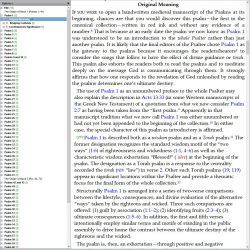
Package: NIV Application Commentaries: OT & NT (44vols.)
About the Book
The NIV Application Commentary helps you communicate and apply biblical text effectively in today’s context.
To bring the ancient messages of the Bible into today’s context, each passage is treated in three sections:
- Original Meaning. Concise exegesis to help readers understand the original meaning of the biblical text in its historical, literary, and cultural context.
- Bridging Contexts. A bridge between the world of the Bible and the world of today, built by discerning what is timeless in the timely pages of the Bible.
- Contemporary Significance. This section identifies comparable situations to those faced in the Bible and explores relevant application of the biblical messages. The author alerts the readers of problems they may encounter when seeking to apply the passage and helps them think through the issues involved.
This unique, award-winning commentary is the ideal resource for today’s preachers, teachers, and serious students of the Bible, giving them the tools, ideas, and insights they need to communicate God’s Word with the same powerful impact it had when it was first written.
theWord Features:
- Verse popups
- Verse (span) synchronization
- Fully searchable text
- Footnotes
- Pages links
- Easy navigation of topics via topics tree display.
- *Scripture Index
- *Subject Index
- *Author Index
- Special Text Colors
- Normal: Text
- Hyperlink: Glossary | Gen. 9:8
- Page Number: [pg 21>
- *Greek Transliteration: kataskanoo
- *Hebrew Transliteration: ’ish ha’elohim
- *Greek Transliteration: archon
- *Greek: εὐδόκησα
- *Hebrew Transliteration: weʿattah
- *Hebrew: יָרֵךְ
Note: Does not display commentary under Bible text.
* Depends on each specific commentary.
Pastor/Elder/Minister Package
DESCRIPTION
Advanced Greek Package
DESCRIPTION
New International Commentary: The Book of Ezekiel, Chapters 1–24
PRODUCT HIGHLIGHTS:
- Verse-by-verse commentary
- In-depth discussion of textual and critical matters
- Introductions to each book’s authorship, date, purpose, structure, and theology
- Detailed bibliography
DESCRIPTION
To many modern readers the prophecies of Ezekiel are a mystery. This commentary by Daniel Block—Part I of his two-volume study of the whole book of Ezekiel—seeks to answer the questions that contemporary readers bring to the text by examining the language, the message, and the methods of this obscure and often misunderstood Hebrew prophet. The result of twelve years of study, this volume provides an excellent discussion of the background of Ezekiel and offers a verse-by-verse exposition of each literary/prophetic unit in Ezekiel 1–24 that not only makes clear the prophet’s message to his original readers but also shows that Ezekiel’s ancient wisdom and vision are still very much needed by the church in the twenty-first century.
….
New International Commentary: The Book of Isaiah, Chapters 1–39
PRODUCT HIGHLIGHTS:
- Verse-by-verse commentary
- In-depth discussion of textual and critical matters
- Introductions to each book’s authorship, date, purpose, structure, and theology
- Detailed bibliography
DESCRIPTION
The first of John N. Oswalt’s two-part study of the book of Isaiah for the NICOT series, this commentary on chapters 1–39 combines theological acumen, literary sensitivity, philological expertise, and historical knowledge to present a faithful and accurate reading of one of the Old Testament’s most important books.
In the introduction to this work, Oswalt considers Isaiah’s background, unity of composition, date and authorship, canonicity, Hebrew text, theology, and problems of interpretation, and he offers a select bibliography for further research. Oswalt also provides substantial discussions of several issues crucial to the book of Isaiah. He notes, for example, that scholars often divide Isaiah into three divisions, with chapters 1–39 addressing Isaiah’s contemporaries in the eighth century b.c., chapters 40–55 presupposing the exile of the sixth century, and chapters 56–66 presupposing the eventual return from exile. While taking this scholarship into account Oswalt defends the unity of the prophetic book and argues convincingly that the whole book can be attributed to the Isaiah of the eighth century.
The commentary proper, based on Oswalt’s own translation of the Hebrew text, provides pastors, scholars, and students with a lucid interpretation of the book of Isaiah in its ancient context as well as an exposition of its message for today.
….
New International Commentary: The Book of Proverbs, Chapters 15–31
PRODUCT HIGHLIGHTS:
- Verse-by-verse commentary
- In-depth discussion of textual and critical matters
- Introductions to each book’s authorship, date, purpose, structure, and theology
- Detailed bibliography
DESCRIPTION
For the modern mind, the book’s cultural setting seems far removed from the twenty-first century. Proverbs puts a high priority on tradition and age, while the modern mind prizes change and youth. For Christians, Proverbs seems irrelevant. For the translator, Proverbs defies translations.
In the second part of his two-volume commentary, Waltke confronts these exegetical and interpretive challenges head on. This historico-grammatical commentary on Proverbs uncovers the profound philosophical and theological insights of this ancient book. Waltke helps readers understand the poetics used in its composition, and challenges modern prejudices toward the book.
….
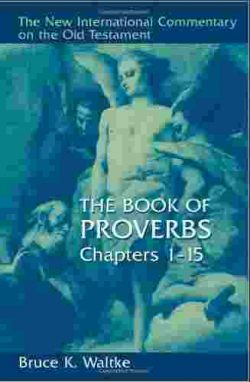
New International Commentary: The Book of Proverbs, Chapters 1–15
PRODUCT HIGHLIGHTS:
- Verse-by-verse commentary
- In-depth discussion of textual and critical matters
- Introductions to each book’s authorship, date, purpose, structure, and theology
- Detailed bibliography
DESCRIPTION
Over twenty-five years in the making, this much-anticipated commentary promises to be the standard study of Proverbs for years to come. Written by eminent Old Testament scholar Bruce Waltke, this two-volume commentary is unquestionably the most comprehensive work on Proverbs available.
Grounded in the literary criticism that has so strengthened biblical interpretation, Waltke’s commentary on Proverbs demonstrates the profound, ongoing relevance of this Old Testament book for Christian faith and life. A thorough introduction addresses such issues as text and versions, structure, authorship, and theology. The detailed commentary itself explains and elucidates Proverbs as “theological literature.” Waltke’s highly readable style—evident even in his original translation of the Hebrew text—makes his scholarly work accessible to teachers, pastors, Bible students, and general readers alike.
Daily Scriptures – 365 Readings in Hebrew, Greek, and Latin
DESCRIPTION
Pastors, students, and scholars not in the midst of language coursework often find it difficult to maintain their knowledge of biblical languages like Hebrew, Greek, and Latin. For those looking to do so in a meaningful but manageable way, this devotional offers 365 short daily readings, pairing an Old Testament passage in Hebrew and Greek with a corresponding New Testament passage in Greek and Latin. Lexical notes in English are included as a way of facilitating a comfortable reading experience that will build one’s confidence and ability in reading the Hebrew Bible, the Septuagint, the Greek New Testament, and the Latin Vulgate.
“Our goal and our purpose for this volume is to keep you in the languages, keep you fed in the Word, and hopefully spark a desire to explore more deeply how the New Testament at its core relies upon the Old Testament Scriptures.”
— from the introduction
theWord Features:
-
Devotional 365-day synchronization
-
Date and topic-tree navigation
-
Verse popups and Bible links
-
Fully searchable reading and note text
-
Exact single-footnote popups
-
Hebrew, Greek, and Latin source text
-
Native tables and images
-
Special Text Colors
-
Normal: Text
-
Bible link: Psalm 110:1
-
Greek: Εἶπεν ὁ κύριος τῷ κυρίῳ μου
-
Hebrew: נְאֻם יְהוָה לַאדֹנִי
-
Latin: qui cum sit splendor gloriae
-
Introductory Study Package
DESCRIPTION
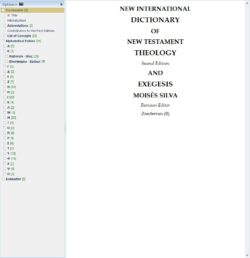
New International Dictionary of New Testament Theology and Exegesis Set
DESCRIPTION
A standard and widely-used reference work for nearly 40 years, the New International Dictionary of New Testament Theology and Exegesis has been thoroughly revised and updated to aid today’s pastors, students, scholars, and teachers in their study of the New Testament.
Offering a wealth of background and information on the meaning of Greek words in the New Testament—as well as related usage in classical Greek sources, the Septuagint, Jewish literature, and more—this important tool offers the following features:
• Alphabetical arrangement according to Greek words instead of previous order according to English topics; this ensures that individual Greek words are not discussed in isolation from one another and are easy to access
• Expanded to include additional Greek words and concepts not covered in the original work, NIDNTTE includes nearly 800 entries covering over 3,000 Greek words
• Discussions have been revised to be in line with modern scholarship and bibliographies are updated
• Corrections have been made to inconsistencies and omissions in earlier versions
• Updated and added consistency to include—for every entry—all necessary background information from classical Greek, the LXX, and Jewish literature.
• A helpful semantic domain index now directs the reader to all of the Greek words that have something to do with a particular English word. For example, under the English word “Anger, Wrath,” there is a list of thirteen Greek words that are related to that topic.
• Significant changes have been made in the presentation and discussion of linguistic details
• and much more!
theWord Features:
- Verse popups
- Fully searchable text
- Footnotes
- Easy navigation of topics via topics tree display.
- Cross-links to NIDOTTE, TDOT and TDNT.
- Special Text Colors
- Normal: Text
- Hyperlink: Glossary | Gen. 9:8
- G/K Numbering G325
Note: The codes H## and G## used in this module refer to the Goodrick–Kohlenberger (G/K) numbering system, not to Strong’s Concordance numbers. This follows the publisher’s data. Strong to Goodrick-Kohlenberger Number Conversion Chart at the end of the resource. - Greek: πατήρ
- Greek Transliteration: pater
- Hebrew: אֱלֹהִים
- Hebrew Transliteration: ʾelōhîm
Exploring the Bible: Ezra
Description
An easy to read guide to the main teaching and events of Ezra. Short chapters make use of alliteration and other catchy stylistic devices to make the key points of the book easily memorable. It traces the homecoming journey of God’s people from bondage to blessing under the leadership of one of Israel’s greatest historical heroes. In a fresh and forthright manner, it treats a diverse range of biblical and theological themes, including the sovereignty of God, the authority of Scripture, and the centrality of Scripture.
theWord Features:
Note: Does not display commentary under Bible text.