
Premium Feature: Full Bible Search Helper
Description:
This is still a work in progress feature and subject to change.
(Note: Premium Features are not needed to use theWord it still maintains existing functionality this just adds special extended features.)
- theWord Version: 7.7.2.1620-691 or newer
- Bible Background Indexer
- Indexes the Bibles to provide much internal data (Original Word, Strong, Lemma, Morphology). This is required for the use of the Inline Helper, Bible Search Helper.
- .morph files (May be included with their Bibles or this Premium feature (to decide)
- Used for Definitions of the Morphology code and Morphology Builder
- Available through Add Titles in the MorphX section required for full functionality of this feature.
- BSB-MorphX for BSBHebInt, BSBGrkInt, BSBRevInt
- BHS5-ETCBC-MorphX for BHS5/ETCBC
- LXX-PMAC-MorphX for lxx
- RMAC-MorphX for NA28, BYZa, SBLGNT, etc.
- WHMC-MorphX for WHM 4.22
- Bible View – Top translation words: for Bibles with Strong’s #/Lemma
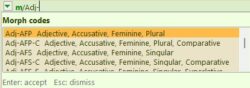
- Bible Search – inline helper (as you type it gives you a list of available terms.)
- Auto complete for Original Words (English, Hebrew, Greek, Main Text of the Bible)
- Auto complete for Strongs (H#, G#)
- Auto complete for Lemma (Hebrew/Greek)
- Auto complete for Morphology with expanded definition:
- BSB-MorphX for BSBHebInt, BSBGrkInt, BSBRevInt
- BHS5-ETCBC-MorphX for BHS5/ETCBC
- LXX-PMAC-MorphX for lxx
- RMAC-MorphX for NA28, BYZa, SBLGNT, etc.
- WHMC-MorphX for WHM 4.22
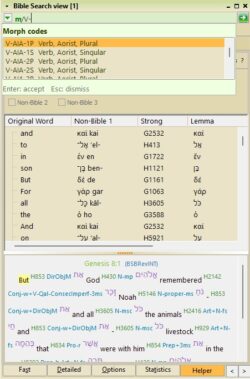
- Bible Search Helper (accessible via Helper tab in Bible Search)
- Tabs: (Dependent on what is supported in a Bible)
- Combined
- Filter for sorting with advanced sorting
- Column Toggles: Original Word, Strong, Lemma, Morphology, Switch Text 1..3, Non-Bible 1..3, Count
- Column Sorting
- Verse Preview
- highlight of hovered word
- Right Click to go to Verse
- Original Word
- Filter for sorting
- Columns: Key, Original Forms (OT, NT), Count
- Column Sorting
- Dictionary shown on Hover if activated.
- Word preview pane
- Double click to send to Bible search
- Strong’s #
- Filter for sorting
- Columns: Key, Top Words, Count
- Column Sorting
- Dictionary shown on Hover if activated.
- Word preview pane
- Double click to send to Bible search
- Morphology
- Filter for sorting
- Columns: Key, Top Words, Count
- Column Sorting
- Dictionary shown on Hover if activated.
- Word preview pane
- Double click to send to Bible search
- Morphology Builder
- Uses the .morph file to help with building morphology
- Part of speech check boxes for easy building of Morphology.
- Matching codes with definitions.
- Lemma
- Filter for sorting
- Columns: Key, Representative Forms, Count
- Column Sorting.
- Send to Lemma Family
- Dictionary shown on Hover if activated.
- Word preview pane
- Double click to send to Bible search
- Lemma Family
- Enter Lemma Root, Include all forms (substring match): Find Family
- Dictionary shown on Hover if activated.
- Double click to send to Bible search
- Syntax Validator
- Used for help you build good Bible Search syntax (may not stay in release)
- Headings
- Filter forsorting
- Columns: Key, Testament, Count
- Double Click to go to first verse occurence
- Right Click to go to a specific verse
- Footnotes
- Filter, Key, Testament, Count
- Double Click to go to first verse occurence
- Right Click to go to a specific verse
- Switch Text 1…3
- Filter for sorting
- Columns: Key, Testament, Count
- Word preview pane
- Non-Bible 1…3
- Filter for sorting
- Columns: Key, Testament, Count
- Word preview pane
- Preferences
- Settings for Bible Search Helper
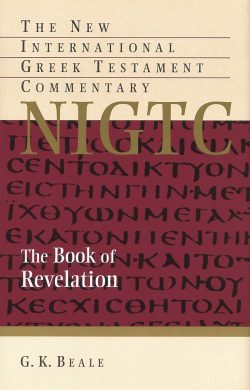
NIGTC: Revelation
DESCRIPTION
Series: The New International Greek Testament Commentary (NIGTC)
This volume on Revelation is accessible and comprehensive. It provides an in-depth look at the parallels between images in the Apocalypse and their Old Testament and Jewish antecedents G.K. Beale’s painstaking anaylsis will help you better understand the obscure metaphors in Revelation and the purpose of the book itself.
Author:
G. K. Beale is J. Gresham Machen Chair of New Testament and professor of New Testament and biblical theology at Westminster Theological Seminary.
G. K. Beale is J. Gresham Machen Chair of New Testament and professor of New Testament and biblical theology at Westminster Theological Seminary.
theWord Features
- Fully searchable text
- Easy navigation through the topic tree
- Bible-verse synchronization
- Bible-reference links and verse popups
- Internal cross-references
- Footnote popups with backlinks
- Apocrypha links to the default edition
- Native tables
- Resource images
- Print-page markers and bookmarks
- Pgs: 1312
- Special Text Colors
- Normal: Text
- Internal link: Abbreviations
- Bible reference: Rev. 1:1
- Greek: πίστις
- Hebrew: א
- Page Number: [p1>
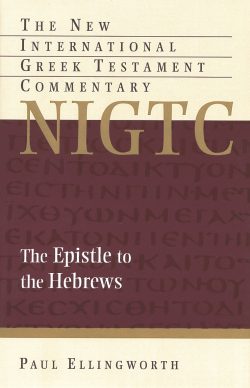
NIGTC: Hebrews
DESCRIPTION
Series: The New International Greek Testament Commentary (NIGTC)
This superb work is sure to win a name for itself as one of the major commentaries on the Epistle to the Hebrews. The principal purpose of this substantial volume is to clarify the meaning of Hebrews, long considered a complicated and obscure book. Paul Ellingworth’s fine-tooth-comb coverage of Hebrews looks at the text up close and in a broad light, enabling the reader to see the forest as well as the trees.
In his determined quest to understand Hebrews, Ellingworth begins with a detailed study of the Greek text, working outward to consider the wider context, linguistic questions, and the relation of Hebrews to other early Christian writings and to the Old Testament. Nonbiblical writings such as Philo and the Dead Sea Scrolls, though less directly related to Hebrews, are considered where appropriate.
Unveiling the discourse structure of this carefully written letter, Ellingworth’s commentary helps make coherent sense of the complexities of Hebrews. As a result of his exhaustive study, Ellingworth finds Hebrews to be primarily a pastoral, not a polemical, writing. Showing how Hebrews beautifully emphasizes the supremacy of Christ, Ellingworth concludes that the essential purpose of the epistle – which maintains the continuity of God’s people before and after Christ – is to encourage readers to base their lives on nothing other and nothing less than Jesus.
A substantive bibliography and a comprehensive introduction precede Ellingworth’s commentary, and three indexes – of subjects, authors, and Greek words discussed – conclude the volume.
Author:
Paul Ellingworth (1931–2018) was a British biblical scholar who taught at the University of Aberdeen and served as a translation consultant for the United Bible Societies.
theWord Features
- Fully searchable text
- Easy navigation through the topic tree
- Bible-verse synchronization
- Bible-reference links and verse popups
- Internal cross-references
- Apocrypha links to the default edition
- Footnote popups with backlinks
- Native tables
- Resource images
- Print-page markers and bookmarks
- Pgs: 862
- Special Text Colors
- Normal: Text
- Internal link: Abbreviations
- Bible reference: Heb. 1:1
- Greek: πίστις
- Hebrew: אשר
- Hebrew Transliteration: liPnê
- Latin: Studia Patristica
- Page Number: [p1>
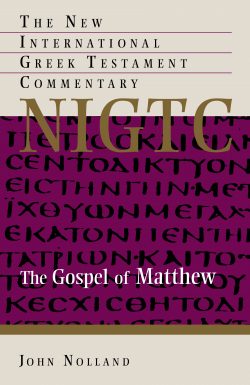
NIGTC: Matthew
DESCRIPTION
Series: The New International Greek Testament Commentary (NIGTC)
Having devoted the past ten years of his life to research for this major new work, John Nolland gives us a commentary on the Gospel of Matthew that engages with a notable range of Matthean scholarship and offers fresh interpretations of the dominant Gospel in the history of the church.
Without neglecting the Gospel’s sources or historical background, Nolland places his central focus on the content and method of Matthew’s story. His work explores Matthew’s narrative technique and the inner logic of the unfolding text, giving full weight to the Jewish character of the book and its differences from Mark’s presentation of parallel material. While finding it unlikely that the apostle Matthew himself composed the book, Nolland does argue that Matthew’s Gospel reflects the historical ministry of Jesus with considerable accuracy, and he brings to the table new evidence for an early date of composition.
Including accurate translations based on the latest Greek text, detailed verse-by-verse comments, thorough bibliographies for each section, and an array of insightful critical approaches, Nolland’s Gospel of Matthew will stimulate students, preachers, and scholars seeking to understand more fully Matthew’s presentation of the gospel narrative.
Author:
John Nolland is academic dean and lecturer in New Testament studies at Trinity College, Bristol, England. An ordained minister of the Church of England, he is also the author of the three-volume Word Biblical Commentary on the Gospel of Luke.
theWord Features:
- Fully searchable text
- Easy navigation through the topic tree
- Bible-verse synchronization
- Bible-reference links and verse popups
- Internal cross-references
- Footnote popups with backlinks
- Native tables
- Resource images
- Print-page markers and bookmarks
- Pgs: 1579
- Apocrypha passage popups with labeled reference notes
- Special Text Colors
- Normal: Text
- Internal link: Abbreviations
- Bible reference: Matthew 1:1
- Greek: πίστις
- Hebrew: א
- Transliteration: rûaḥ
- Latin: ex hypothesi
- Page Number: [p1>
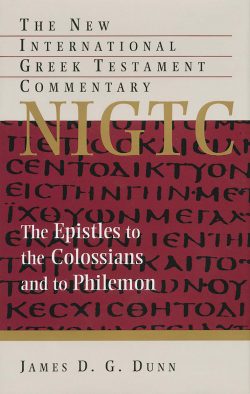
NIGTC: Colossians & Philemon
DESCRIPTION
Series: The New International Greek Testament Commentary (NIGTC)
Paul’s Epistle to the Colossians merits detailed study for at least two reasons. First, it provides an unexpectedly interesting window into the character of Christianity in Asia Minor in the second half of the first century. With the information it gives about the religious tensions within which emergent Christianity was caught up, not least those between Christianity and diaspora Judaism, we begin to gain more insight into the influences and factors that shaped the transition from apostolic to subapostolic Christianity in the region. Second, Colossians represents a crucial stage in the development of Pauline theology itself. Whether it was written at the end of Paul’s life or soon after his death, it indicates how Pauline theology retained its own vital character and did not die with Paul.
In this volume in the celebrated New International Greek Testament Commentary, James D. G. Dunn, author of numerous well-received works on the historical origin and theological interpretation of the New Testament, provides detailed expositions of the text of Paul’s letters to the Colossians and to Philemon.
Dunn examines each of these letters within the context of the Jewish and Hellenistic cultures in the first century, and discusses the place of Colossians and Philemon in the relationship between the Pauline mission and the early churches that received these letters. Particular stress is also placed on the role of faith in Jesus Christ within and over against Judaism and on the counsel of these two important letters with regard to the shaping of human relationships in the community of faith.
Author:
James D. G. Dunn (1939–2020) was a renowned New Testament scholar and the longtime Lightfoot Professor of Divinity at Durham University. His numerous books include The Theology of Paul the Apostle, Jesus according to the New Testament, and the magisterial Christianity in the Making trilogy.
theWord Features:
- Fully searchable text
- Easy navigation through the topic tree
- Bible-verse synchronization
- Bible-reference links and verse popups
- Internal cross-references
- Footnote popups with topic-end notes and backlinks
- Native tables
- Resource images
- Print-page markers and bookmarks
- Apocrypha reference passages
- Added passage text: World English Bible British Edition (public domain)
- Reference passage: Jdt. 4:9
- Pgs: 406
- Special Text Colors
- Normal: Text
- Internal link: Abbreviations
- Bible reference: Col. 1:1
- Greek: πίστις
- Transliteration: qibbel
- Latin: primatum habere
- Page Number: [p1>
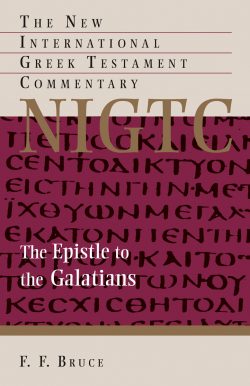
NIGTC: Galatians
DESCRIPTION
Series: The New International Greek Testament Commentary (NIGTC)
Paul’s letter to the churches of Galatia was for many years a document of special interest and study for renowned New Testament scholar F. F. Bruce. This excellent volume in the New International Greek Testament Commentary series contains Bruce’s mature work on that important early epistle.
Through phrase-by-phrase exegesis of the Greek text, consistent awareness of the historical and geographical context, and balanced dialogue with scores of other scholars, Bruce successfully bridges the hermeneutical gap and makes the text of Galatians come alive for both scholars and students. Based on careful historical-critical-linguistic exegesis yet primarily theological in character, this commentary places special emphasis throughout on Paul’s insistence on justification before God by faith apart from works of the law, and on Paul’s presentation of the Spirit as the principle of the new life in Christ.
Author:
F. F. Bruce (1910-1990) was Rylands Professor of Biblical Criticism and Exegesis at the University of Manchester, England. Author of numerous commentaries and other books, he served as general editor of the NICNT series from 1962 to 1990.
theWord Features:
- Fully searchable text
- Easy navigation through the topic tree
- Bible-reference links and verse popups
- Internal cross-references
- Footnote popups with topic-end notes and backlinks
- Native tables
- Resource images
- Print-page markers and bookmarks
- Special Text Colors
- Normal: Text
- Internal link: Abbreviations
- Bible reference: Gal. 1:1
- Greek: πίστις
- Page Number: [p1>
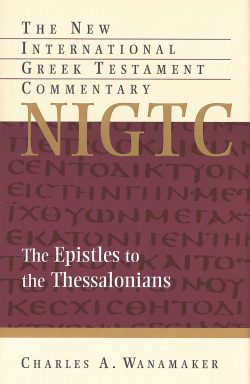
NIGTC: 1 & 2 Thessalonians
DESCRIPTION
Series: The New International Greek Testament Commentary (NIGTC)
The letters of Paul to the newly founded Christian community at Thessalonica hold a special place within the Christian tradition as possibly the earliest extant Christian writings. They are also of special interest not only for their theological value but for their sociological context. Among the communities established by Paul, the church at Thessalonica appears to have been the only one to have suffered serious external oppression. These two important epistles, then, speak uniquely to contemporary Christians living in a society often ideologically, if not politically, opposed to Christian faith.
In this innovative commentary Charles A. Wanamaker incorporates what may be called a social science approach to the study of 1 and 2 Thessalonians, taking into full account the social context that gave rise to Paul’s correspondence. While Wanamaker in no way ignores traditional historical-critical, linguistic, literary, and theological approaches to writing a commentary — in fact, at several points he makes a significant contribution to the questions raised by traditional exegesis — at the same time he goes beyond previous commentaries on the Thessalonian correspondence by taking seriously the social dimensions both of Christianity at Thessalonica and of the texts of 1 and 2 Thessalonians themselves. In blending traditional exegetical methods with this newer approach, Wanamaker seeks to understand Pauline Christianity at Thessalonica as a socio-religious movement in the first-century Greco-Roman world and attempts to grasp the social character and functions of Paul’s letters within this context.
Author:
Charles A. Wanamaker, Associate professor in the department of religious studies and director of postgraduate studies at the University of Cape Town in South Africa. He received his doctorate in New Testament studies at the University of Durham under C. K. Barrett.
theWord Features:
-
Fully searchable text
-
Easy navigation through the topic tree
-
Bible-reference links and verse popups
-
Internal cross-references
-
Native tables
-
Resource images
-
Print-page markers and bookmarks
- Special Text Colors
- Normal: Text
-
Internal link: Abbreviations and Bibliography
-
Bible reference: 1 Thes 1:1
- Greek: πίστις
-
Page Number: [p1>

Premium Feature: Semantics Helper
Description:
- theWord Version: 7.7.1.1613 or newer
- Bible View – Semantic Rule Highlights: Bibles with Morphology
- Bible View Options: Use Pre-built rules and add your own.
- Pre-built rules
- Build your own: Verbs, Nouns, using the Simple Builder Or more complex using morph-code directly like *-NSM for Articles and Nouns that match.
- Rules can Hover On as you move the mouse around or be Always On.
- Rules can be tied to the selected verse or the chapter (Example: Verbs throughout).
- .morphx files
- Used for Building custom rules in the Semantics Helper
- Available through Add Titles in the MorphX section required for this feature.
- BSB-MorphX for BSBHebInt, BSBGrkInt, BSBRevInt
- BHS5-ETCBC-MorphX for BHS5/ETCBC
- LXX-PMAC-MorphX for lxx
- RMAC-MorphX for NA28, BYZa, SBLGNT, etc.
- WHMC-MorphX for WHM 4.22
Premium Feature: Inline Bible Search Helper
Description:
- theWord Version: 7.7.1.1612 or newer
- Bible Background Indexer
- Indexes the Bibles to provide much internal data (Original Word, Strong, Lemma, Morphology). This is required for the use of the Inline Helper, Bible Search Helper.
- .morphx files
- Used for Definitions of the Morphology code
- Available through Add Titles in the MorphX section required for full functionality of this feature.
- BSB-MorphX for BSBHebInt, BSBGrkInt, BSBRevInt
- BHS5-ETCBC-MorphX for BHS5/ETCBC
- LXX-PMAC-MorphX for lxx
- RMAC-MorphX for NA28, BYZa, SBLGNT, etc.
- WHMC-MorphX for WHM 4.22
- Bible View – Top translation words: for Bibles with Strong’s #/Lemma
- Bible Search – inline helper (as you type it gives you a list of available terms.)
- Auto complete for Original Words (English, Hebrew, Greek, Main Text of the Bible)
- Auto complete for Strongs (H#, G#)
- Auto complete for Lemma (Hebrew/Greek)
- Auto complete for Morphology with expanded definition:
- BSB-MorphX for BSBHebInt, BSBGrkInt, BSBRevInt
- BHS5-ETCBC-MorphX for BHS5/ETCBC
- LXX-PMAC-MorphX for lxx
- RMAC-MorphX for NA28, BYZa, SBLGNT, etc.
- WHMC-MorphX for WHM 4.22
- Preferences
- Settings for Inline Bible Search Helper
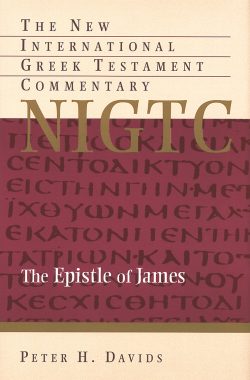
NIGTC: James
DESCRIPTION
Series: The New International Greek Testament Commentary (NIGTC)
Peter H. Davids’s study on the Epistle of James is a contribution to The New International Greek Testament Commentary, a series based on the UBS Greek New Testament, which attempts to provide thorough exegesis of the text that is sensitive to theological themes as well as to the details of the historical, linguistic, and textual context.
Author:
Peter H. Davids is professor of biblical theology at St.Stephen’s University, St. Stephen, New Brunswick. He is also the coeditor of Dictionary of the Later NewTestament and Its Developments.
theWord Features:
-
Fully searchable text
-
Always-available topic tree (table of contents)
-
Bible-reference links and verse popups
-
Internal cross-references
-
Native tables
-
Resource images
-
Print-page markers
- Special Text Colors
- Normal: Text
-
Internal link: Abbreviations and Bibliography
-
Bible reference: James 1:1
- Greek: πίστις
-
Page Number: [p1>
The Encyclopedia of Christianity, Volumes 1–5
DESCRIPTION
Volume 1 (A-D) contains 465 articles featuring (Retail $109.99)
- articles on all but the smallest countries of the world, including the former communist nations that have gained independence since 1989;
- the latest statistical information from David B. Barrett on the religious affiliation and ecclesiastical breakdown of each country and continent;
- articles on doctrines, denominations, and social and ethical issues in relation to the churches;
- biographical articles on prominent figures through church history.
Volume 2 of the award-winning reference work on Christianity. (Retail: $99.99)
The multiple award-winning Encyclopedia of Christianity (EC), copublished by Eerdmans and Brill, is a monumental five-volume work presenting the history and current state of the Christian faith in its rich spiritual and theological diversity around the world. The much-anticipated second volume of the EC contains more than 300 articles for alphabetical entries EûI. Written by leading scholars from around the world, the articles in Volume 2 range from discussions of early church history, ethics, and evil to entries on Holy Week, icons, and Christianity in Ireland.
Volume 3 of the EC (Retail: $109.99)
contains 342 articles constituting the alphabetical entries J–O — articles on significant topics ranging from Jesus, the kingdom of God, liberation theology, and Martin Luther to medical ethics, the Middle Ages, North American theology, and the Orthodox Church. Like each volume in the complete EC, this book incorporates many enhancements of and additions to the third revised edition of the German Evangelisches Kirchenlexikon: Internationale theologische EnzyklopSdie, on which the EC is based. Among the new features of this English work are the following:
- articles on all but the smallest countries of the world, including former communist states that have gained their independence since 1989;
- the latest, best statistical information, compiled by David B. Barrett, on the religious affiliation and ecclesiastical breakdown of each country and continent;
- the addition of over seventy biographical articles on prominent figures throughout church history;
- many expanded or entirely new articles that address topics of particular interest to English-speaking readers.
Unparalleled in scholarship and breadth of content, the Encyclopedia of Christianity will long serve as the standard reference work for the study of Christianity in the past and the present — and its trajectory into the twenty-first century.
Volume 4 of the EC (Retail: $109.99)
contains 299 articles constituting the alphabetical entries PûSh — articles on significant topics ranging from Paul, process theology, and the Qur’an to religious liberty, salvation history, and Scholasticism. Like each volume in the complete EC, this book incorporates many enhancements of and additions to the third revised edition of the German Evangelisches Kirchenlexikon: Internationale theologische Enzyklopädie, on which the EC is based. Among the features of this English work are the following:
- articles on all but the smallest countries of the world, including former communist states that have gained their independence since 1989;
- the latest, best statistical information, compiled by David B. Barrett, on the religious affiliation and ecclesiastical breakdown of each country and continent;
- the addition of over seventy biographical articles on prominent figures throughout church history;
- many expanded or entirely new articles that address topics of particular interest to English-speaking readers.
Unparalleled in scholarship and breadth of content, the Encyclopedia of Christianity will long serve as the standard reference work for the study of Christianity in the past and the present — and its trajectory into the twenty-first century.
Volume 5 of the EC (Retail: $99.99)
contains 295 articles constituting the alphabetical entries Si–Z — articles on significant topics ranging from sin, spiritual direction, Sufism, and terrorism to Vatican I and II, Vineyard Christian Fellowship, World Alliance of Reformed Churches, and Zionism. Like each volume in the complete EC, this book incorporates many enhancements of and additions to the third revised edition of the German Evangelisches Kirchenlexikon: Internationale theologische Enzyklopädie, on which the EC is based. Among the features of this English work are the following:
- articles on all but the smallest countries of the world, including former communist states that have gained their independence since 1989;
- the latest, best statistical information, compiled by David B. Barrett, on the religious affiliation and ecclesiastical breakdown of each country and continent;
- the addition of over seventy biographical articles on prominent figures throughout church history;
- many expanded or entirely new articles that address topics of particular interest to English-speaking readers.Unparalleled in scholarship and breadth of content, the Encyclopedia of Christianity will long serve as the standard reference work for the study of Christianity in the past and the present — and its trajectory into the future.
theWord Features:
-
Dictionary lookup and A-Z topic-tree navigation
-
Fully searchable five-volume text
-
Internal cross-references
-
Verse popups
-
Abbreviation and table-note popups
-
Tables and restored publisher illustrations
-
Volume-qualified print-page markers and bookmarks
-
Vol. 1 Pgs: 933
-
Vol. 2 Pgs: 819
-
Vol. 3 Pgs: 916
-
Vol. 4 Pgs: 984
-
Vol. 5 Pgs: 896
-
Total Pgs: 4548
- Special Text Colors

Revelation: A Shorter Commentary
DESCRIPTION
G. K. Beale’s monumental New International Greek Testament Commentary volume on Revelation has been highly praised since its publication in 1999. This shorter commentary distills the superb grammatical analysis and exegesis from that tome (over 1,300 pages) into a book more accessible and pertinent to preachers, students, and general Christian readers.
As in the original commentary, Beale views Revelation as an integrated whole, as a conscious continuation of the Old Testament prophetic books, and shows that recognizing Revelation’s nearly constant use of Old Testament allusions is key to unlocking its meaning. Interspersed throughout the volume are more than sixty sets of “Suggestions for Reflection” to help readers better grasp the relevance of Revelation to their lives and our world today.
theWord Features:
- Revelation verse-range synchronization
- Verse popups and Bible links
- Chapter, section, and index topic navigation
- Fully searchable commentary text
- Internal cross-references
- Native commentary tables
- Native cover image
- Print-page markers and navigation
- Pgs: 576
- Special Text Colors
- Normal: Text
-
Scripture: Revelation 1:1
- Greek Transliteration: sēmainō
- Page Number: [p1>
- Latin: ex nihilo
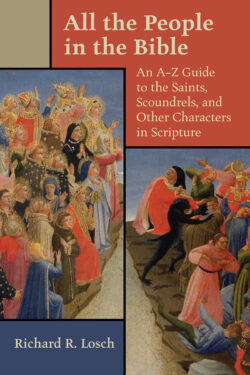
All the People in the Bible
DESCRIPTION
“More than any other book, the Bible offers an amazing collection of fascinating characters ranging from the holiest of the holy to some of the most depraved scoundrels imaginable. Many are mentioned only in passing, yet history and archaeology can often fill in the blanks and flesh them out as exciting human beings. For this reason we have in many cases been able to tell much more about them than the Bible alone reveals.”
— Richard R. Losch (from the preface)
A comprehensive gathering of persons found in the Bible, including the Apocrypha, All the People in the Bible really delivers on its title: literally all of the Bible’s characters appear in this fascinating reference work. From the first article on Aaron to the final entry on Zophar, Richard Losch details each person in a lively narrative style.
The bulk of the book consists of Losch’s A–Z articles covering the familiar and the not-so-familiar figures in Scripture. Names of people who are found only in genealogies or who had no significant effect on history are included solely in the alphabetical listing starting on page 452. That listing, “All the People in the Bible and Apocrypha,” includes pronunciations, brief identifications, and biblical references. Persons covered in greater detail in the main part of the book are identified in bold print.
Losch’s intriguing look at all the people in the Bible is anything but a dry reference work. This is a book to dip into and enjoy over and over.
theWord Features:
- Dictionary lookup and A-Z topic-tree navigation
- Fully searchable biographical entries
- Aliases and internal cross-references
- Bible-reference links and verse popups
- Footnotes with exact single-note popups
- Greek, Hebrew, and transliterated name forms
- Images and tables
- Print-page markers and bookmarks
- Pgs: 586
- Special Text Colors
- Normal: Text
-
Dictionary link: Peter
- Greek: Πέτρος
- Hebrew: שמעון
- Transliteration: Kephah
-
Page Number: [p1>


theWord-App Advanced Subscription (Beta)
theWord-App Advanced Features
Includes every feature available in theWord-App Basic, plus:
- Bible Search
- Create and manage custom cross-reference sets and files
- Reading plans, daily readings, and devotionals
- Saved layouts and multi-view workspace layouts
- Create new user modules
- Create, organize, format, edit, and save user-module topics
- Paste Bible selections directly into the editor
- Copy Verses dialog with advanced copying and printing
- Bible View List and Compare modes
- Create, save, manage, copy, and print verse lists
- Display commentaries inline within Bible View
- Bible text-formatting toolbar, advanced colors, and link styling
- Advanced Strong’s, morphology, and lemma colors, fonts, substitutions, and display styling
- Book View background images with placement controls
- Fuzzy topic matching, diacritic reorientation, and matching highlights
- Advanced startup, update, and view preferences
30 Day Trial below so you can try before you buy https://app.theword.net (or download it first from a link below).
Android, iPhone, iPad, macOS, Linux, Windows
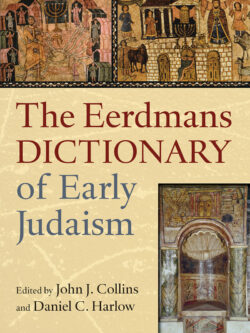
The Eerdmans Dictionary of Early Judaism
DESCRIPTION
The Dictionary of Early Judaism is the first reference work devoted exclusively to Second Temple Judaism (fourth century b.c.e. through second century c.e.).
The first section of this substantive and incredible work contains thirteen major essays that attempt to synthesize major aspects of Judaism in the period between Alexander and Hadrian. The second — and significantly longer — section offers 520 entries arranged alphabetically. Many of these entries have cross-references and all have select bibliographies. Equal attention is given to literary and nonliterary (i.e. archaeological and epigraphic) evidence and New Testament writings are included as evidence for Judaism in the first century c.e. Several entries also give pertinent information on the Hebrew Bible.
The Dictionary of Early Judaism is intended to not only meet the needs of scholars and students — at which it succeeds admirably — but also to provide accessible information for the general reader. It is ecumenical and international in character, bringing together nearly 270 authors from as many as twenty countries and including Jews, Christians, and scholars of no religious affiliation.
theWord Features:
- Dictionary lookup and A-Z topic-tree navigation
- Fully searchable articles, bibliographies, and author lines
- Scripture-reference popups and Bible links
- Internal cross-references
- Pgs: 1406
- Maps, illustrations, and tables
- Special Text Colors
- Normal: Text
-
Dictionary link: Apocalypticism
-
Scripture: Genesis 3
-
Page Number: [p1>
-
Hebrew transliteration: halakah
-
Greek transliteration: apokalypsis
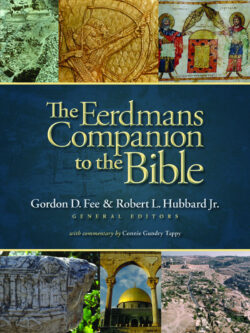
The Eerdmans Companion to the Bible
DESCRIPTION
A quality guidebook that opens up new vistas and insights into the whole Bible
Marked by a broad evangelical perspective, up-to-date research, and contributions from respected biblical scholars, The Eerdmans Companion to the Bible offers a reliable and illuminating guide to the entire Bible. Whether readers find the Bible familiar or foreign, they will appreciate the Companion’s informative articles and its commentary by Connie Gundry Tappy on all of the Old and New Testament books. This comprehensive reference work promises to make the Word of God come alive as never before.
- Compiled by some of the foremost biblical scholars in the world today
- New articles by sixty expert authors on many pertinent biblical topics
- Well-written background information and commentary on every book of the Bible
- Illustrated with maps, photos, and charts throughout
theWord Features:
-
Fully searchable text
-
Chapter, section, and indexed-entry navigation via the topic tree
-
Internal cross-references
-
Pgs: 834
-
Maps, illustrations, and tables
- Special Text Colors
- Normal: Text
- Internal link: Lands of the Bible
- Hebrew: א
- Transliteration: aleph
- Latin: testamentum
- Page Number: [p210>

theWord-App Premium Subscription (Beta)
theWord-App Premium Features
Includes every feature available in theWord-App Basic and Advanced, plus:
- Book Search
- Create, edit, order, import, and export Book View module sets
- Bible View Interlinear mode
- Original-word and gloss sections
- Ancient Biblical language databases
- Bible and Book Word Study
- Power Word Study
- Word-popup statistics with original-word, transliteration, and gloss information
- Bible View background images with placement controls
- Custom Bible tab flags and icons
- Go directly to a topic by ID and export topics
- Change abbreviations or original-module identity for non-user modules
- Bible Search indexing preferences
- Book Search indexing and maintenance preferences
- Clipboard Monitor and Clipboard Viewer
- Proofing and spell-checking tools
Please note: Full Bible Search Helper and Inline Bible
Search Helper are optional add-ons. Premium access is required, but these
add-ons must be purchased and unlocked separately.
30 Day Trial below so you can try before you buy https://app.theword.net (or download it first from a link below).
Android, iPhone, iPad, macOS, Linux, Windows
NIGTC: 2 Corinthians
Series: The New International Greek Testament Commentary (NIGTC)
The reputation of the NIGTC series is so outstanding that the appearance of each new volume is noteworthy. This book on 2 Corinthians is no exception. Master New Testament exegete Murray J. Harris has produced a superb commentary that analyzes the Greek text verse by verse against the backdrop of Paul’s tumultuous relations with his converts at Corinth.
Believing that Scripture cannot be understood theologically unless it has first been understood grammatically, Harris provides a careful, thoroughgoing reading of the text of 2 Corinthians. He gives special attention to matters of translation, making regular references not only to the standard modern English translations but also to influential older versions such as The Twentieth Century New Testament and those by Weymouth, Moffatt, and Goodspeed. His close attention to matters of textual criticism and grammar leads to discussions of the theology of 2 Corinthians that show the relevance of Paul’s teaching to Christian living and church ministry.
Other notable features of the book include a comprehensive introduction in which all the relevant literary and historical issues are discussed, an expanded paraphrase of the letter that conveniently shows Harris’s decisions on exegetical issues and indicates the flow of Paul’s argument, a chronology of the relations of Paul, Timothy, and Titus with the Corinthian church, and an excursus on Paul’s “affliction in Asia” (1:8-11) and its influence on his outlook and theology.
Author:
Murray J. Harris is professor emeritus of New Testament exegesis and theology at Trinity Evangelical Divinity School, Deerfield, Illinois. His numerous other books include Jesus as God: The New Testament Use of Theos in Reference to Jesus, Slave of Christ: A New Testament Metaphor for Total Devotion to Christ, and Prepositions and Theology in the Greek New Testament.
theWord Features: