

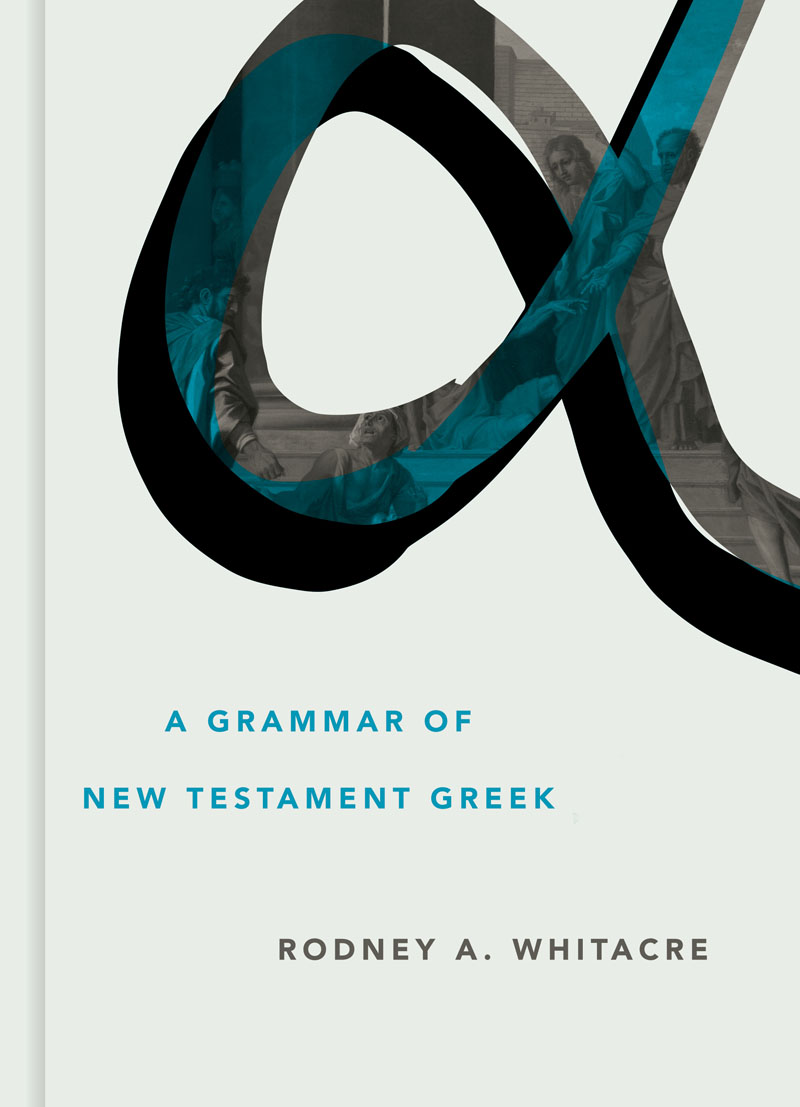
A grammar for moving from word forms to confident reading. Rodney A. Whitacre’s A Grammar of New Testament Greek helps beginning and intermediate readers understand how Greek words, phrases, clauses, and sentences communicate meaning. It combines morphology and syntax with the practical goal of reading and interpreting actual passages.
Why choose Whitacre’s grammar?
- Explanation that supports learning and review. Whitacre deliberately includes extra explanation and repetition for readers meeting a topic for the first time. The opening chapters also provide a starting point for those returning to Greek. You can read the book through to consolidate your knowledge as well as consult individual sections.
- Sentence maps that make relationships visible. Worked Greek and English examples arrange clauses, prepositional phrases, and modifiers to show how each part contributes to the sentence. This offers a practical way to work through difficult constructions and trace a passage’s flow of thought.
- Word forms and syntax in one reference. Declensions, verb forms, participles, cases, tense and aspect, word order, and clause relationships are treated within the same volume. Material on word formation and word families also encourages closer attention to how Greek words are built.
- Eight appendices for recurring questions. Find accent rules, words distinguished by accents and breathing marks, common suffixes, reference paradigms, syntax summaries, English grammar essentials, guidance for approaching a Greek sentence, and principal parts of common verbs. A glossary of grammatical terms provides another point of reference.
Who will find it useful? Second-year Greek students, readers refreshing skills they have not used recently, and pastors or teachers preparing a close study of a passage. Its opening review supports the transition to more detailed morphology and syntax, connecting grammatical analysis with interpretation. Use it as a textbook or a continuing reference for the Greek New Testament and other Koine texts, including the Septuagint and Apostolic Fathers.
Using it in theWord: Search Greek and English text, consult the paradigms and sentence maps, follow links between grammar sections, and open Bible references and footnotes while working alongside your study library.
About the author
Author: Rodney A. Whitacre (1949–2023) taught Greek for more than forty years. His books include Using and Enjoying Biblical Greek, A Patristic Greek Reader, and a commentary on John in the IVP New Testament Commentary series.
Series: Eerdmans Language Resources (ELR)
Author: Rodney A. Whitacre
Publisher: Wm. B. Eerdmans Publishing Co.
Publication date: November 30, 2021
Pgs: 522

Reviews
There are no reviews yet.