
Give Thanks to God

Praise the Lord for His wonderous blessings.
We praise the Lord for you. Thank you for giving to theWord.
This sale is during the month of November!
Strong’s Number Package
Package: NIV Application Commentary: New Testament
Description
The NIV Application Commentary helps you communicate and apply biblical text effectively in today’s context.
Package: NIV Application Commentaries: OT & NT (44vols.)
About the Book
The NIV Application Commentary helps you communicate and apply biblical text effectively in today’s context.
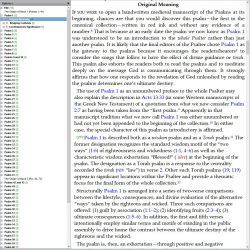
To bring the ancient messages of the Bible into today’s context, each passage is treated in three sections:
- Original Meaning. Concise exegesis to help readers understand the original meaning of the biblical text in its historical, literary, and cultural context.
- Bridging Contexts. A bridge between the world of the Bible and the world of today, built by discerning what is timeless in the timely pages of the Bible.
- Contemporary Significance. This section identifies comparable situations to those faced in the Bible and explores relevant application of the biblical messages. The author alerts the readers of problems they may encounter when seeking to apply the passage and helps them think through the issues involved.
This unique, award-winning commentary is the ideal resource for today’s preachers, teachers, and serious students of the Bible, giving them the tools, ideas, and insights they need to communicate God’s Word with the same powerful impact it had when it was first written.
theWord Features:
- Verse popups
- Verse (span) synchronization
- Fully searchable text
- Footnotes
- Pages links
- Easy navigation of topics via topics tree display.
- *Scripture Index
- *Subject Index
- *Author Index
- Special Text Colors
- Normal: Text
- Hyperlink: Glossary | Gen. 9:8
- Page Number: [pg 21>
- *Greek Transliteration: kataskanoo
- *Hebrew Transliteration: ’ish ha’elohim
- *Greek Transliteration: archon
- *Greek: εὐδόκησα
- *Hebrew Transliteration: weʿattah
- *Hebrew: יָרֵךְ
Note: Does not display commentary under Bible text.
* Depends on each specific commentary.
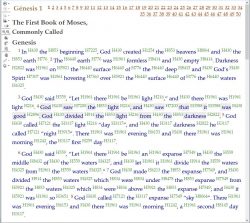
World English Bible with Strong’s numbers. Apocrypha Book, Glossary Book
Description:
Why was the World English Bible translated?
There are already many good translations of the Holy Bible into contemporary English. Unfortunately, almost all of them are restricted by copyright and copyright holder policy. This restricts publication and republication of God’s Word in many ways, such as in downloadable files on the Internet, use of extensive quotations in books, etc. The World English Bible was commissioned by God in response to prayer about this subject.
Because the World English Bible is in the Public Domain (not copyrighted), it can be freely copied, distributed, and redistributed without any payment of royalties. You don’t even have to ask permission to do so. You may publish the whole World English Bible in book form, bind it in leather and sell it. You may incorporate it into your Bible study software. You may make and distribute audio recordings of it. You may broadcast it. All you have to do is maintain the integrity of God’s Word before God, and reserve the name “World English Bible” for faithful copies of this translation.
How was the World English Bible translated?
The World English Bible is an update of the American Standard Version (ASV) of the Holy Bible, published in 1901. A custom computer program updated the archaic words and word forms to contemporary equivalents, and then a team of volunteers proofread and updated the grammar. The New Testament was updated to conform to the Majority Text reconstruction of the original Greek manuscripts, thus taking advantage of the superior access to manuscripts that we have now compared to when the original ASV was translated.
What is different about the World English Bible?
The style of the World English Bible, while fairly literally translated, is in informal, spoken English. The World English Bible is designed to sound good and be accurate when read aloud. It is not formal in its language, just as the original Greek of the New Testament was not formal. The WEB uses contractions rather freely.
The World English Bible doesn’t capitalize pronouns pertaining to God. The original manuscripts made no such distinction. Hebrew has no such thing as upper and lower case, and the original Greek manuscripts were written in all upper case letters. Attempting to add in such a distinction raises some difficulties in translating dual-meaning Scriptures such as the coronation psalms.
The World English Bible main edition translates God’s Proper Name in the Old Testament as “Yahweh.” The Messianic Edition and the British Edition of the World English Bible translates the same name as “LORD” (all capital letters), or when used with “Lord” (mixed case, translated from “Adonai”,) GOD. There are solid translational arguments for both traditions.
Because World English Bible uses the Majority Text as the basis for the New Testament, you may notice the following differences in comparing the WEB to other translations:
The order of Matthew 23:13 and 14 is reversed in some translations.
Luke 17:36 and Acts 15:34, which are not found in the majority of the Greek Manuscripts (and are relegated to footnotes in the WEB) may be included in some other translations.
Romans 14:24-26 in the WEB may appear as Romans 16:25-27 in other translations.
1 John 5:7-8 contains an addition in some translations, including the KJV. Erasmus admitted adding this text to his published Greek New Testament, even though he could at first find no Greek manuscript support for it, because he was being pressured by men to do so, and because he didn’t see any doctrinal harm in it. Lots of things not written by John in this letter are true, but we decline to add them to what the Holy Spirit inspired through John.
With all of the above and some other places where lack of clarity in the original manuscripts has led to multiple possible readings, significant variants are listed in footnotes. The reading that in our prayerful judgment is best is in the main text. Overall, the World English Bible doesn’t differ very much from several other good contemporary English translations of the Holy Bible. The message of Salvation through Jesus Christ is still the same. The point of this translation was not to be very different (except for legal status), but to update the ASV for readability while retaining or improving the accuracy of that well-respected translation and retaining the public domain status of the ASV.
theWord Version includes Strong Numbers (Not on every word but many if not most.), Glossary Dictionary and Apocrypha
theWord Features
Bible
- Strong’s Numbers
- Headings
- Verse popups
- Cross References
- Fully searchable text
- Footnote(s)
- Easy navigation of topics via Bible tree or Verse Reference Entry
- Special Text Colors
- Normal: Text
- Greek: λογος
- Hebrew: א
Glossary
- Verse popups
- Fully searchable text
- Easy navigation of topics via topics tree display.
- Special Text Colors
- Normal: Text
- Hyperlink: Link | Jn 3:36
Apocrypha
Books included: Tobit, Judith, Esther (Greek*), Wisdom of Solomon, Sirach, Baruch, 1 Maccabees, 2 Maccabees, 1 Esdras, Prayer of Manasses, Psalms 151, 3 Maccabees, 2 Esdras, 4 Maccabees, Daniel (Greek*)
*Greek means they included portions translated from the Greek in addition to the Hebrew.
- Verse popups
- Fully searchable text
- Footnote(s)
- Easy navigation of topics via topics tree display.
- Special Text Colors
- Normal: Text
- Hyperlink: Link | Jn 3:36
- Hebrew: א
Advanced Greek Package
Intermediate Hebrew Package
Basic Greek Package
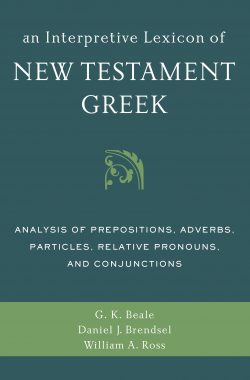

An Interpretive Lexicon of New Testament Greek
Book Summary
This interpretive lexicon is a Greek language resource that is intended to help students and translators to easily and quickly determine the range of translation possibilities for a wide variety of the smallest and most difficult words in the Greek New Testament to translate
About the Book
Save considerable time in translating and exegesis of the Greek New Testament text.
This Lexicon has a very specific and important purpose: to make the process of New Testament interpretation easier and more accurate by providing a comprehensive yet concise interpretation of Greek words that determine logical relationships between statements or clauses.
These words (prepositions, adverbs, particles, relative pronouns, conjunctions and other connectors) are essential to revealing and supporting the main ideas in the text and are especially useful for interpreting logical arguments, such as those found in the epistles.
While not exhaustive, this Interpretive Lexicon lists the vast majority of Greek connecting words, especially those that are notorious for being some of the most difficult words to translate.
Features include:
- Concise definitions for quick analysis.
- Examples of where the word is found in Scripture.
- Page references to several major lexical resources for further translation options and nuances.
- Interpretation of the broader categories of each word (for example: locative (in, among, on), means-end (with, by), grounds (because, on account of), temporal (while, at), and so on.
The interpretive feature of the book–evaluating the word’s function in discourse–is tremendously helpful for the exegetical process, allowing the translator to closely follow the logical flow of the text with greater efficiency. This Interpretive Lexicon is a valuable handbook for student, pastor, and scholar alike.
theWord Features:
- Verse popups
- Abbreviation popups
- Many internal links
- Word lookup via right-click-menu
- Fully searchable text
- Footnotes
- Page numbers noted for BDAG (00 and 79)
- Easy navigation of topics via topics tree display.
- Special Text Colors
- Normal: Text
- Hyperlink: Luke 20:21
- Greek: χρησις
- Hebrew: א
- Page Number: [pg21>
Package: Wuest Word Studies & New Testament Expanded Translation
Kenneth Wuest was a long time Greek teacher at Moody Bible Institute back in 1920’s, ‘30’s, 40’s, and 50’s. (Yeah – he taught almost 30 years). At that time, Moody was one of the leaders in both dispensationalism and fundamentalism.
When he started writing, it was his intent to bring the nuance of the Greek language out for the non-Greek speaking English reader. This reviewer thinks that he hits that mark pretty well.
His first book was entitled Treasures from the Greek New Testament for the English Reader. This was a collection of twelve essays (which became twelve chapters – imagine that!) that are topical. His second book was a commentary on 1Peter entitled First Peter in the Greek New Testament for the English Reader (do you see a common theme?). It is pleasantly verse by verse.
Over the course of his writing career, he wrote commentaries on Mark, Romans, Galatians, Ephesians, Philippians, Colossians, 1Timothy, 2Timothy, Hebrews, 1Peter, 2Peter, 1John, 2John, 3John, & Jude. [If you’re keeping score at home, that means he missed Matthew, Luke, John, Acts, 1Corinthians, 2Corinthians, 1Thessalonians, 2Thessalonians, Titus, Philemon, James, and Revelation.]
In addition to his commentaries, he also wrote six topical books – all revolving around word studies in the Greek New Testament.
I’ve already noted that Wuest is both dispensational and evangelical in his doctrinal outlook. I also mentioned that in the era he wrote, Moody was considered a fundamentalist institution. That’s good.
I would like to point out that Wuest was not a KJV lover. He served on the translation team that produced the NASB. He actually published an entire expanded translation of the New Testament. But as you might think with his NASB background, his own translation is based on the Nestle Greek text, and not the Textus Receptus (which is the text behind the KJV). Personal kudos for rejecting the ASV; but he was one of the early proponents within the fundamentalist movement to depart from the KJV. He makes no apologies for correcting “error” in the KJV. For this reason alone, I don’t recommend this resource to anyone not grounded in bibliology.
Entry Length
Again, please note that his NT commentary covers only 15 books of the NT (of 27 total books); but because he left off four of the five longest books in the NT, his commentary actually covers far less than 50% of it. However, where he does have comments, they are more than sufficient. For me, they are right in the sweet spot between “sufficient” and “verbose” (I guess I like ‘em a little longer than sufficient…).
I like to provide an example from Rom 3:24 in these reviews. So here is Wuest on Rom 3:24 –
QUOTATION BEGINS – “Freely” is dōrean [δωρεαν], “freely, for naught, gratis, gratuitously, without just cause.” “Grace” is Charis [Χαρις] which signified in classical authors a favor done out of the spontaneous generosity of the heart without any expectation of return. Of course, this favor was always done to one’s friend, never to an enemy. But when Charis [Χαρις] comes into the New Testament, it takes an infinite leap forward, for the favor God did at Calvary was for those who hated Him. It was a favor clone out of the spontaneous generosity of God’s heart of love with no expectation of return. There are no strings attached to grace. It is given dōrean [δωρεαν], gratuitously. Of course, grace in the form of salvation is so adjusted that the one who receives it, turns from sin to serve the living God and live a holy life, for grace includes not only the bestowal of a righteousness, but the inward transformation consisting of the power of indwelling sin broken and the divine nature implanted, which liberates the believer from the compelling power of sin and makes him hate sin, love holiness, and gives him the power to obey the Word of God.
This grace shown the believing sinner is made possible, Paul says through the redemption which is in Christ Jesus. “Redemption” is apolutrōseōs [ἀπολυτρωσεως], the verbal form of which is apolutroō [ἀπολυτροω], “to redeem by paying the lutron [λυτρον] price.” There are three words translated “redeem,” agorazō [ἀγοραζω], “to buy in the slave market” (1 Cor. 6:20; 7:23, 2 Pet. 2:1), Christ bought us in this slave market of sin by His own blood; believers are His bondslaves; exagorazō [ἐξαγοραζω], “to buy out of the slave market” (Gal. 3:13; 4:5), the redeemed are never to be put up for sale in any slave market again; and litroō [λιτροω], “to set free by paying a price” (Tit. 2:14, 1 Pet. 1:18): the believer is set free from sin and free to live a life pleasing to God in the power of the Holy Spirit. The redemption price, the precious blood of Jesus, makes it possible for a righteous God to justify a believing sinner on the basis of justice satisfied. This Paul proceeds to explain in the next two verses. – QUOTATION ENDS
This might be a little longer than his typical comment, but you get the flavor here of how he writes.
Language Skills Needed
Did you remember the ending phrase in his titles? “…for the English Reader.” While a little bit of Greek is helpful (he does use words like “aorist,” “imperfect,” “middle voice,” and even “pluperfect,”), he actually does a pretty good job of explaining the importance of each of those words in his exposition. So Greek is helpful, yes, but not essential in profiting from this work. HOWEVER: keep reading for more info on the necessity of language skills.
Academic Target
Wuest and I are going to disagree on this. His work; my review. Wuest would tell you that his target was the Bible disciple who wanted to know more about his English Bible by expanding all of the nuances of the Greek into English. Fair enough. I would tell you that Wuest does not like the KJV, believes there to be translation errors in it, and those errors are due to the KJV coming from a corrupt Greek text. Hmmm. I have a problem with that.
Some of his comments are based on the Nestle text, which differs regularly from the TR. A knowledge of Greek will be very helpful – especially to those expositors who, like me, use the KJV/TR. When he makes an argument based on the Nestle text, it will be very helpful to know what the TR instead says. So due to his theological bias, I don’t recommend this resource to anyone who is not clear in his stance on bibliology. I have it tagged above as “Pastoral” for this reason.
And Then There’s All This Topical Content
Let’s not forget that he wrote six topical books, totaling almost another 100 chapters. From a personal perspective, this will be a harder tool to use (how are you going to find his interesting comments on “crowns” in a topical presentation?). But the writing is just as good, even though it may be hard to find.
Contents Conclusion
I like Wuest very much, as a matter of fact. It is too bad he did not finish all of the NT Books. I wish he had. And with the above mentioned foibles in mind, I recommend the use of his writing to you. This is a DDT approved Good Resource.
$120.90Original price was: $120.90.$90.67Current price is: $90.67. Add to cart