
New International Commentary: The Epistles to the Colossians, to Philemon and to the Ephesians
PRODUCT HIGHLIGHTS:
- Verse-by-verse commentary
- In-depth discussion of textual and critical matters
- Introductions to each book’s authorship, date, purpose, structure, and theology
- Detailed bibliography
DESCRIPTION
This collection of three commentaries in one volume completes F. F. Bruce’s lifelong study of Paul’s writings. With the publication of this volume, Bruce—one of the most respected New Testament scholars in the world—finished writing commentaries on all the Pauline epistles except the Pastorals.
According to Bruce, there are important reasons for linking Colossians, Philemon, and Ephesians together in one work. The study of both Ephesians and Colossians, says Bruce, confirms his belief that Ephesians continues the line of thought followed in Colossians—in particular because it draws out the implications of Christ’s cosmic role (set forth in Colossians) for the church, which is his body. At the same time Ephesians constitutes the crown of Paulinism, gathering up the main themes of the apostle’s teaching into a unified presentation sub specie aeternitatis. The letter to Philemon, too, has a close association to Colossians, and is appropriately included in this volume.
….

New International Commentary: Paul’s Letter to the Philippians
PRODUCT HIGHLIGHTS:
- Verse-by-verse commentary
- In-depth discussion of textual and critical matters
- Introductions to each book’s authorship, date, purpose, structure, and theology
- Detailed bibliography
DESCRIPTION
This commentary by respected New Testament scholar Gordon D. Fee is a scholarly yet thoroughly readable study of Paul’s letter to the suffering community of believers in Philippi.
Working directly from the Greek text but basing his comments on the New International Version, Fee sets Paul’s letter to the Philippians squarely within the context of first-century “friendship” and “moral exhortation” to a church facing opposition because of its loyalty to Jesus Christ. At the same time Fee gives equal concern to the letter’s theological and spiritual relevance.
Important features of this commentary include a remarkable comparison of Philippians to two well-known types of letters in the Greco-Roman world: the letter of friendship and the letter of moral exhortation; an introduction that discusses the occasion, authenticity, and theological contributions of Philippians; and scholarly insights that resolve many of the formal and structural issues that have long puzzled New Testament scholars.
….
New International Commentary: The Epistle to the Galatians
PRODUCT HIGHLIGHTS:
- Verse-by-verse commentary
- In-depth discussion of textual and critical matters
- Introductions to each book’s authorship, date, purpose, structure, and theology
- Detailed bibliography
DESCRIPTION
This commentary by Ronald Y.K. Fung has been added to the NICNT series to address significant new questions regarding the study of Galatians that have arisen since the publication of Herman N. Ridderbos’s commentary—the original NICNT volume on Galatians—in 1953.
Begun under the mentorship of F.F. Bruce at the University of Manchester, England, Fung’s work on Galatians offers solid, reliable exposition of the text while also providing a fresh assessment of the large number of interpretive questions—past and present—raised by Paul’s letter. This work also examines Galatians specifically as Paul’s most direct defense and exposition of justification by faith, which Fung says is the central motif of Paul’s understanding of the Gospel.
….
New International Commentary: The Second Epistle to the Corinthians
PRODUCT HIGHLIGHTS:
- Verse-by-verse commentary
- In-depth discussion of textual and critical matters
- Introductions to each book’s authorship, date, purpose, structure, and theology
- Detailed bibliography
DESCRIPTION
This excellent commentary on 2 Corinthians by Paul Barnett illumines the historical background of the church at Corinth and clarifies the meaning of Paul’s passionate letter both for those first-century Christians and for the church today.
Assuming the unity of the letter, for which extensive argument is offered, Barnett takes the view that Paul is, in particular, addressing the issue of triumphalism in Corinth. This triumphalism is expressed by the newly arrived missionaries who portray Paul as “inferior” to themselves; it is also endemic among the Corinthians. According to Barnett, the recurring theme of the letter is “power-in-weakness,” based on the motif of the Resurrection of the Crucified, which lies at the heart of the Gospel of Christ. Also fundamental to the letter is the theme of fulfillment of the “promises of God” by Christ and the Spirit under the New Covenant.
Written for scholars, pastors, and lay readers alike, this commentary on 2 Corinthians will be a lasting reference work for those interested in this important section of Scripture.
….
New International Commentary: The First Epistle to the Corinthians
PRODUCT HIGHLIGHTS:
- Verse-by-verse commentary
- In-depth discussion of textual and critical matters
- Introductions to each book’s authorship, date, purpose, structure, and theology
- Detailed bibliography
DESCRIPTION
This award-winning commentary on 1 Corinthians by Gordon D. Fee has been lauded as the best study now available of Paul’s exciting and theologically rich first letter to the Corinthians.
Writing primarily for pastors, teachers, and students, Fee offers a readable exposition of 1 Corinthians that clearly describes the meaning of Paul’s ideas and their larger theological relevance. The more scholarly dimension of the work, including Fee’s considerable interaction with other commentators, is found in the footnotes.
Several features make this commentary unique. First, Fee takes great care to establish the all-important historical/literary context of this letter by including numerous sectional introductions that reconstruct the historical background and trace the flow of Paul’s argument. Fee is also concerned to exegete the whole book from a consistent perspective as to the historical situation. Second, Fee’s expertise in textual criticism has led him to discuss every exegetically significant variant, some at considerable length. Third, Fee concludes almost every paragraph with some observations about application—illustrating his deep concern that the Word of God be a living word for today.
….
New International Commentary: The Epistle to the Romans
PRODUCT HIGHLIGHTS:
- Verse-by-verse commentary
- In-depth discussion of textual and critical matters
- Introductions to each book’s authorship, date, purpose, structure, and theology
- Detailed bibliography
DESCRIPTION
Paul’s letter to the Romans has been called “the quintessence and perfection of saving doctrine.” Perhaps the most challenging and thoroughly doctrinal book of the entire New Testament, Romans deals with many issues that are basic to Christian theology and practice. In this volume respected New Testament scholar Douglas J. Moo provides a superb study of Paul’s letter to the Roman Christians and restates the enduring message of Romans for Christians today.
Based on the English text but bringing into the discussion the underlying Greek at every point, this commentary focuses both on theological meaning and on contemporary significance. Moo contributes to the continuing debate regarding Paul’s teaching on such issues as Jewish law and the relationship between Jews and Gentiles in the people of God. He also critically interacts with “the new perspective on Paul,” highlights Romans’s emphasis on “practical divinity,” and traces the theme of gospel throughout the epistle.
Twelve years in the making and a steady seller during its first decade in print, Moo’s Epistle to the Romans will continue to serve as a standard exposition of Romans.
….
New International Commentary: The Book of the Acts
PRODUCT HIGHLIGHTS:
- Verse-by-verse commentary
- In-depth discussion of textual and critical matters
- Introductions to each book’s authorship, date, purpose, structure, and theology
- Detailed bibliography
DESCRIPTION
First published in 1954, F.F. Bruce’s volume on the Book of Acts in the NICNT series has stood for more than fifty years as a standard commentary on Acts. In keeping with the effort to be faithful to the description “new” in the series title, however, Bruce undertook a thorough revision of this commentary before his death in 1990.
Expanded and fully updated, this volume now reflects the best elements of recent notable contributions to the study of Luke-Acts as well as the author’s own deepened understanding gained from years of further reflection on the text. Whereas the first edition used the text of the American Standard Version of 1901, this revision is based on Bruce’s own fresh translation of the Greek text. The result is a work that makes transparent the walls between the first and the twentieth centuries and enables readers to hear not only the voice of Luke but the Word of God.
….
New International Commentary: The Gospel According to John
PRODUCT HIGHLIGHTS:
- Verse-by-verse commentary
- In-depth discussion of textual and critical matters
- Introductions to each book’s authorship, date, purpose, structure, and theology
- Detailed bibliography
DESCRIPTION
Hailed as perhaps “the best commentary on any book of the Bible by an evangelical in recent decades” by Christianity Today when it was first published in 1971, Leon Morris’s Gospel According to John has become one of the enduring standard commentaries on John’s Gospel.
Recognizing the central importance of the Fourth Gospel in any series on the New Testament, Morris devoted more than ten years to preparing this volume. Written with considerable acumen and a thorough knowledge of the previous scholarly work on the Johannine text, The Gospel According to John is one of the largest and most comprehensive commentaries ever to come out of the evangelical community.
This revised edition includes significant modifications and additions made in the light of more recent writings on John’s Gospel. While maintaining substantially the same stance as in his original work, Morris here references important secondary sources and studies that have appeared over the last two decades. The commentary is now also based on the New International Version.
….
New International Commentary: The Gospel of Luke
PRODUCT HIGHLIGHTS:
- Verse-by-verse commentary
- In-depth discussion of textual and critical matters
- Introductions to each book’s authorship, date, purpose, structure, and theology
- Detailed bibliography
DESCRIPTION
This highly original commentary on the Gospel of Luke is unique for the way it combines concerns with first-century culture in the Roman world with understanding the text of Luke as a wholistic, historical narrative. Focusing primarily on how each episode functions within Luke’s narrative development, Joel B. Green provides countless fresh perspectives on and new insights into the Third Gospel. His extended examination of Luke’s literary art and Luke’s narrative theology allows the Evangelist to address clearly and convincingly both ancient and contemporary readers.
Insisting on the narrative unity of Luke–Acts, Green highlights in this volume the centrality of God’s purpose to bring salvation to all people. Against the backdrop of the conflicted first-century world of the Mediterranean, Green proposes that the purpose of Luke–Acts would have been to strengthen the early Christians in the face of opposition by assuring them in their interpretation and experience of the redemptive purpose and faithfulness of God and by calling them to continued faithfulness and witness in God’s salvific project.
….
New International Commentary: The Gospel of Mark
PRODUCT HIGHLIGHTS:
- Verse-by-verse commentary
- In-depth discussion of textual and critical matters
- Introductions to each book’s authorship, date, purpose, structure, and theology
- Detailed bibliography
DESCRIPTION
The Gospel of Mark is significant in many ways. Not only was it the first Gospel to be written and an important literary source for Matthew and Luke, but it is also best characterized as a witness document, a proclamation of salvation through Jesus Christ, which received its creative impulse from the early apostolic preaching. Mark bears witness to the word of revelation that Jesus is the Messiah, the Son of God.
In this widely praised commentary by William L. Lane, Mark is revealed as a theologian whose primary intention was the strengthening of the people of God in a time of fiery persecution by Nero. Using redaction criticism as a hermeneutical approach for understanding the text and the intention of the evangelist, Lane considers the Gospel of Mark as a total literary work and describes Mark’s creative role in shaping the Gospel tradition and in exercising a conscious theological purpose. By taking care to indicate how the text was heard by Mark’s contemporaries while also placing the study of Mark within the frame of reference offered by modern Gospel research, Lane has constructed a thorough going work that is at once useful to scholars and highly intelligible to nonspecialists.
….
New International Commentary: The Gospel of Matthew
PRODUCT HIGHLIGHTS:
- Verse-by-verse commentary
- In-depth discussion of textual and critical matters
- Introductions to each book’s authorship, date, purpose, structure, and theology
- Detailed bibliography
DESCRIPTION
“It is a special pleasure to introduce R. T. (Dick) France’s commentary to the pastoral and scholarly community, who should find it a truly exceptional—and helpful—volume.” So says Gordon Fee in his preface to this work. France’s masterful commentary on Matthew focuses on exegesis of Matthew’s text as it stands rather than on the prehistory of the material or details of Synoptic comparison. The exegesis of each section is part of a planned literary whole supplemented, rather than controlled, by verse-by-verse commentary, allowing the text as a complete story to come into brilliant focus.
Rather than being a “commentary on commentaries,” The Gospel of Matthew is concerned throughout with what Matthew himself meant to convey about Jesus and how he set about doing so within the cultural and historical context of first-century Palestine. France frequently draws attention to the distinctive nature of the province of Galilee and the social dynamics involved when a Galilean prophet presents himself in Jerusalem as the Messiah.
The English translation at the beginning of each section is France’s own, designed to provide the basis for the commentary. This adept translation uses contemporary idioms and, where necessary, gives priority to clarity over literary elegance.
Amid the wide array of Matthew commentaries available today, France’s world-class stature, his clear focus on Matthew and Jesus, his careful methodology, and his user-friendly style promise to make this volume an enduring standard for years to come.
….
New International Commentary: The Books of Haggai and Malachi
PRODUCT HIGHLIGHTS:
- Verse-by-verse commentary
- In-depth discussion of textual and critical matters
- Introductions to each book’s authorship, date, purpose, structure, and theology
- Detailed bibliography
DESCRIPTION
This commentary by Pieter A. Verhoef offers a thorough exegesis and exposition of Haggai and Malachi—two important books of Scripture that, unfortunately, are not only little studied but have sometimes been maligned by contemporary scholarship—and stresses the relevance of these prophets’ messages in terms of continuity and discontinuity for the Christian church.
Verhoef’s introduction to each book elucidates the questions of authorship, style, text, structure, historical background, and message. Making extensive use of structural analysis, Verhoef argues convincingly for the authenticity, unity, and integrity of both books.
Verhoef also brings his knowledge of the ancient Near East, the Old Testament, and past and current biblical scholarship to bear in the commentary proper, and he displays theological acumen and pastoral sensitivity in tailoring his exposition for the student and pastor as well as for the scholar.
….
New International Commentary: The Books of Nahum, Habakkuk and Zephaniah
PRODUCT HIGHLIGHTS:
- Verse-by-verse commentary
- In-depth discussion of textual and critical matters
- Introductions to each book’s authorship, date, purpose, structure, and theology
- Detailed bibliography
DESCRIPTION
The close-knit bond between prophecy and history, according to O. Palmer Robertson, becomes particularly clear through the study of Nahum, Habakkuk, and Zephaniah. As the historical context of their messages is explored, it becomes ever more apparent that biblical history—in addition to providing the context for prophecy—actually embodies and functions as prophecy. The events that occurred to Judah and its neighbors spoke in anticipation of world-shaking circumstances that were yet to come.
In this commentary Robertson combines the insights of biblical theology with a keen awareness of the age in which we live. After first dealing with the relevant background issues of Nahum, Habakkuk, and Zephaniah—redemptive-historical setting, theological perspective, date and authorship, and so on—Robertson applies the care and precision of an exegete and the concern of a pastor to his verse-by-verse exposition of each book. The result is a relevant confrontation with the ancient call to repentance and faith—a confrontation greatly needed in today’s world.
….
New International Commentary: The Books of Joel, Obadiah, Jonah, and Micah
PRODUCT HIGHLIGHTS:
- Verse-by-verse commentary
- In-depth discussion of textual and critical matters
- Introductions to each book’s authorship, date, purpose, structure, and theology
- Detailed bibliography
DESCRIPTION
The eloquent and uncompromising calls for social righteousness by some of the Minor Prophets are familiar to many, yet the writings themselves are probably the least studied and least known texts of the Old Testament. Those who are familiar with these books are also aware of the historical and literary problems that plague their study. Drawing on insights from various perspectives—theological, historical, and literary—Leslie Allen’s commentary on Joel, Obadiah, Jonah, and Micah carefully and imaginatively reconstructs the stage on which the message of these four books was conveyed to their Hebrew hearers and shows what relevance, in turn, they hold for contemporary Christians.
For each of the books there is a substantial introduction in which the full range of scholarly opinion is presented and assessed, a select bibliography, the author’s own translation of the text—a significant contribution to biblical studies in itself—and an extensive commentary. The commentary on Micah is foundational for these four books in that it treats at greater length some of the same forms and motifs that appear in Joel, Obadiah, and Jonah. The introductory material for Joel includes discussions of canonicity and textual criticism that apply to the entire volume.
….
New International Commentary: The Book of Ezekiel (2 vols.)
PRODUCT HIGHLIGHTS:
- Verse-by-verse commentary
- In-depth discussion of textual and critical matters
- Introductions to each book’s authorship, date, purpose, structure, and theology
- Detailed bibliography
DESCRIPTION
This collection includes the two volumes of Daniel Block’s study of Ezekiel from The New International Commentary on the Old Testament
Volume 1
To many modern readers the prophecies of Ezekiel are a mystery. This commentary by Daniel Block—Part I of his two-volume study of the whole book of Ezekiel—seeks to answer the questions that contemporary readers bring to the text by examining the language, the message, and the methods of this obscure and often misunderstood Hebrew prophet. The result of twelve years of study, this volume provides an excellent discussion of the background of Ezekiel and offers a verse-by-verse exposition of each literary/prophetic unit in Ezekiel 1–24 that not only makes clear the prophet’s message to his original readers but also shows that Ezekiel’s ancient wisdom and vision are still very much needed by the church in the twenty-first century.
Volume 2
To many modern readers the prophecies of Ezekiel are a mystery. This commentary by Daniel Block—which completes his two-volume study of the whole book of Ezekiel—seeks to answer the questions that contemporary readers bring to the text by examining the language, the message, and the methods of this obscure and often misunderstood Hebrew prophet. The result of twelve years of study, this volume, like the one on chapters 1–24, provides an excellent discussion of the background of Ezekiel and offers a verse-by-verse exposition of each literary/prophetic unit in Ezekiel 25–48 that not only makes clear the prophet’s message to his original readers but also shows that Ezekiel’s ancient wisdom and vision are still very much needed by the church in the twenty-first century.
….
New International Commentary: The Book of Ezekiel, Chapters 25–48
PRODUCT HIGHLIGHTS:
- Verse-by-verse commentary
- In-depth discussion of textual and critical matters
- Introductions to each book’s authorship, date, purpose, structure, and theology
- Detailed bibliography
DESCRIPTION
To many modern readers the prophecies of Ezekiel are a mystery. This commentary by Daniel Block—which completes his two-volume study of the whole book of Ezekiel—seeks to answer the questions that contemporary readers bring to the text by examining the language, the message, and the methods of this obscure and often misunderstood Hebrew prophet. The result of twelve years of study, this volume, like the one on chapters 1–24, provides an excellent discussion of the background of Ezekiel and offers a verse-by-verse exposition of each literary/prophetic unit in Ezekiel 25–48 that not only makes clear the prophet’s message to his original readers but also shows that Ezekiel’s ancient wisdom and vision are still very much needed by the church in the twenty-first century.
….
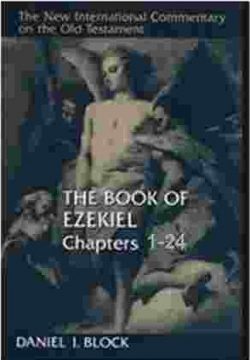
New International Commentary: The Book of Ezekiel, Chapters 1–24
PRODUCT HIGHLIGHTS:
- Verse-by-verse commentary
- In-depth discussion of textual and critical matters
- Introductions to each book’s authorship, date, purpose, structure, and theology
- Detailed bibliography
DESCRIPTION
To many modern readers the prophecies of Ezekiel are a mystery. This commentary by Daniel Block—Part I of his two-volume study of the whole book of Ezekiel—seeks to answer the questions that contemporary readers bring to the text by examining the language, the message, and the methods of this obscure and often misunderstood Hebrew prophet. The result of twelve years of study, this volume provides an excellent discussion of the background of Ezekiel and offers a verse-by-verse exposition of each literary/prophetic unit in Ezekiel 1–24 that not only makes clear the prophet’s message to his original readers but also shows that Ezekiel’s ancient wisdom and vision are still very much needed by the church in the twenty-first century.
….
New International Commentary: The First and Second Epistles to the Thessalonians
PRODUCT HIGHLIGHTS:
DESCRIPTION
In this commentary Gordon Fee aims first and foremost to offer a fresh exposition of the text of 1 and 2 Thessalonians. He shows the reader what is in the biblical text, what the text meant in the first century, and what it means now. Fee reveals the logic of each argument or narrative before moving on to the details of each verse, and he concludes each section with a theological-practical reflection on the meaning of the text today. Among other things, Fee explores the occasion for writing for each epistle, restoring 2 Thessalonians to the place it deserves as a full companion to the first letter, rather than merely a tagalong to 1 Thessalonians.
….